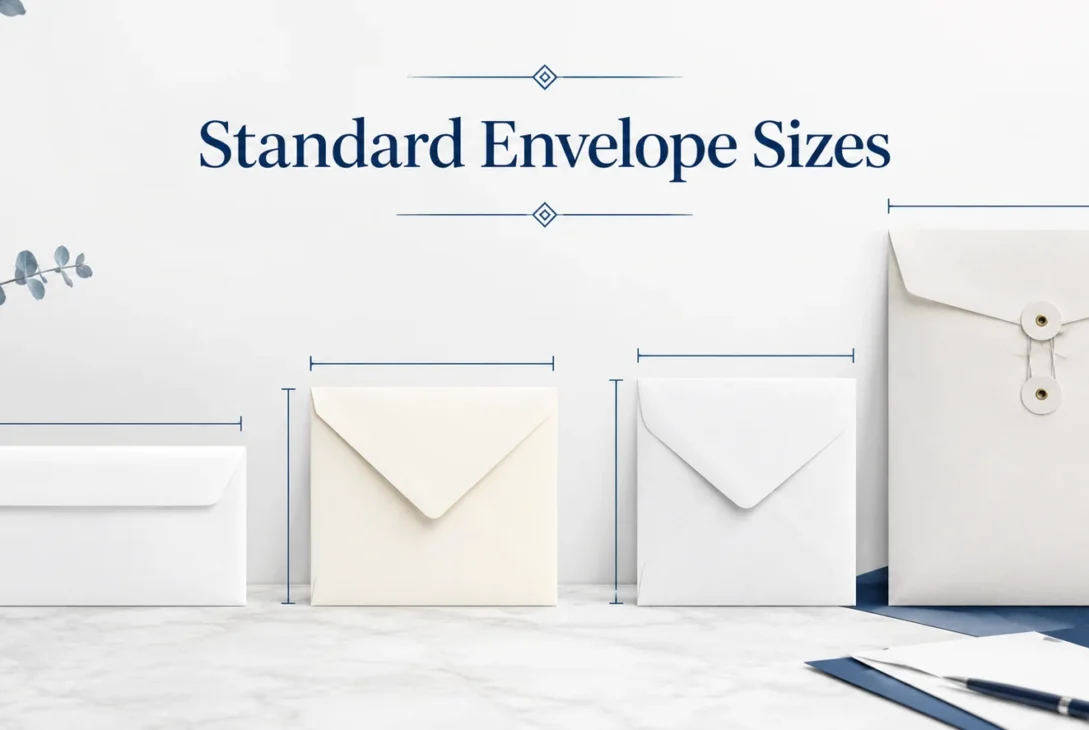
Standard envelope dimensions depend on what you are mailing. For everyday business letters in the United States, the most common size is the #10 envelope, which measures 4.125 x 9.5 inches. For invitations, A2 and A7 envelopes are common. For unfolded documents, 9 x 12 and C4 envelopes are popular choices.
This Packaging Next Gen size page gives you a fast chart first, then explains which envelope fits letters, invoices, cards, brochures, catalogs, legal papers, and international paper sizes.
Standard Envelope Size Chart
Use this quick envelope size chart when you already know the type of mail you want to send.
| Envelope Type | Size in Inches | Size in mm | Common Use |
| #6 3/4 Envelope | 3.625 x 6.5 | 92 x 165 | Small checks, personal mail, short notes |
| #9 Envelope | 3.875 x 8.875 | 98 x 225 | Return envelopes, reply mail, invoices |
| #10 Envelope | 4.125 x 9.5 | 105 x 241 | Business letters, statements, folded letter paper |
| #11 Envelope | 4.5 x 10.375 | 114 x 264 | Longer business inserts |
| #12 Envelope | 4.75 x 11 | 121 x 279 | Larger forms and statements |
| #14 Envelope | 5 x 11.5 | 127 x 292 | Thick business mail and longer documents |
| A2 Envelope | 4.375 x 5.75 | 111 x 146 | Thank-you cards, RSVP cards, small invitations |
| A6 Envelope | 4.75 x 6.5 | 121 x 165 | Greeting cards and announcements |
| A7 Envelope | 5.25 x 7.25 | 133 x 184 | 5 x 7 cards, wedding invitations, event cards |
| A9 Envelope | 5.75 x 8.75 | 146 x 222 | Large cards, photos, folded inserts |
| 6 x 9 Envelope | 6 x 9 | 152 x 229 | Brochures, half-sheet documents, small booklets |
| 9 x 12 Envelope | 9 x 12 | 229 x 305 | Letter-size paper without folding |
| 10 x 13 Envelope | 10 x 13 | 254 x 330 | Catalogs, reports, legal paperwork |
| 6 x 6 Square Envelope | 6 x 6 | 152 x 152 | Square cards and special invitations |
| DL Envelope | 4.33 x 8.66 | 110 x 220 | A4 paper folded into thirds |
| C6 Envelope | 4.49 x 6.38 | 114 x 162 | A6 paper or A4 folded twice |
| C5 Envelope | 6.38 x 9.02 | 162 x 229 | A5 paper or A4 folded once |
| C4 Envelope | 9.02 x 12.76 | 229 x 324 | A4 paper without folding |
What Are Standard Envelope Dimensions?
Standard envelope dimensions are common envelope measurements used for mailing letters, cards, flat documents, invoices, catalogs, brochures, and printed inserts. These sizes help the envelope match the paper inside and keep the mailpiece easier to process.
A good envelope should do three things:
- Fit the insert without bending it too tightly.
- Leave enough room for easy insertion and sealing.
- Stay within postal size rules when postage cost matters.
The right size is not always the biggest envelope. A very large envelope can make the insert slide around, crease at the corners, or cost more to mail. A very small envelope can crush the paper, split at the seams, or make the flap hard to close.
Most Common Envelope Size in the USA
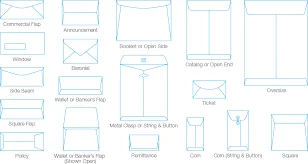
The most common business envelope size in the United States is the #10 envelope.
A #10 envelope measures:
| Measurement | Size |
| Inches | 4.125 x 9.5 |
| Millimeters | 105 x 241 |
| Centimeters | 10.5 x 24.1 |
A #10 envelope fits standard 8.5 x 11 inch letter paper folded into thirds. That is why offices use it for invoices, statements, business letters, appointment letters, notices, checks, and direct mail.
Standard Business Envelope Sizes
Business envelopes are usually long, rectangular, and made for folded letter-size paper. They are also called commercial envelopes.
| Business Envelope | Dimensions | Best For |
| #6 3/4 | 3.625 x 6.5 in | Personal mail, checks, compact notes |
| #9 | 3.875 x 8.875 in | Reply mail, return envelopes, payment slips |
| #10 | 4.125 x 9.5 in | Standard letters, invoices, statements |
| #11 | 4.5 x 10.375 in | Longer folded inserts |
| #12 | 4.75 x 11 in | More pages or longer forms |
| #14 | 5 x 11.5 in | Thick mail, extended forms, multi-page mail |
#9 vs #10 Envelope
A #9 envelope is smaller than a #10 envelope. Businesses often place a #9 return envelope inside a #10 outgoing envelope. This setup is common for billing, donations, payment returns, and response mail.
#10 vs Legal Envelope
A #10 envelope is made for standard letter paper folded into thirds. A legal envelope is larger and is often used when longer legal-size paper or bulkier documents need more room. If your document should not be folded, use a 9 x 12 or 10 x 13 envelope instead.
Standard Invitation and Card Envelope Sizes
Announcement envelopes are used for greeting cards, wedding invitations, thank-you cards, RSVP cards, photos, and event announcements.
| Envelope Size | Dimensions | Fits |
| A2 | 4.375 x 5.75 in | 4.25 x 5.5 cards |
| A6 | 4.75 x 6.5 in | 4.5 x 6.25 cards |
| A7 | 5.25 x 7.25 in | 5 x 7 cards |
| A8 | 5.5 x 8.125 in | Larger invitation cards |
| A9 | 5.75 x 8.75 in | 5.5 x 8.5 cards |
| A10 | 6 x 9.5 in | Large invitations and folded pieces |
A7 is one of the most searched invitation envelope sizes because it fits a 5 x 7 card. This size is common for wedding invitations, event cards, graduation cards, and formal announcements.
Packaging Next Gen tip: when choosing invitation envelopes, measure the card first, then leave a little breathing room so the card slides in without scraping the edges.
Catalog and Booklet Envelope Sizes
Catalog and booklet envelopes are larger than business envelopes. They are used for brochures, catalogs, reports, booklets, photos, certificates, and documents that should stay flat.
| Envelope Type | Dimensions | Common Use |
| 6 x 9 | 6 x 9 in | Half-sheet inserts, brochures, small booklets |
| 6.5 x 9.5 | 6.5 x 9.5 in | Booklets, folded documents, catalogs |
| 9 x 12 | 9 x 12 in | Letter paper without folding |
| 10 x 13 | 10 x 13 in | Legal papers, catalogs, reports |
| 10 x 15 | 10 x 15 in | Oversized documents and printed sets |
9 x 12 Envelope Dimensions
A 9 x 12 envelope measures 9 inches by 12 inches. It is one of the best choices for mailing standard 8.5 x 11 inch paper without folding. Businesses use it for contracts, certificates, presentations, reports, school records, medical forms, and marketing packets.
10 x 13 Envelope Dimensions
A 10 x 13 envelope gives more space than 9 x 12. It is useful when the insert is thick, has multiple pages, or includes a folder, booklet, catalog, or legal document.
International Envelope Sizes: DL, C4, C5, and C6
Outside the United States, many businesses use ISO-style envelope sizes. These sizes are closely connected to A-series paper such as A4, A5, and A6.
| Envelope Size | Dimensions in mm | Dimensions in Inches | Fits |
| DL | 110 x 220 | 4.33 x 8.66 | A4 folded into thirds |
| C6 | 114 x 162 | 4.49 x 6.38 | A6 paper or A4 folded twice |
| C5 | 162 x 229 | 6.38 x 9.02 | A5 paper or A4 folded once |
| C4 | 229 x 324 | 9.02 x 12.76 | A4 paper without folding |
| C3 | 324 x 458 | 12.76 x 18.03 | A3 paper without folding |
What Size Envelope Fits A4 Paper?
For A4 paper, use:
| A4 Paper Format | Envelope Size |
| A4 unfolded | C4 |
| A4 folded once | C5 |
| A4 folded into thirds | DL |
| A4 folded twice | C6 |
This is an important difference. A5 is a paper size, while C5 is usually the envelope size used for A5 paper or A4 paper folded in half.
Envelope Dimensions by Document Type
If you are not sure which envelope size to use, start with the item inside the envelope.
| What You Are Mailing | Best Envelope Size |
| Standard business letter | #10 |
| Invoice or statement | #10 |
| Return payment envelope | #9 |
| 5 x 7 invitation | A7 |
| Thank-you card | A2 |
| Greeting card | A6 or A7 |
| A4 paper folded into thirds | DL |
| A4 paper folded once | C5 |
| A4 paper flat | C4 |
| Letter-size paper flat | 9 x 12 |
| Thick report or catalog | 10 x 13 |
| Small brochure | 6 x 9 |
| Square invitation | 5 x 5 or 6 x 6 square envelope |
USPS Envelope Size Rules to Know
For U.S. mailing, envelope size affects how your mail is handled. A standard letter-size mailpiece should be rectangular and must stay within USPS letter-size limits.
For letter-size mail, the common USPS size range is:
| Measurement | Minimum | Maximum |
| Height | 3.5 in | 6.125 in |
| Length | 5 in | 11.5 in |
| Thickness | 0.007 in | 0.25 in |
A mailpiece that is too large for letter size may be treated as a large envelope or flat. Flats can hold larger documents, but they still have size limits.
For large envelopes and flats, the general maximum is:
| Measurement | Maximum |
| Height | 12 in |
| Length | 15 in |
| Thickness | 0.75 in |
Square envelopes, rigid envelopes, vertical envelopes, unevenly thick envelopes, or envelopes with clasps can cost more because they may need manual handling. Always check current postage rules before mailing large batches.
How Much Space Should Be Left Inside an Envelope?
Do not choose an envelope that is exactly the same size as the insert. Leave a small amount of extra space around the document so the paper slides in and out easily.
A simple rule:
- For single cards, leave about 1/8 inch of extra room.
- For folded letters, use the standard matching envelope size.
- For thick inserts, catalogs, or multi-page sets, leave more space.
- For rigid inserts, test one finished sample before ordering in bulk.
If your insert is too tight, the envelope can tear at the seam. If the envelope is too loose, the insert may shift, bend, or look poorly packed.
How to Measure an Envelope
Measure the envelope with the flap closed.
- Place the envelope flat on a table.
- Measure the shorter side first. This is the height.
- Measure the longer side next. This is the length.
- If the envelope has thick contents, measure the final thickness after inserting the document.
- Compare the final mailpiece size with postal rules before mailing.
Envelope dimensions are usually written as height x length. For example, a #10 envelope is written as 4.125 x 9.5 inches.
Standard Envelope Dimensions in Inches, mm, and cm
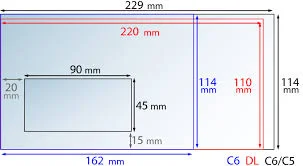
Here are the most searched sizes with unit conversions.
| Envelope | Inches | mm | cm |
| #10 | 4.125 x 9.5 | 105 x 241 | 10.5 x 24.1 |
| #9 | 3.875 x 8.875 | 98 x 225 | 9.8 x 22.5 |
| A2 | 4.375 x 5.75 | 111 x 146 | 11.1 x 14.6 |
| A7 | 5.25 x 7.25 | 133 x 184 | 13.3 x 18.4 |
| A9 | 5.75 x 8.75 | 146 x 222 | 14.6 x 22.2 |
| 6 x 9 | 6 x 9 | 152 x 229 | 15.2 x 22.9 |
| 9 x 12 | 9 x 12 | 229 x 305 | 22.9 x 30.5 |
| 10 x 13 | 10 x 13 | 254 x 330 | 25.4 x 33.0 |
| DL | 4.33 x 8.66 | 110 x 220 | 11.0 x 22.0 |
| C5 | 6.38 x 9.02 | 162 x 229 | 16.2 x 22.9 |
| C4 | 9.02 x 12.76 | 229 x 324 | 22.9 x 32.4 |
Choosing the Right Envelope for Business Mail
For business mail, think about the goal before choosing a size.
Use a #10 envelope when you are sending regular folded letters, invoices, bank letters, appointment notices, statements, and office mail. Use a #9 envelope when the recipient needs to mail something back. Use a 9 x 12 envelope when the document should stay flat. Use a 10 x 13 envelope when the paper stack is thicker, or the document needs more edge protection.
With Packaging Next Gen, the goal is not only to choose the right measurement. The envelope should also match the print, brand message, paper weight, seal type, and mailing method.
Choosing the Right Envelope for Invitations
For invitations, choose the envelope after the card size is final. The most common pairing is a 5 x 7 card with an A7 envelope. For smaller RSVP cards, A2 is a common choice. For larger event cards, A9 may work better.
If you use square envelopes, remember that they may require extra postage in the United States. A rectangular invitation envelope is usually safer for high-volume mailing.
Choosing the Right Envelope for Brochures and Marketing Mail
Brochures, flyers, catalogs, and print sets need more room than a standard #10 envelope. Use 6 x 9 for compact brochures, 9 x 12 for letter-size inserts, and 10 x 13 for thicker reports or catalogs.
If your marketing material has multiple sheets, test the final packed sample. Paper weight, folding style, coating, and insert count can change the final thickness.
For related print workflow tips, read this Packaging Next Gen article on what collate means when printing.
Common Envelope Size Mistakes
Choosing the Envelope Before Measuring the Insert
Always measure the finished insert, not the design file. Folding, trimming, coating, and paper thickness can change the final fit.
Mixing Up A5 Paper and A-Series Envelopes
A5 is a paper size in the international system. If you want to mail A5 paper, C5 is often the right envelope size.
Ignoring Thickness
A document may fit by height and length but still become too thick after folding. This can affect closing, sealing, and postage.
Using Square Envelopes for Bulk Mail Without Checking Postage
Square envelopes look different in the mailbox, but they may require manual handling. For large mailings, check postage before printing the full run.
Leaving No Clearance
A tight envelope can damage corners, bend cards, or split at the seam. Leave enough space for smooth insertion.
Best Envelope Sizes by Use Case
| Use Case | Best Size |
| Office letter | #10 |
| Invoice with return envelope | #10 outer + #9 return |
| Wedding invitation | A7 |
| RSVP card | A2 |
| Greeting card | A6 or A7 |
| Flat letter-size paper | 9 x 12 |
| Thick document set | 10 x 13 |
| A4 folded into thirds | DL |
| A4 unfolded | C4 |
| Brochure packet | 6 x 9 or 9 x 12 |
| Catalog | 10 x 13 |
Should You Use a Custom Envelope Size?
A custom envelope size can make sense when your insert has a nonstandard size, your campaign uses a unique print format, or you need a special packaging presentation. However, custom sizing should be planned carefully.
Before choosing a custom envelope, check:
- Insert size
- Paper thickness
- Closure type
- Postal size limits
- Printing area
- Address placement
- Return address location
- Barcode or stamp area
- Quantity and mailing cost
Packaging Next Gen can help plan envelope sizing around paper fit, print layout, and mailing needs so the final piece looks clean and arrives in good shape.
Final Thoughts
Standard envelope dimensions are easier to choose when you start with the item inside. For a folded business letter, use #10. For return mail, use #9. For 5 x 7 invitations, use A7. For flat letter-size documents, use 9 x 12. For A4 paper, use C4, C5, or DL depending on how the paper is folded.
Save this Packaging Next Gen chart when planning business mail, invitations, brochures, catalogs, and document packaging. The right envelope size protects the insert, supports a cleaner mailing experience, and helps your print piece reach the recipient in better condition.
FAQs
What is the standard envelope size?
The most common standard business envelope size in the United States is the #10 envelope, which measures 4.125 x 9.5 inches.
What size envelope fits 8.5 x 11 paper?
A #10 envelope fits 8.5 x 11 paper folded into thirds. A 9 x 12 envelope fits 8.5 x 11 paper without folding.
What size envelope fits A4 paper?
A C4 envelope fits A4 paper without folding. A C5 envelope fits A4 folded once. A DL envelope fits A4 folded into thirds.
What are A7 envelope dimensions?
An A7 envelope measures 5.25 x 7.25 inches. It is commonly used for 5 x 7 invitation cards.
What are 9 x 12 envelope dimensions?
A 9 x 12 envelope measures 9 inches by 12 inches. It is commonly used for flat letter-size documents.
FAQs About Standard Envelope Dimensions
What is the size of a #10 envelope?
A #10 envelope measures 4.125 x 9.5 inches, or about 105 x 241 mm. It is the standard envelope for business letters in the United States.
What is the size of a business envelope?
The most common business envelope is #10, measuring 4.125 x 9.5 inches. Other business sizes include #9, #11, #12, and #14.
What size envelope should I use for a 5 x 7 card?
Use an A7 envelope. It measures 5.25 x 7.25 inches and gives a 5 x 7 card enough room to slide in cleanly.
What is the difference between a booklet envelope and a catalog envelope?
A booklet envelope usually opens on the long side, while a catalog envelope usually opens on the short side. Both are used for larger documents, brochures, reports, and catalogs.
What size is a legal envelope?
Legal envelopes vary by style, but 9.5 x 15 inches and 10 x 15 inches are common for longer legal documents. If the document should stay flat, choose a size that gives enough room around the edges.
Are square envelopes standard?
Square envelopes are common for cards and invitations, but they are not always the best choice for postage. In the United States, square mail may require extra handling.
What envelope size is best for invoices?
A #10 envelope is best for most invoices. If you need the recipient to mail back a payment or form, include a #9 return envelope.
What is the best envelope size for catalogs?
For small catalogs, use 6 x 9 or 9 x 12. For larger or thicker catalogs, 10 x 13 is often a better fit.