
Cereal mascots are more than cartoon characters printed on a box. They are cultural icons, childhood companions, and one of the most powerful branding tools in the history of food marketing. Whether you grew up chasing Trix Rabbit commercials on Saturday mornings, memorizing the snap-crackle-pop rhythm of Rice Krispies elves, or obsessing over the cinnamon swirls on your Cinnamon Toast Crunch box, breakfast cereal characters have shaped your memories in ways most brands can only dream of.
This is the most complete guide to cereal mascots ever written. You will find a full list of cereal mascots by brand, the history behind each character, deep dives into fan favorites like the Cinnamon Toast Crunch mascot and the Cheerios mascot, a breakdown of every cereal logo, retired characters, female mascots, and much more. By the end, you will know every cereal cartoon character by name, face, and story.
1. What Are Cereal Mascots and Why Do They Matter?
A cereal mascot is a cartoon character animal, human, creature, or mythological figure created by a breakfast cereal brand to represent its product across packaging, television commercials, print advertising, and merchandise. These breakfast cereal characters are not random artwork. They are strategic branding assets, each one engineered to trigger emotional responses in specific audiences.
Cereal characters serve several precise marketing functions:
Recognition at a glance. In a grocery aisle stacked with fifty brands of breakfast cereal, a familiar face stops the eye in under half a second. Children and adults alike gravitate toward known characters before reading a word of text. The cereal box character is a face before it is a product.
Emotional bonding. Humans form attachments to characters. When a child watches Toucan Sam follow his nose to Froot Loops every morning for five years, the bond formed with that cartoon is nearly identical to the bond formed with a television show character. That emotional attachment transfers directly to the brand.
Long-term brand loyalty. Research consistently shows that purchasing habits formed in childhood persist into adulthood. The adults buying Frosted Flakes today are often doing so because Tony the Tiger lived in their kitchen growing up. Cereal mascots are one of the few marketing tools that earn loyalty that spans decades.
Storytelling shorthand. Each cereal cartoon character embeds a narrative. The Trix Rabbit always wants what he cannot have. Lucky the Leprechaun is endlessly trying to protect his charms from greedy children. These simple recurring stories make the brand memorable in ways a logo alone never could.
2. The History of Breakfast Cereal Characters
The first cereal mascot: 1877
The story of breakfast cereal mascots begins not with a cartoon tiger or a magical leprechaun but with a simple man in a black coat and a Quaker hat. The Quaker Oats Man, introduced in 1877, is widely credited as the first cereal mascot and the first branded mascot ever registered as a trademark in the United States. He was not designed for children. He was a symbol of Quaker values of honesty, integrity, and quality aimed directly at adult consumers in the late nineteenth century.
For roughly fifty years after the Quaker Man’s debut, breakfast cereal brands leaned on straightforward imagery rather than characters. It was not until the 1930s and 1940s that the modern concept of the cereal cartoon character began to take shape, largely driven by the explosion of radio and, later, television advertising.
The golden age of cereal mascots: 1950s–1980s
The 1950s changed everything. Television entered American living rooms at exactly the same time that breakfast cereal companies discovered their most valuable audience: children. The combination of Saturday morning cartoons, mass-market TV advertising, and a postwar baby boom produced an arms race of breakfast cereal characters unlike anything before or since.
Between 1952 and 1963, nearly every major mascot in cereal history was born:
- Tony the Tiger (Kellogg’s Frosted Flakes) — 1952
- Snap, Crackle, and Pop (Kellogg’s Rice Krispies) redesigned and popularized in the 1950s after debuting in the 1930s
- Toucan Sam (Kellogg’s Froot Loops) — 1963
- Cap’n Crunch (Quaker Oats) — 1963
- Lucky the Leprechaun (General Mills Lucky Charms) — 1964
- Sonny the Cuckoo Bird (General Mills Cocoa Puffs) — 1962
- The Trix Rabbit (General Mills Trix) — 1959
This era established the template: a charismatic non-human character with a memorable catchphrase, a strong visual identity tied to the cereal’s flavor or texture, and a story that repeated itself entertainingly in thirty-second commercial slots.
The 1970s and 1980s expanded the roster further, introducing monster cereals, mascots tied to licensed properties (Fred Flintstone for Fruity Pebbles in 1971), and increasingly elaborate character backstories. By the mid-1980s, cereal mascots had become embedded in popular culture at a level that transcended advertising.
The 90s cereal mascots era
The 1990s brought a new wave of breakfast cereal characters who pushed into more irreverent, high-energy territory. Brands chased the aesthetic of action cartoons and extreme sports culture. Characters became edgier, commercials became louder, and cereal boxes transformed into collector’s items packed with games, cut-out activities, and prizes. For many millennials, the 90s cereal mascots the Honey Smacks Frog, the Cookie Crisp Wolf, the Honey Monster from Sugar Puffs represent the gold standard of nostalgic breakfast culture.
3. Complete List of Cereal Mascots by Brand
Kellogg’s cereal mascots
| Character | Cereal | Introduced | Catchphrase |
| Tony the Tiger | Frosted Flakes | 1952 | “They’re Gr-r-reat!” |
| Snap, Crackle & Pop | Rice Krispies | 1933 (trio by 1950s) | “Snap! Crackle! Pop!” |
| Toucan Sam | Froot Loops | 1963 | “Follow your nose!” |
| Dig’em Frog | Honey Smacks | 1972 | “Dig ’em!” |
| Coco the Monkey | Coco Pops | 1961 | “I’d rather have a bowl of Coco Pops!” |
| Cornelius (Corny) | Corn Flakes | 1958 | “The original and best” |
| Tony Jr. | Frosted Flakes | Various | — |
| Honey the Bee | Honey Smacks (UK variant) | Various | — |
General Mills cereal mascots
| Character | Cereal | Introduced | Catchphrase |
| Lucky the Leprechaun | Lucky Charms | 1964 | “They’re magically delicious!” |
| The Trix Rabbit | Trix | 1959 | “Silly rabbit! Trix are for kids!” |
| Count Chocula | Count Chocula | 1971 | “I vant to eat your cereal!” |
| Franken Berry | Franken Berry | 1971 | — |
| Boo Berry | Boo Berry | 1973 | — |
| Sonny the Cuckoo Bird | Cocoa Puffs | 1962 | “I’m cuckoo for Cocoa Puffs!” |
| Buzz the Bee | Honey Nut Cheerios | 1979 | — |
| Wendell the Baker | Cinnamon Toast Crunch | 1984 | — |
| The CinnaMinis | Cinnamon Toast Crunch | 2010s | — |
| Chip the Wolf | Cookie Crisp | 1997 | — |
Post cereal mascots
| Character | Cereal | Introduced | Catchphrase |
| Fred Flintstone | Fruity Pebbles / Cocoa Pebbles | 1971 | “Yabba-Dabba-Doo!” |
| Barney Rubble | Fruity Pebbles / Cocoa Pebbles | 1971 | — |
| Sugar Bear | Golden Crisp / Super Sugar Crisp | 1963 | “Can’t get enough of that Golden Crisp!” |
| CinnaMon & Bad Apple | Apple Jacks | 2003 | — |
Quaker Oats cereal mascots
| Character | Cereal | Introduced | Notes |
| Cap’n Crunch | Cap’n Crunch | 1963 | Full name: Horatio Magellan Crunch |
| Jean LaFoote | Cap’n Crunch’s Crunch Berries | 1971 | The villain pirate |
| The Quaker Man | Quaker Oats | 1877 | Oldest registered mascot in the US |
4. The Most Iconic Cereal Mascots of All Time
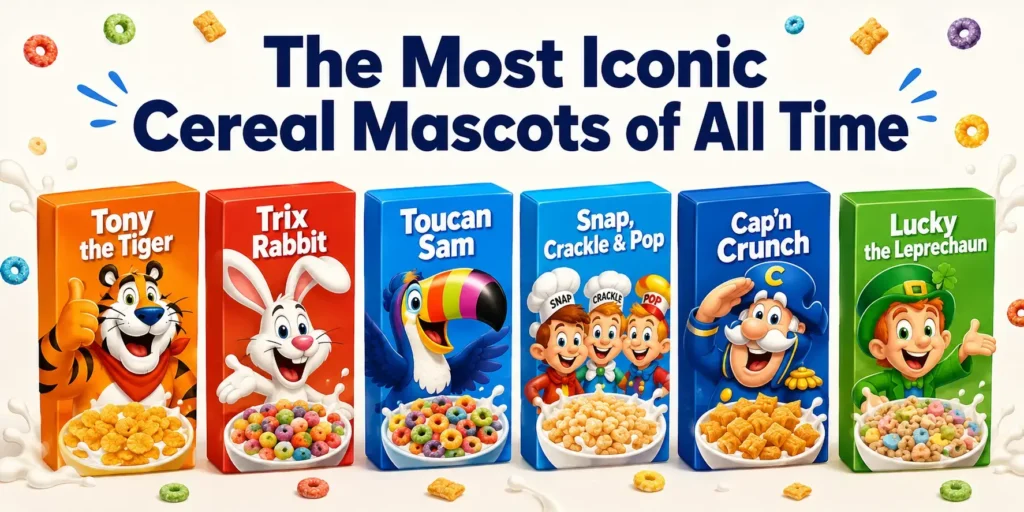
Tony the Tiger — Kellogg’s Frosted Flakes
No list of cereal mascots is complete without Tony the Tiger at the top. Introduced in 1952 alongside Kellogg’s Frosted Flakes (then called Sugar Frosted Flakes), Tony was designed by children’s illustrator Martin Provensen. He was one of four mascots originally proposed for the cereal the others were Katy the Kangaroo, Elmo the Elephant, and Newt the Gnu. Children voted, and Tony won.
Tony is a large, anthropomorphic orange Bengal tiger who wears a red kerchief and speaks with a deep, confident voice that became synonymous with enthusiasm and energy. His famous catchphrase “They’re Gr-r-reat!” was voiced by Thurl Ravenscroft for over five decades and has entered the English language as shorthand for unbeatable quality.
What makes Tony endure is not just nostalgia. He has been redesigned numerous times (becoming taller, more athletic, and more dynamic in each iteration) while retaining enough visual consistency to be recognized instantly by consumers across three generations. Tony the Tiger is not just a cereal mascot. He is one of the most recognizable mascots in all of advertising history.
The Trix Rabbit — General Mills
The Trix Rabbit is the definitive underdog mascot. Introduced in 1959, his entire story, every commercial, every cereal box sidebar, every promotional piece is built around one premise: the rabbit desperately wants Trix, but children keep it from him, repeating the slogan “Silly rabbit! Trix are for kids!” The genius of this character is that children watching the commercials identify both with the rabbit’s craving and against it, positioning themselves as the gatekeepers of a treat they control.
The Trix Rabbit has been through multiple visual redesigns, including a CGI era in the 2010s, but his original hand-drawn look has enjoyed a major nostalgic revival. In 2016, fans voted to temporarily bring back fruit-shaped Trix pieces rather than the round balls, illustrating the brand’s unusual cultural relationship with its audience.
Toucan Sam — Kellogg’s Froot Loops
Toucan Sam has one of the most distinctive visual designs in the history of cereal box characters. His enormous multicolored beak banded in rings matching the colors of Froot Loops is inseparable from the cereal’s identity. Introduced in 1963 and originally voiced by Mel Blanc (the voice behind Bugs Bunny and Daffy Duck), Sam speaks with a refined British accent that contrasts amusingly with the chaotic fruity adventure of his commercials.
His catchphrase, “Follow your nose! It always knows!” is a masterclass in product-linked character design. Sam’s ability to smell Froot Loops from a distance drives every plot, making the sensory appeal of the cereal the literal superpower of its mascot.
Snap, Crackle, and Pop — Kellogg’s Rice Krispies
The three Rice Krispies elves are unique among cereal cartoon characters because they are a trio, not a solo character. Snap (the oldest, wearing a baker’s hat), Crackle (a middle child in a red-and-white striped hat), and Pop (the youngest, wearing a military-style drum major hat) each have distinct personalities and roles. Their names and existence are entirely derived from the sound Rice Krispies make when milk is added, a branding masterstroke that makes the product’s sensory experience its primary feature.
The trio debuted in the 1930s and became enormously popular through television. They are among the few cereal mascots who have existed across nine decades without losing mainstream recognition.
Cap’n Crunch — Quaker Oats
Cap’n Horatio Magellan Crunch is one of the most elaborately backstoried cereal mascots in history. He is the captain of the S.S. Guppy and hails from Crunch Island in the Sea of Milk a land featuring Soggyland, the Milky Way, and a crew of young sailors. The Cap’n has a full cast of supporting characters including Jean LaFoote (the barefoot pirate), Harry S. Hippo, and Brunhilde the mermaid.
Introduced in 1963, Cap’n Crunch was created by Jay Ward Productions, the same studio behind Rocky and Bullwinkle. This pedigree explains the unusually sophisticated storytelling and visual humor that distinguished Cap’n Crunch commercials from most competitors. Decades later, the internet briefly seized on the apparent discrepancy in his hat insignia (three stripes versus the four typically denoting a naval captain’s rank), but Quaker Oats addressed the fictional rank with admirable seriousness.
Lucky the Leprechaun — General Mills Lucky Charms
Lucky, whose full name was originally L.C. Leprechaun and who has also been called Sir Charms, debuted in 1964 as the face of Lucky Charms cereal. He is a small Irish leprechaun dressed entirely in green who spends every commercial trying to protect his magical marshmallow charms from children who want to eat them a paradoxical mascot structure that somehow works brilliantly.
Lucky’s charms (the colored marshmallow shapes in the cereal) have changed over the decades, with new shapes being added and old ones retired, each change becoming a minor cultural event among cereal enthusiasts. The character is so deeply associated with Irish-American culture and St. Patrick’s Day that General Mills typically runs Lucky Charms promotions around March 17 every year.
5. Cinnamon Toast Crunch Mascot — A Deep Dive
The Cinnamon Toast Crunch mascot has one of the most unusual histories in cereal cartoon character lore. Originally, the cereal had three bakers Wendell, Bob, and Quello who appeared in early advertising, showing off their craft of coating cereal squares with “real cinnamon and sugar in every bite.” By the early 1990s, only Wendell remained, and for many years he was the primary Cinnamon Toast Crunch mascot.
However, in the 2010s General Mills pivoted dramatically. Wendell was retired, and the mascots became the CinnaMons anthropomorphic Cinnamon Toast Crunch cereal squares that had developed their own little civilization on the cereal box. The Cinnamon Toast Crunch mascots in this era were essentially the cereal pieces themselves, desperately trying to avoid being eaten while the box told the story of each square’s swirly cinnamon coating being so irresistible that even the squares were hungry for each other.
This deeply strange premise became wildly popular online, particularly after a 2021 viral moment in which actor Ryan Reynolds claimed to find shrimp tails in his Cinnamon Toast Crunch cereal. General Mills’ Twitter response (handled with deadpan seriousness) kept the brand and its mascots in headlines for days.
The current Cinnamon Toast Crunch mascot exists as part of the broader cinnaverse branding a world of cinnamon-obsessed squares whose packaging tells miniature visual stories on every panel of the box.
6. Cheerios Mascot — Does Cheerios Have One?
The Cheerios mascot question is one of the most frequently asked in breakfast cereal character history. The answer is both yes and somewhat complicated.
General Mills’ Cheerios has historically relied on its simple, clean brand identity rather than a prominent character mascot. However, Honey Nut Cheerios has had a mascot since 1979: BuzzBee (sometimes spelled Buzz Bee), a cheerful animated bee who appears on every box of Honey Nut Cheerios and in advertising. Buzz is arguably the Cheerios mascot by default, since Honey Nut Cheerios has consistently been one of the best-selling cereals in the United States.
In 2017, General Mills briefly removed Buzz from Honey Nut Cheerios packaging as part of a campaign to raise awareness about declining bee populations, replacing him with a message about bee conservation. The absence of the Cheerios mascot from the box became a significant news story, generating far more press attention than any ad campaign could have purchased, and Buzz was restored to the packaging shortly afterward.
The original plain Cheerios line has used various mascots and characters in advertising over the decades but has never had a single consistent mascot with the staying power of Buzz Bee for Honey Nut Cheerios.
7. Count Cereal Mascot — Count Chocula and the Monster Cereals
The count cereal mascot Count Chocula is one of the most beloved characters in General Mills history and the anchor of an entire franchise of monster cereal mascots.
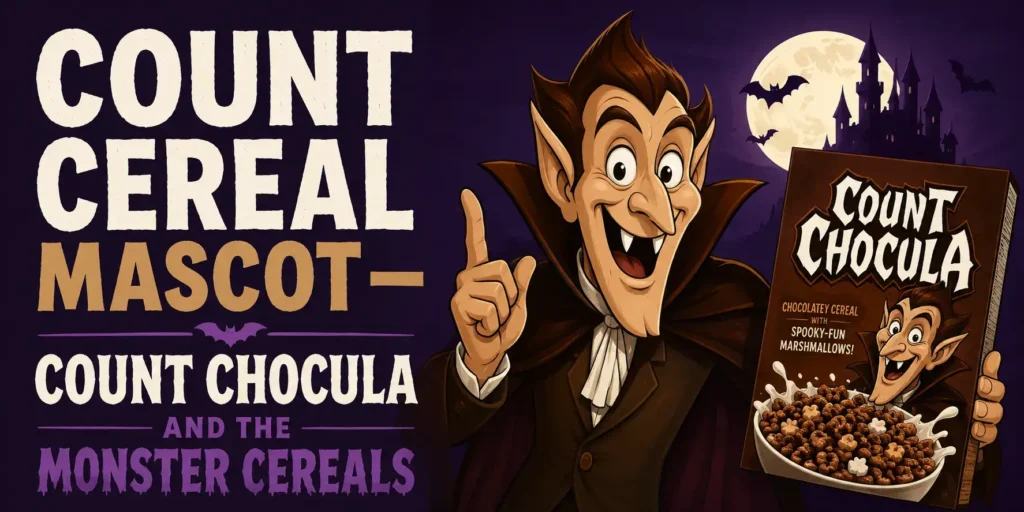
Count Chocula was introduced in 1971 alongside Franken Berry as part of General Mills’ “monster cereals” line. He is a vampire aristocrat (clearly modeled on Count Dracula) with a penchant for chocolate-flavored cereal and an endearing inability to be threatening despite his undead status. His love of chocolate is so powerful it overrides every vampiric instinct, making him more of a fanged sweet tooth than a monster.
The monster cereal lineup expanded quickly:
- Count Chocula (1971) — chocolate flavor, vampire theme
- Franken Berry (1971) — strawberry flavor, Frankenstein’s monster theme
- Boo Berry (1973) — blueberry flavor, ghost theme
- Fruit Brute (1974–1982) — fruit flavor, werewolf theme; briefly revived in 2013
- Yummy Mummy (1988–1993) — fruit flavor with vanilla cream, mummy theme; briefly revived in 2013
All five characters were revived for limited Halloween releases in 2013, catering directly to nostalgic adults who had grown up with the originals. The monster cereal mascots have since become a Halloween staple, with limited-edition boxes featuring retro artwork that explicitly targets collector nostalgia.
Count Chocula remains the most recognized count cereal mascot and one of the most recognized Halloween-themed brand characters in American retail history.
8. Rooster Cereal Mascot — Cornelius the Cockerel
The rooster cereal mascot belongs to Kellogg’s Corn Flakes. His name is Cornelius, and he has appeared on Corn Flakes packaging in various forms since 1958 in the United Kingdom and internationally. In the United States, the Kellogg’s Corn Flakes box has also featured a rooster prominently, though the North American branding has gone through multiple iterations.
The rooster was a natural choice for a morning cereal mascot roosters crow at dawn, symbolically waking the world for breakfast. Cornelius is typically depicted as a proud, dignified rooster crowing with enormous energy, reinforcing the “start your morning right” messaging that has anchored Corn Flakes advertising for decades.
In the UK, the Corn Flakes cockerel remains one of the most recognized breakfast cereal characters in the country, competing with Tony the Tiger for shelf presence in British supermarkets.
9. Female Cereal Mascots
One of the most discussed topics in breakfast cereal character history is the near-total dominance of male mascots. The overwhelming majority of cereal cartoon characters Tony the Tiger, Cap’n Crunch, Lucky the Leprechaun, Toucan Sam, the Trix Rabbit, Snap, Crackle, and Pop are coded male. Female cereal mascots are comparatively rare, but several notable ones exist:
Pebbles Flintstone (Post Fruity Pebbles / Cocoa Pebbles) While Fred Flintstone is the face of the Pebbles cereal line, his daughter Bamm-Bamm’s companion Pebbles appears on packaging and in advertising, making her one of the most visible female cereal box characters.
CinnaMon from Apple Jacks represents one half of a character duo with Bad Apple. CinnaMon is often read as the positive, energetic female counterpart in the duo’s ongoing rivalry, which played out in early 2000s commercials where children raced to determine which flavor was stronger.
Sunny (various breakfast cereals) a generic sun character associated with several cereals’ morning-energy branding, often depicted with feminine features.
Crackle of Snap, Crackle & Pop in some regional and international versions of the Rice Krispies mascot trio, Crackle has been portrayed with feminine characteristics, though the core North American branding treats all three as male.
Industry analysts have repeatedly pointed to the lack of female cereal mascots as a significant branding gap. As breakfast cereal brands compete for increasingly diverse audiences, the introduction of prominent female breakfast cereal characters represents both a cultural opportunity and an untapped commercial one.
10. Retired and Discontinued Cereal Mascots
Not every cereal cartoon character endures. The history of breakfast cereal mascots is filled with characters who had their moment and were eventually retired, rebranded, or quietly dropped as their cereals were reformulated or discontinued.
Sugar Bear (Post Golden Crisp) is among the most famous semi-retired mascots. A cool, laid-back bear who speaks in a low, Elvis-like baritone, Sugar Bear was enormously popular in the 1960s and 1970s. While the cereal continues to be sold, his promotional presence has been drastically reduced.
Chip the Wolf (Cookie Crisp) replaced an earlier mascot Officer Crumb and was himself the subject of controversy when critics noted that advertising a wolf trying to steal cookies from children sent an arguably concerning message. He has appeared with varying frequency since his introduction.
Fruit Brute and Yummy Mummy (General Mills monster cereals) were both officially discontinued in the 1980s and early 1990s, making their 2013 revival feel like genuine events to collectors and nostalgic fans.
Tony the Tiger Jr. and various promotional mascots tied to licensed properties (Teenage Mutant Ninja Turtles Cereal, Ghostbusters Cereal, Batman cereal) came and went with their licensed properties, often leaving passionate communities of collectors behind.
The Honey Smacks Frog (Dig’em Frog) has spent periods in semi-retirement as the Smacks/Honey Smacks cereal underwent multiple reformulations and rebranding exercises across different markets.
11. 90s Cereal Mascots That Defined a Generation
For millennials, the 1990s represent the apex of cereal mascot culture. The convergence of Saturday morning cartoons, licensed merchandising, and an explosion of sugary cereals targeted directly at children produced a specific aesthetic loud, fast, colorful, ironic that has never quite been replicated.
Dig’em Frog (Honey Smacks) epitomized 90s coolness with his backwards cap and street-smart attitude. He was hip-hop cereal branding before hip-hop branding was mainstream.
Chip the Wolf (Cookie Crisp) replaced Officer Crumb in 1997 with a hipper, more irreverent energy that felt purely of the era.
Tony the Tiger’s 90s redesign made him taller, leaner, and more athletic, aligning with the decade’s obsession with extreme sports culture. Kellogg ran campaigns showing Tony surfing, skateboarding, and playing basketball a dramatic shift from the 1950s Tony who simply ate cereal with children.
Wendell (Cinnamon Toast Crunch) was a 90s staple on after-school television, with his baker persona and cinnamon-obsession driving countless short commercial narratives.
Lucky the Leprechaun in the 1990s underwent a subtle but important evolution, becoming more mischievous and fast-talking, chasing his charms through increasingly elaborate magical scenarios. The decade also saw the most aggressive expansion of Lucky Charms’ marshmallow shapes, with each new addition becoming a marketing event.
12. Cereal Mascots Tier List
Based on cultural impact, longevity, memorability, and brand effectiveness:
S Tier — All-time legends
- Tony the Tiger (Frosted Flakes)
- Toucan Sam (Froot Loops)
- Lucky the Leprechaun (Lucky Charms)
- Snap, Crackle & Pop (Rice Krispies)
- The Trix Rabbit (Trix)
A Tier — Iconic and enduring
- Cap’n Crunch (Cap’n Crunch)
- Count Chocula (Count Chocula)
- Sonny the Cuckoo Bird (Cocoa Puffs)
- BuzzBee (Honey Nut Cheerios)
- Fred Flintstone (Fruity / Cocoa Pebbles)
B Tier — Beloved but regional or era-specific
- Dig’em Frog (Honey Smacks)
- Wendell (Cinnamon Toast Crunch)
- Sugar Bear (Golden Crisp)
- Franken Berry (Franken Berry)
- Cornelius the Rooster (Corn Flakes)
C Tier — Notable but lesser known
- Boo Berry (Boo Berry)
- CinnaMon & Bad Apple (Apple Jacks)
- Chip the Wolf (Cookie Crisp)
- Sunny Jim (Force Wheat Flakes, vintage)
13. Cereal Logos and What They Say About Branding
Cereal logos are inseparable from cereal mascots. The two design elements work together to form the complete visual identity of a breakfast brand, and understanding how they interact reveals the sophistication of cereal marketing.
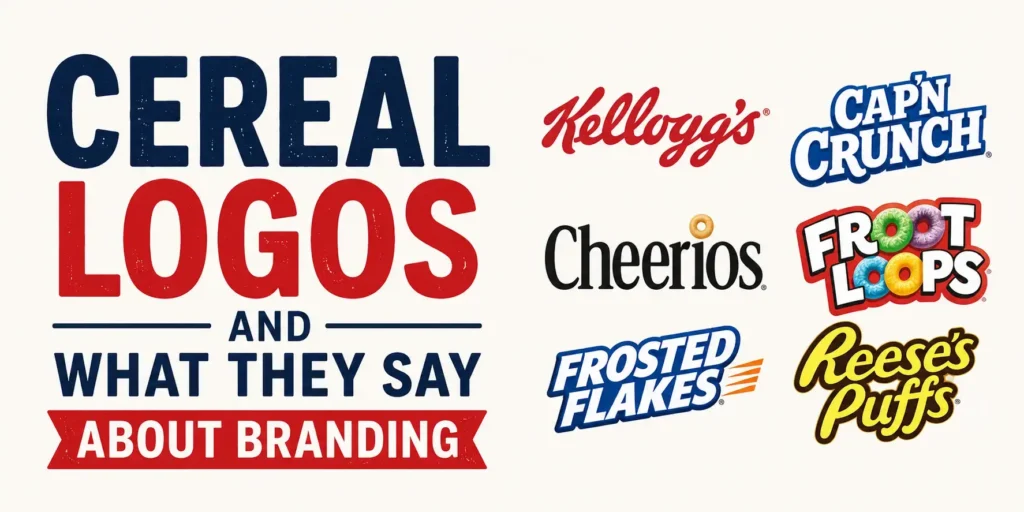
Tony the Tiger and Frosted Flakes uses a combination of Tony’s bold orange-and-black design with Kellogg’s signature red logo treatment. The logo communicates energy, strength, and satisfaction. Tony’s muscular proportions have become more prominent in logo art over the decades, reinforcing the “athletic energy” positioning Kellogg’s adopted in the 1980s.
Lucky Charms uses Lucky the Leprechaun surrounded by floating marshmallow shapes in the logo, with a rainbow and the phrase “magically delicious” embedded into the design. The logo is essentially a visual story; it tells you the characters, the product’s key differentiator, and the emotional promise in a single glance.
Rice Krispies is exceptional because the cereal logo literally incorporates Snap, Crackle, and Pop into the wordmark treatment, making the mascots structurally part of the brand name rather than separate from it. Remove the elves and the visual identity becomes meaningfully weaker.
Honey Nut Cheerios pairs the classic Cheerios “O” logo with Buzz Bee, creating one of the most clean and recognizable cereal logos in history. The simplicity of the logo round honey-colored lettering, a bee, a bright yellow field is a masterclass in uncomplicated visual communication.
Froot Loops uses Toucan Sam’s beak colors (red, orange, yellow, green, blue, purple) as the color palette for the cereal name itself, making the cereal logo and the mascot a unified chromatic system. You cannot separate Sam’s visual identity from Froot Loops’ brand without destroying both.
14. Cereal Box Characters and the Psychology Behind Them
The psychology of cereal box characters is a studied and deliberate science. Researchers in marketing and child psychology have documented several consistent principles that cereal brands have applied for decades.
Eye contact on the box. A Cornell Food and Brand Lab study found that cereal mascot characters on children’s cereals are positioned so their eyes angle downward — directly making eye contact with children standing in the cereal aisle. Adult cereals position characters’ eyes horizontally. This asymmetry is not accidental. It creates a direct, intimate connection between the character and the specific audience the cereal is targeting.
Character agency versus product focus. Adult cereals tend to lead with the product (a bowl of cereal, a farm scene, nutrition information). Children’s cereals lead with the character. The cereal is a supporting element in the mascot’s story, not the hero of the packaging. This character-first approach makes the product feel like an accessory to an adventure rather than a food purchase.
Color psychology. Nearly every successful cereal cartoon character wears or is associated with warm, high-energy colors orange (Tony the Tiger), red (the Trix Rabbit), yellow (Cap’n Crunch’s coat, Lucky’s pot of gold). These colors are associated with energy, appetite stimulation, and excitement. Cool blues and greens appear only as accent colors, never as primary mascot tones.
Repetition and ritual. The most successful cereal mascots embed themselves in morning rituals. When a child sees the same character every morning for years, the character becomes associated with the safety and comfort of home, family, and routine. This is why cereal brand loyalty formed in childhood is among the most durable in consumer goods.
FAQ
What is the most famous cereal mascot?
Tony the Tiger is widely considered the most famous cereal mascot of all time. He has appeared on Kellogg’s Frosted Flakes since 1952, making him one of the longest-running and most globally recognized mascots in advertising history.
What is the oldest cereal mascot?
The Quaker Oats Man is the oldest cereal mascot, first appearing in 1877 and registered as the first US trademark mascot in America. If you restrict the question to cartoon-style characters, Sunny Jim (Force Wheat Flakes, debuted early 1900s) is among the oldest animated cereal characters.
What cereal has the rabbit mascot?
The Trix Rabbit is the mascot for Trix cereal by General Mills. He has been associated with the brand since 1959 and is famous for his catchphrase “Silly rabbit! Trix are for kids!”
What is the rooster cereal mascot?
The rooster cereal mascot is Cornelius (also called Corny), the mascot for Kellogg’s Corn Flakes. A rooster has appeared on Corn Flakes packaging since the late 1950s in various markets.
Does Cheerios have a mascot?
The plain Cheerios line does not have a single consistent mascot. However, Honey Nut Cheerios has had BuzzBee (Buzz the Bee) as its mascot since 1979, and Buzz effectively functions as the broader Cheerios mascot in popular recognition.
Who is the count cereal mascot?
Count Chocula is the count cereal mascot, representing General Mills’ Count Chocula cereal since 1971. He is a chocolate-loving vampire and part of the broader monster cereal family.
What is the Cinnamon Toast Crunch mascot?
The Cinnamon Toast Crunch mascot has evolved over the years. Originally it was Wendell the Baker. Modern packaging features the CinnaMons — animated cinnamon-swirl cereal squares who are the stars of their own miniature universe on the box.
What are all the monster cereal mascots?
The monster cereal mascots are Count Chocula (chocolate), Franken Berry (strawberry), Boo Berry (blueberry), Fruit Brute (fruit, werewolf), and Yummy Mummy (fruit vanilla, mummy). The first three are available year-round in limited markets; all five are released as limited Halloween editions.
Are there any female cereal mascots?
Female cereal mascots are rare. The most notable include Pebbles Flintstone (Post Pebbles), and arguably CinnaMon from Apple Jacks. Most major cereal cartoon characters are male-coded, a gap that industry observers have noted as an opportunity for modern brands.
What cereal has a frog mascot?
Dig’em Frog is the mascot for Kellogg’s Honey Smacks cereal (formerly Sugar Smacks). He has appeared on the cereal since 1972 and is particularly associated with 1990s cereal nostalgia.
Who are Snap, Crackle, and Pop?
Snap, Crackle, and Pop are the three elf mascots for Kellogg’s Rice Krispies. They represent the three sounds the cereal makes when milk is added. Snap wears a baker’s hat, Crackle wears a red-and-white striped hat, and Pop wears a drum major hat. They have appeared in various forms since the 1930s.
Final Thoughts
Cereal mascots are among the most enduring and psychologically sophisticated characters ever created for commercial purposes. They have outlasted advertising trends, platform shifts, and generations of children growing up and growing old. Tony the Tiger has been “Gr-r-reat!” for over seventy years. Toucan Sam has been following his nose for sixty. Lucky has been protecting his marshmallow charms for nearly as long.
What makes these breakfast cereal characters immortal is not just nostalgia, though nostalgia plays a powerful role. It is the clarity of their design, the simplicity of their stories, and the remarkable ability of the best cereal mascot to transform an ordinary cereal box into the beginning of an adventure.
The next time you stand in the cereal aisle, take a closer look at the characters looking back at you. Every color, expression, and design choice has a purpose. At Packaging NextGen, we understand how thoughtful packaging and memorable brand characters create lasting connections with consumers, proving that great packaging is more than a container; it’s part of the brand’s story.