
A cereal carton, a luxury gift box and the stiff back of a notepad can all contain material sold as chipboard, yet they may not look, bend or print the same way. That is why the question “What is chipboard packaging?” needs more than a one-line definition. In packaging, chipboard generally means a dense, non-fluted paperboard made largely from recovered paper fiber. Its actual performance depends on the grade, thickness, density, surface, grain direction, coating and box structure.
The word creates another problem: a furniture supplier may use “chipboard” for resin-bonded wood particles, while a packaging converter may use it for recycled paperboard. These materials do not belong in the same specification. This guide from Packaging NextGen explains the paper-based meaning, how the board is produced, where it works, where it falls short and what buyers should confirm before printing or ordering a production run.
What Is Chipboard Packaging?
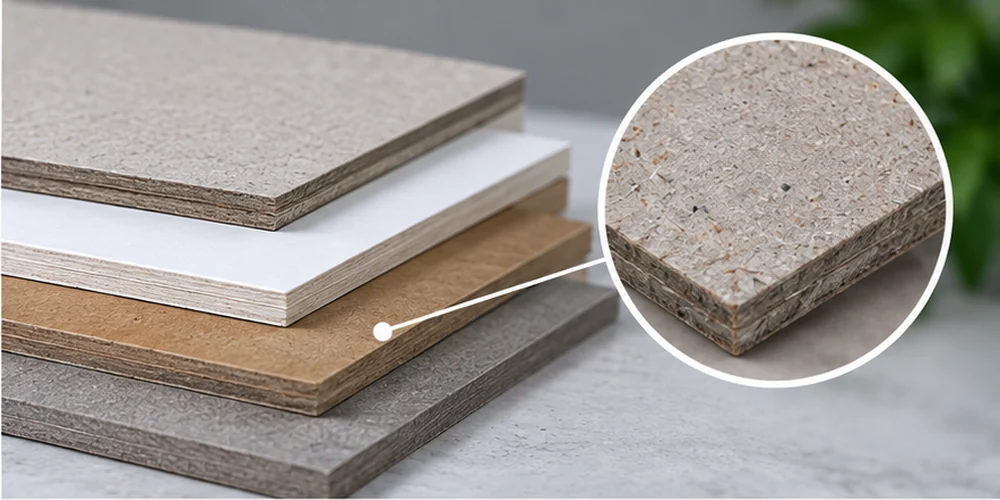
Chipboard packaging is solid paperboard without a fluted middle layer. It is commonly made with recovered paper fibers that are repulped, formed, pressed and dried into dense sheets. Depending on the grade, the sheet may remain grey or brown, receive a coated white face, or be covered with printed paper, film or another decorative wrap.
In practical terms, the answer to “What is chipboard packaging?” depends on how a supplier uses the name. It may describe uncoated recycled board for pads and partitions, greyboard for wrapped rigid boxes, or a coated recycled grade used for folding cartons. Always match the trade name to a technical data sheet and physical sample.
Key Takeaways
- Packaging chipboard is paper-based board, not wood particleboard.
- “Solid” means there is no corrugated flute; it does not prove that the sheet was formed as one fiber ply.
- Many grades contain recovered paper, but the recycled percentage varies.
- Uncoated grey or brown board is absorbent and usually gives less controlled direct-print results than a coated white surface.
- Chipboard works well for retail cartons, rigid-box cores, dividers, inserts, pads and backing sheets.
- Standard chipboard is sensitive to water and prolonged humidity.
- It provides stiffness but little impact cushioning.
- Caliper, GSM and density describe different material properties.
- A chipboard retail carton normally needs a corrugated outer case when parcel-shipping conditions are demanding.
- Food contact, recycled content and recyclability must be checked as separate claims.
Packaging Chipboard Is Not Wood Particleboard
The same word describes two very different material families.
Packaging chipboard is made by forming paper fibers into board. It can be cut, creased, folded, laminated, wrapped and printed. Common uses include folding cartons, rigid-box cores, slip sheets, layer pads, dividers and product backers.
Wood particleboard is an engineered panel made by bonding wood particles with resin under heat and pressure. It is used in cabinets, shelving, furniture and building products. It is usually measured in fractions of an inch or millimeters far beyond normal folding-carton calipers, and it requires woodworking tools rather than carton-converting equipment.
| Feature | Packaging chipboard | Wood particleboard |
| Main raw material | Paper fiber, often recovered fiber | Wood particles and resin |
| Typical form | Thin or thick paperboard sheet | Thick engineered wood panel |
| Main processing | Cutting, scoring, folding, wrapping and printing | Sawing, routing, drilling and edge finishing |
| Common uses | Cartons, box cores, pads, inserts and backers | Furniture, cabinets, shelving and construction |
| Surface options | Grey, brown, white-lined, clay-coated or wrapped | Raw, veneered, melamine-faced or laminated |
| Packaging role | Primary, secondary or internal pack component | Rarely used in normal consumer packaging |
This distinction belongs near the beginning of the article because a user searching “what is chipboard” may be looking for either material. A packaging specification should use terms such as recycled paperboard, uncoated recycled board, greyboard, coated recycled board or white-lined chipboard where possible.
How Is a Chipboard Made?
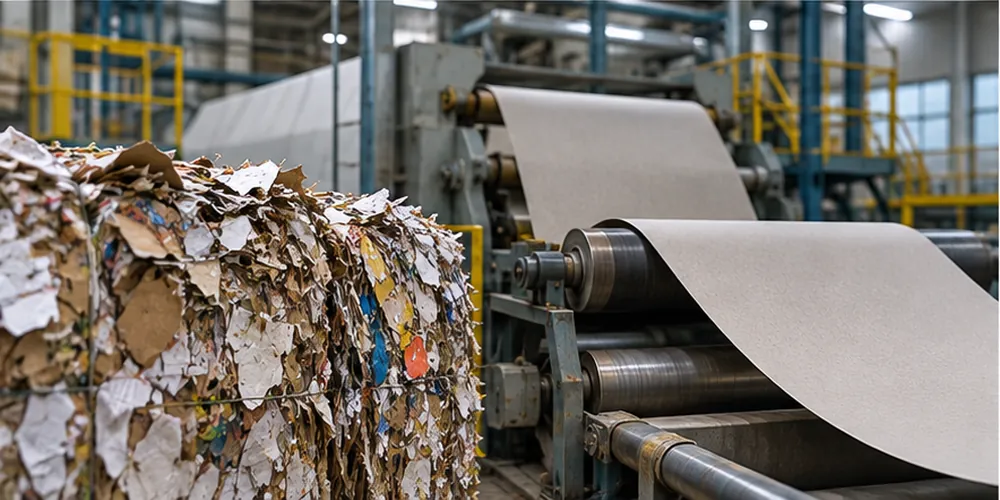
The exact mill process varies, but recycled paperboard production commonly follows these stages.
1. Recovered Paper Is Sorted
Collected paper and paperboard are grouped according to the mill’s furnish requirements. The input mix may include recovered cartons, paper trim and other acceptable grades. Contaminants such as plastic, metal, glass, pressure-sensitive material and unsuitable coated papers must be controlled.
The word “recycled” does not reveal whether the fiber is pre-consumer, post-consumer or a mixture. Buyers who plan to print a percentage claim should request a supplier declaration that states both the percentage and the calculation basis.
2. Paper Is Repulped and Cleaned
Water and mechanical action separate the paper into a fiber suspension. Screens, cleaners and other mill equipment remove unwanted pieces and control non-fiber material. Recovered fibers have already passed through at least one paper-making cycle, so their length, cleanliness, color and bonding behavior can differ from virgin pulp.
3. The Fiber Web Is Formed
The diluted stock is deposited onto forming equipment so water can drain and fibers can join into a wet web. Some board machines build the sheet from several wet fiber layers. For that reason, calling every chipboard grade “single-layer” can be misleading. A finished sheet may feel solid and contain no flute while still having a multi-ply fiber build.
4. The Board Is Pressed and Dried
Pressing removes water and consolidates the fiber network. Heated drying sections reduce the remaining moisture. Pressure, fiber mix and finishing settings affect thickness, density, stiffness, smoothness and dimensional stability.
5. The Surface Is Finished
The board may be calendered to adjust smoothness and thickness. A visible print face can receive mineral or clay coating, surface sizing or another treatment. Uncoated grades may stay grey or brown. Thick rigid-board grades are often covered later with a separately printed wrap.
6. Rolls or Sheets Are Converted
The mill or converter slits, sheets, trims, laminates, die-cuts or scores the board. The same base material can become a layer pad, folding carton, binder panel or rigid-box core depending on caliper and conversion.
Common Types of Chipboard Used in Packaging
Supplier terminology changes across mills and countries. The categories below describe common buying contexts, not universal grades.
Uncoated Recycled Board
Uncoated recycled board, often shortened to URB, is generally grey or brown and has a relatively absorbent surface. It is commonly used for concealed structural parts, partitions, backing sheets, pads and low-graphic applications.
Because the surface absorbs ink, direct printing may look softer or darker than the same artwork on coated white board. Large type, simple line art and controlled spot colors normally reproduce more predictably than fine photography.
Greyboard and Rigid-Box Board
Greyboard is a thick, dense recycled board often used as the core of rigid set-up boxes, book covers, binders and game boards. The visible graphics are commonly printed on a separate sheet and wrapped around the core.
“Greyboard” and “chipboard” overlap in some supplier catalogs, but the names are not perfectly interchangeable. A rigid-box buyer should specify caliper, density, flatness, moisture, sheet size, color and wrap requirements instead of ordering by name alone.
Coated Recycled Board
Coated recycled board has a smoother print face over a recovered-fiber base. CRB, CCNB and WLC may appear in this category:
- CRB generally means coated recycled board.
- CCNB commonly means clay-coated newsback or news board.
- WLC means white-lined chipboard and is widely used in international paperboard terminology.
The reverse side may be grey, brown or lighter in color. Coating quality, odor, fiber furnish, brightness and stiffness vary. Review the actual supplier specification rather than treating these acronyms as identical.
Laminated or Wrapped Chipboard
Chipboard can be laminated to printed paper, colored paper, film or another facing. This construction is common in rigid presentation boxes, game boards, notebook covers and retail displays.
The facing provides the visible print surface, while the core supplies thickness and shape. Adhesive application, moisture balance and wrap direction require control because an uneven build can cause bowing or corner lift.
Kraft-Faced or White-Faced Board
Some converters offer chipboard with kraft or white paper laminated to one or both sides. A lighter face can improve color reproduction; a kraft face can create a brown-paper appearance. Ask whether the face is mill-applied or converter-laminated, as the two routes may behave differently during scoring and gluing.For a wider comparison of SBS, FBB, CUK, CRB, WLC and URB, use this guide to paperboard grades for packaging.
Chipboard Thickness, Caliper, GSM and Density
One number cannot describe a board completely. Buyers should understand four related measurements.
Caliper or Point Thickness
Caliper is the distance between the two faces of the sheet under a defined measuring pressure. In the United States, paperboard thickness is frequently stated in points. One point equals 0.001 inch.
The conversion formulas are:
Thickness in inches = points ÷ 1,000
Thickness in millimeters = points × 0.0254
| Nominal caliper | Inches | Millimeters | Possible packaging context |
| 18 pt | 0.018 in | 0.457 mm | Lightweight carton or printed backer |
| 20 pt | 0.020 in | 0.508 mm | Small folding carton or pad |
| 24 pt | 0.024 in | 0.610 mm | Retail carton or insert |
| 28 pt | 0.028 in | 0.711 mm | Heavier carton or divider |
| 40 pt | 0.040 in | 1.016 mm | Pad, backer or light wrapped structure |
| 60 pt | 0.060 in | 1.524 mm | Rigid-box core or thick board component |
| 80 pt | 0.080 in | 2.032 mm | Rigid box, game board or binder panel |
| 100 pt | 0.100 in | 2.540 mm | Heavy rigid-board application |
These are dimensional conversions, not universal use rules. A dense 60-point sheet can behave differently from a lower-density sheet of the same caliper. Supplier tolerance also matters, particularly when a board must enter a narrow slot, wrap around a tight corner or fit a die made for another lot.
GSM
GSM means grams per square meter and measures mass per area. It does not directly measure thickness. Two boards with the same GSM can have different calipers because their fiber furnish and density differ.
Basis Weight
U.S. suppliers may state basis weight as the weight of a defined number of sheets at a category-specific basic size. Because basic sheet sizes differ across paper categories, a pound value should never be converted without knowing its basis.
Density
Apparent sheet density helps explain why boards with the same thickness may feel and bend differently. When GSM and thickness in millimeters are known:
Approximate density in kg/m³ = GSM ÷ thickness in mm
For example, a 600 GSM sheet that measures 1.0 mm has an apparent density of about 600 kg/m³. Density alone still does not predict a finished box. Fiber direction, moisture, score geometry and structure also matter.
Grain Direction and Stiffness
Paper fibers tend to align more strongly in the machine direction during manufacture. As a result, paperboard properties differ between machine direction and cross direction. The board may bend more easily one way and resist bending more strongly the other way.
Grain direction affects:
- Main-panel stiffness
- Fold resistance
- Score quality
- Corner formation
- Warp and curl
- Sheet feeding
- Rigid-box wrapping
- Long-panel sag
There is no single grain rule for every carton. A converter balances panel stiffness, fold position, sheet yield and equipment direction. The approved dieline should identify grain direction when it affects production. Readers preparing artwork can use this packaging dieline guide to review cut, crease, bleed, glue and technical layers before print approval.
Where Is Chipboard Packaging Used?
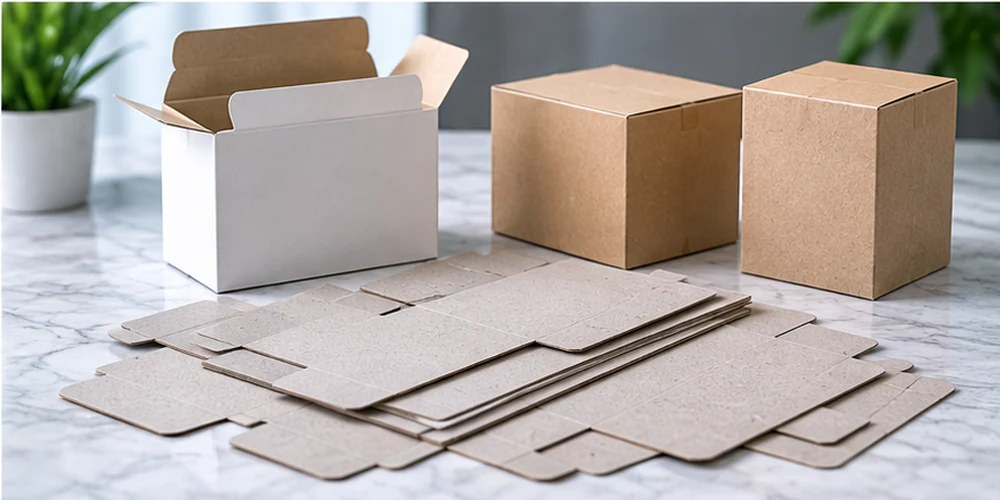
Chipboard appears across retail, industrial and publishing applications because it provides a compact solid sheet that can be cut into many shapes.
Folding Cartons
Coated recycled grades are used for cereal, dry-food, tissue, household-product, toy and personal-care cartons. Suitability depends on product weight, carton dimensions, print quality, cleanliness, odor, humidity and distribution demands.
A folding carton gains much of its performance from structure. Flaps, seams, panel proportions and score quality determine whether the pack stays square and closes correctly. Board thickness alone cannot compensate for a weak layout.
Wrapped Rigid Boxes
Thick greyboard can form the base and lid of gift boxes, presentation kits, jewelry boxes, electronics boxes and cosmetic sets. A printed paper wrap supplies the visible graphics. The box arrives assembled rather than flat, so storage and freight volume are greater than for a folding carton.
Inserts and Dividers
Die-cut chipboard can separate components, keep a product centered or add stiffness beneath a tray. It is useful when the job needs flat separation rather than deep cushioning. Fragile products may still require corrugated, molded fiber, foam or another shock-control material.
Pads, Tier Sheets and Slip Sheets
Flat sheets can separate layers on a pallet, cover pallet deck gaps, stabilize loads or protect products from dirty surfaces. The grade must match load, handling method, humidity and pallet pattern. A thin pad that works between lightweight cartons may buckle beneath a concentrated metal or glass load.
Printed Backers and Display Cards
Retail products, stationery, samples and promotional items may be attached to a printed or laminated chipboard backer. Hole position, hanging load, tear resistance and store-fixture dimensions should be tested with the actual product.
Book, Binder, Puzzle and Game Components
Dense board is common in hard covers, binders, puzzle boards and game boards. Flatness, cut-edge quality, lamination bond and humidity response are important because a slight warp becomes visible across a large panel.
Why Is Chipboard Packaging Chosen?
The material has clear advantages when the application matches its limits.
Compact Thickness
Chipboard does not contain a fluted middle, so sheets and flat cartons can occupy less space than corrugated components of similar face dimensions. This can help with storage and high-volume converting, although the complete packed system determines the final logistics result.
Good Stiffness for Retail Packs
The dense fiber structure gives lightweight cartons, backers and dividers useful shape retention. Thick greyboard creates the solid feel associated with many rigid boxes.
Wide Range of Surface Options
A buyer can select plain grey board for concealed use, a coated face for direct printing or a separate printed wrap for a rigid-box presentation. The print route should be decided before the board is approved.
Efficient Die Cutting
Chipboard can be converted into flat pads, shaped inserts, carton blanks and display components. Cut quality depends on board density, thickness, moisture, tool condition and grain direction.
Recovered-Fiber Availability
Many chipboard grades use recovered paper, giving paper fiber another production cycle. The American Forest & Paper Association reported that around 45 million tons of paper were recycled in the United States in 2025, with the national paper recycling rate estimated at 61% to 65%. Those industry-wide figures do not prove the recycled percentage or recyclability of a specific package.
Limitations Buyers Should Not Ignore
Moisture Sensitivity
Standard uncoated chipboard absorbs water and moisture from humid air. It can swell, soften, bow or lose dimensional stability. A coating or lamination may improve resistance, but it does not automatically make the full pack waterproof.
Cold-chain, bathroom, refrigerated, frozen and outdoor uses need testing at the expected temperature and humidity. Condensation can reach an area that seemed protected in a dry office trial.
Limited Cushioning
A solid sheet can separate and brace products but does not have the spring-like air spaces of corrugated flutes or foam. A fragile glass bottle may need a different insert even if chipboard holds it neatly on a shelf.
Lower Heavy-Duty Shipping Performance
Most retail chipboard cartons are not designed to serve as parcel shippers on their own. A corrugated case normally provides greater compression strength, puncture resistance and impact protection.
Surface and Color Variation
Recovered fiber mixes can create changes in grey tone, specks, smoothness and absorption. These variations may be acceptable when the board is hidden but visible when it is printed directly. Set measurable appearance limits if the board itself is part of the visual design.
Odor and Cleanliness
Recovered paper grades can differ in odor and contaminant control. Sensitive products such as chocolate, tea, cosmetics, pharmaceuticals and personal-care items require supplier documentation and product-specific evaluation.
Printing on Chipboard Packaging
Printing decisions should begin with the board surface, not just the artwork. A smooth white-coated face handles fine images differently from absorbent greyboard.
Printing Directly on Uncoated Chipboard
Uncoated surfaces pull liquid into the fiber network. This can increase dot spread, reduce ink holdout and mute transparent colors. Fine reversed type, pale tints and small barcodes may become less reliable.
Useful controls include:
- Print a drawdown or press proof on the production material.
- Use larger type and simpler graphic elements where possible.
- Measure color against a board-specific approved sample.
- Allow for the board color beneath transparent ink.
- Check drying, rub resistance and set-off.
- Keep critical codes away from rough or speckled areas.
White ink can create a lighter base for selected colors, but its opacity, trapping and adhesion must be tested. One white pass may not hide a dark grey sheet completely.
Printing on Coated Chipboard
A mineral-coated face gives a smoother, lighter printing surface and better ink holdout. Offset lithography is common for detailed folding-carton work. Flexography may suit higher-speed or simpler graphics. Digital printing can help with samples, short runs and versioned packs when the press accepts the board’s size and caliper.
What is chipboard packaging from a print buyer’s perspective? It is a substrate whose surface, absorption and color must be confirmed before artwork reaches production. Packaging NextGen recommends checking color on the selected board rather than approving it only on a bright screen or generic white proof.
Printing a Separate Rigid-Box Wrap
Rigid greyboard is often not printed directly. The graphic layer is printed on paper, then laminated or wrapped around the board. This route can provide smoother imagery, tighter color control and more finishing choices.
The team must still plan:
- Wrap grain direction
- Turn-in allowance around edges
- Corner overlap
- Glue compatibility
- Paper stretch
- Scuff resistance
- Foil and emboss position
- Registration across separate box parts
- Moisture balance between the wrap and core
Artwork that aligns across a lid and base may shift if board thickness, wrap tension or assembly position changes. A physical sample is necessary for close-register designs.
Foil, Embossing and Other Finishes
Foil stamping, embossing, debossing, spot coating and lamination can be added to coated cartons or printed wraps. Their success depends on surface smoothness, compression, heat, tool depth and nearby folds.
Deep embossing on a thin carton can distort the reverse side or weaken a fold. A heavy film lamination can change score behavior and recycling acceptance. Treat the board, print, adhesive and finish as one converted structure.
Chipboard vs Cardboard vs Paperboard vs Corrugated
“Cardboard” is an everyday umbrella word, not a precise material specification. It may refer to a cereal carton, greyboard or corrugated shipping case. Paperboard is the more useful technical family for non-fluted carton board.
| Material term | Basic structure | Typical strength profile | Print approach | Common packaging use |
| Chipboard | Dense, non-fluted paperboard, often recovered fiber | Good stiffness; limited cushioning and moisture resistance | Direct on coated grades or by printed wrap | Cartons, rigid-box cores, pads, inserts and backers |
| Folding carton paperboard | Non-fluted board including SBS, FBB, CUK and recycled grades | Designed for scoring, folding and retail presentation | Often offset, flexo or digital | Food, cosmetics, medicine and household cartons |
| Cardboard | Informal term with no single structure | Depends on what material the speaker means | Varies | General consumer description |
| Corrugated board | Fluted medium between liner sheets | Better cushioning, stacking and shipping performance | Flexo, digital or litho-laminated print | Shipping cases, e-commerce boxes and displays |
| Solid fiberboard | Laminated or solid plies without a flute | Dense and puncture-resistant; application-specific | Direct print or laminated label | Industrial packs, partitions and specialty containers |
The correct comparison is therefore not “which material is best?” It is “which construction meets the filled product, print, storage and distribution requirements with the least avoidable material?” Current market and converting changes are covered in this corrugated packaging news guide.
How to Choose the Right Chipboard Grade
Start With the Product
Record the product’s dimensions, filled weight, center of gravity, fragility, surface sensitivity and leakage risk. Measure caps, handles, cables, booklets and accessories rather than relying only on a product catalog. This guide on how to measure a box explains why internal dimensions control product fit while packed external dimensions control storage and shipping calculations.
Define the Pack’s Job
Decide whether the board will:
- Form the entire retail carton
- Act as a hidden rigid-box core
- Hold a product as an insert
- Separate layers on a pallet
- Reinforce another package
- Carry printed instructions or branding
- Serve as a temporary backer or long-life cover
A grade suited to a concealed divider may be a poor choice for close-up photography and small text.
Specify the Environment
List realistic conditions from conversion through disposal:
- Converting-plant humidity
- Filling temperature
- Refrigeration or freezing
- Warehouse duration
- Ocean or truck transit
- Retail shelf exposure
- Bathroom or kitchen moisture
- Consumer handling
Condition and test samples in the expected environment. A flat sheet stored in a climate-controlled sample room does not represent a finished pack exposed to humid distribution.
Select the Surface and Print Route
Choose between plain board, a coated face, a laminated face or a printed wrap. Confirm whether the visible surface needs photography, spot colors, fine text, foil, embossing, a barcode or variable data.
For concepts and artwork orientation, a browser mockup can help teams see how graphics wrap around panels. The Pacdora review explains why a 3D preview still needs converter review and a physical sample before production.
Compare Technical Data
Ask each supplier for the same information so quotations describe comparable materials:
- Mill and grade name
- Fiber furnish and declared recycled percentage
- Caliper and tolerance
- GSM or basis weight
- Apparent density where relevant
- Machine-direction and cross-direction stiffness
- Moisture range
- Surface color and brightness
- Coating type
- Grain direction
- Sheet dimensions and squareness tolerance
- Flatness or warp limit
- Food-contact status where relevant
- Fiber-sourcing certification if requested
- Recommended print and converting processes
- Recyclability or repulpability evidence for the final construction
Testing Chipboard Before Production
A useful test plan connects each result with a real failure risk.
| Check | What it reveals | Possible packaging problem |
| Caliper mapping | Thickness and variation across sheets | Poor fit, die issues or uneven wrapping |
| GSM or basis weight | Material mass per area | Incorrect grade or lot variation |
| MD/CD stiffness | Directional bending resistance | Panel bowing or weak carton shape |
| Moisture content | Water held in the board | Curl, dimension change or brittle scoring |
| Cobb or water absorption | Short-term water uptake | Softening, swelling or coating failure |
| Flatness and warp | Sheet or panel shape | Feeding, gluing and assembly trouble |
| Score-and-fold trial | Crease quality on the final construction | Cracking, delamination or spring-back |
| Surface rub test | Ink and coating durability | Scuffed graphics during packing or transit |
| Adhesion test | Bond between ink, coating, wrap and core | Peeling, corner lift or label loss |
| Barcode verification | Printed code quality | Checkout or tracking failure |
| Filled-pack compression | Resistance under real load | Bulging, collapse or product damage |
| Conditioned sample test | Performance after temperature and humidity exposure | Failure that a dry sample missed |
TAPPI methods often referenced for paper and board evaluation include T 411 for thickness, T 489 or T 566 for bending resistance depending on the material and instrument, and T 441 for water absorptiveness by the Cobb method. The laboratory and supplier should agree on the current method edition, conditioning procedure, specimen direction and pass limits before testing.
Chipboard and Food Packaging
Recycled fiber does not automatically disqualify paperboard from food packaging, but neither does the word “paper” prove food-contact suitability.
In the United States, 21 CFR 176.260 states conditions under which pulp from reclaimed fiber may be used as a component of articles involved in producing, packing, transporting or holding food. The provision also addresses sources that contain harmful substances or have been used to handle them.
A buyer should confirm:
- Whether contact is direct or indirect
- Food type, including dry, aqueous, acidic or fatty food
- Contact time and temperature
- Presence of an inner bag, liner or barrier
- Compliance status of board, coating, ink and adhesive
- Migration and set-off controls
- Odor and taste-transfer requirements
- Supplier declarations for the intended use
Do not transfer a food-contact statement from one grade, factory or package structure to another. The printed and converted pack is the item that enters the use environment.
Is Chipboard Packaging Recyclable?
Many clean, paper-dominant chipboard packs may be accepted in paper recycling systems, but the answer depends on the finished construction and local program. A plain pad is different from a rigid box containing plastic film, magnets, foam, fabric, metal corners and strong wet-strength adhesive.
Keep these claims separate:
- Contains recycled fiber
- Contains a stated percentage of post-consumer fiber
- Comes from certified fiber sources
- Is technically repulpable
- Is accepted by a local recycling program
- Is recyclable for a stated share of consumers
- Is compostable under defined conditions
The FTC Green Guides summary says recyclable claims should be qualified when appropriate recycling facilities are not available to at least 60% of consumers or communities where an item is sold. It also says partial recycled-content claims should state the percentage clearly.
Packaging NextGen advises keeping supplier evidence, test reports and the geographic basis behind every printed environmental statement. Changing a laminate, window, adhesive or insert can change the claim even when the chipboard core stays the same.
Common Chipboard Packaging Mistakes
- Ordering by the word chipboard alone. Supplier meanings vary.
- Confusing points with GSM. One measures thickness; the other measures mass per area.
- Assuming thicker always means stiffer. Density, fiber direction and moisture change bending behavior.
- Approving color on white proofing paper. Grey and brown surfaces alter transparent ink.
- Ignoring grain direction. Folds and long panels may behave differently across directions.
- Using a retail carton as a parcel shipper. A corrugated outer case may be required.
- Expecting an insert to provide cushioning. Flat board positions products but absorbs limited shock.
- Calling coated board waterproof. Moisture can enter at edges, scores and uncovered surfaces.
- Printing an unsupported recycling claim. The complete package and collection access matter.
- Skipping a production-material sample. A digital render cannot reproduce fiber, moisture, folds or wrap tension.
- Changing board caliper without checking the die. Fold allowance, slot width and final dimensions may shift.
- Treating a supplier’s food-grade statement as universal. Intended use and every contact component require review.
Chipboard Packaging Buyer Checklist
Before approving a purchase order, record:
- Product dimensions and filled weight
- Package style and intended role
- Exact material name and supplier code
- Recovered-fiber percentage and claim evidence
- Required caliper with tolerance
- GSM or basis weight
- MD and CD stiffness requirements
- Grain direction
- Surface color and coating
- Direct print, lamination or wrap method
- Color target on the actual substrate
- Ink, coating and adhesive system
- Die-cut and score requirements
- Finished internal and external dimensions
- Moisture and temperature exposure
- Food-contact status where applicable
- Flatness, odor and cleanliness limits
- Barcode grade and text-legibility requirements
- Finished-pack compression and transport testing
- Recycling statement and sales-region qualification
- Approved physical sample
- Lot identification and change-control process
Packaging NextGen recommends signing the physical sample and written specification together. A sample without measurable limits is difficult to reproduce, while a data sheet without a converted sample cannot show real print, fold, glue and pack performance.
Frequently Asked Questions
What Is Chipboard Packaging Made Of?
When buyers ask “What is chipboard packaging made of?”, the answer depends on the grade. Many packaging boards use recovered paper fibers that are repulped, cleaned, formed, pressed and dried into dense sheets. Some grades include surface coatings, laminated faces or printed wraps.
Is Chipboard the Same as Cardboard?
Not exactly. Cardboard is a broad everyday term that may refer to paperboard or corrugated board. Chipboard is a more specific non-fluted paperboard term, commonly associated with recovered-fiber grades.
Is Chipboard the Same as Particleboard?
No. Packaging chipboard is paper-based. Particleboard is made from wood particles bonded with resin and is mainly used for furniture and building products.
Is Chipboard the Same as Greyboard?
The terms overlap, especially for rigid-box cores and backing board, but supplier usage varies. Greyboard usually points to thick grey recycled board, while chipboard may include coated, uncoated, thin or thick paperboard grades.
Can Chipboard Be Printed?
Yes. Coated white faces generally support finer direct printing. Plain grey or brown grades are more absorbent and may need simpler artwork, an opaque base, a laminated face or a separately printed wrap.
Is Chipboard Waterproof?
Standard chipboard is not waterproof. It can absorb water, swell and lose stiffness. Coatings and laminations may improve moisture resistance, but edges, cuts and folds remain possible entry points.
Can Chipboard Boxes Be Used for Shipping?
Lightweight chipboard boxes can hold retail products, but many are not suitable as standalone parcel shippers. Corrugated outer packaging may be needed for stacking, vibration, drops, puncture and impact.
Is Chipboard Safe for Food Packaging?
It can be used in selected food applications when the exact board and all other contact components meet the intended food-contact requirements. Confirm food type, temperature, contact time, barrier use, inks, coatings and supplier documentation.
What Does 24-Point Chipboard Mean?
It means a nominal thickness of 0.024 inch, which converts to approximately 0.610 millimeter. It does not state GSM, density, stiffness, recycled percentage or tolerance.
Is Chipboard Packaging Recyclable in the United States?
Many paper-dominant chipboard items may be accepted, but collection rules differ by location and mixed components can affect processing. Verify the finished package and qualify consumer-facing claims where necessary.
Which Side of Chipboard Should Be Printed?
Print on the side specified as the print face. On coated recycled board, this is usually the smoother white side. With plain board, compare both faces and approve the result on production material.
What Should a Chipboard Specification Include?
At minimum, identify the supplier grade, caliper and tolerance, GSM or basis weight, sheet size, grain direction, surface, color, moisture, stiffness, print process, converting requirements and intended pack use.
Final Answer
The practical answer to what is chipboard packaging is a dense, non-fluted paperboard material used for retail cartons, wrapped rigid-box cores, dividers, inserts, pads and printed backers. It is commonly associated with recovered fiber, but the name alone does not establish recycled percentage, thickness, print quality, food-contact status or recycling acceptance.
Choose it when compact stiffness, flat conversion and paper-based construction fit the job. Add corrugated or cushioning when distribution demands more protection. Most importantly, approve the exact board, print, finish and finished pack under realistic conditions. Packaging NextGen treats “chipboard” as the start of a specification, not the specification itself.