
Learning how to measure a box takes less than a minute, yet placing the tape on the wrong edge can lead to packaging that crushes a product, wastes storage space, or costs more to ship. Internal dimensions determine product fit, whereas packed external dimensions show how much space a parcel occupies within a carrier network.This guide from Packaging NextGen explains both methods without mixing their rules.
How to Measure a Box: The Quick Answer
Record box dimensions in this order:
Length × Width × Height — L × W × H
For a standard rectangular box:
- Length is usually the longest side of the box opening or base.
- Width is the shorter side of that opening or base.
- Height is the distance from the base to the top.
Measure the inside when checking usable product space or ordering custom packaging under an internal-size specification. Measure the outside of the packed and sealed parcel when estimating shipping size, storage footprint or dimensional weight.
Do not assume every supplier uses the same convention. Some packaging companies write depth rather than height, and some structural drawings follow score-to-score measurements. Confirm the dimension order and measurement type before approving a quote or dieline.
Box Dimensions Order: Length, Width and Height
The standard way to list the dimensions of a rectangular box is length first, width second and height or depth third. A box described as 12 × 8 × 4 inches normally means:
- 12 inches long
- 8 inches wide
- 4 inches high
Units matter. Writing 12 × 8 × 4 without inches, millimeters or centimeters can create an avoidable production error. Use the same unit throughout the specification and include it beside the final measurement.
What is the length of a box?
For many standard cartons, length is the longer side of the opening. When a carrier measures a packed parcel, length is generally the longest external dimension of the finished package.
What is the width of a box?
Width is normally the shorter side of the box opening or base. It remains perpendicular to length and sits on the same horizontal plane when the box is in its normal position.
What is box height or depth?
Height measures from the base to the top of the box. Packaging suppliers may call this measurement depth. The terms can refer to the same axis, but the exact convention should be confirmed with the manufacturer.
The dimension order used for envelopes can differ from the common box convention. The guide to standard envelope dimensions explains how flat mailing formats are usually listed and why the object type matters.
What Tools Do You Need to Measure a Box?
Use a rigid ruler for small cartons and a metal tape measure for larger boxes. A soft sewing tape can bend across a panel and produce a less reliable result.
Useful tools include:
- Rigid ruler or metal tape measure
- Caliper for board thickness and small cartons
- Flat table or floor
- Pencil and measurement sheet
- Postal scale for shipping calculations
- Square for checking whether sides sit at right angles
- Calculator for volume, girth and dimensional weight
Before measuring, empty the box if you need its internal size. For shipping dimensions, pack and seal it exactly as it will travel.
How to Measure a Box Step by Step
Knowing how to measure a box correctly begins with identifying whether you need internal dimensions for product fit or external dimensions for shipping. Place the box on a flat surface and keep your measuring tool straight along each edge. Record every measurement in length × width × height order and include the correct unit.
Step 1: Identify the measurement purpose
Ask whether the numbers are needed for product fit, custom manufacturing, storage, shelf planning or shipping. This decision controls whether the tape measure goes inside or outside the box.
Step 2: Place the box on a flat surface
Close or assemble the box into its normal shape. Uneven flooring, open flaps and crushed panels can change the reading. Make sure the base sits flat and the sidewalls are not leaning.
Step 3: Measure the length
Measure the longer side of the opening when recording standard internal box dimensions. For a packed shipping parcel, measure the longest exterior side from its furthest points.
Keep the ruler straight and parallel with the box edge. Do not follow a bowed panel with the tape because this records the curve rather than the true end-to-end distance.
Step 4: Measure the width
Turn the measuring tool 90 degrees and measure the shorter side. Use the same inside or outside method selected for the length. Do not measure one axis internally and another externally.
Step 5: Measure the height
Measure from the base to the top. For internal height, measure usable vertical space inside the closed box. For shipping height, include any bulge, raised flap, corner protector or packing material that changes the maximum profile.
Step 6: Record the result clearly
Write the result as L × W × H, followed by the unit and measurement type.
Examples:
- 305 × 205 × 100 mm — internal dimensions
- 12.5 × 8.5 × 4.5 in — packed external dimensions
Step 7: Measure again
Repeat all three readings before submitting an order or creating a shipping label. For large orders, another team member should independently confirm the measurements.
Internal vs External Box Dimensions
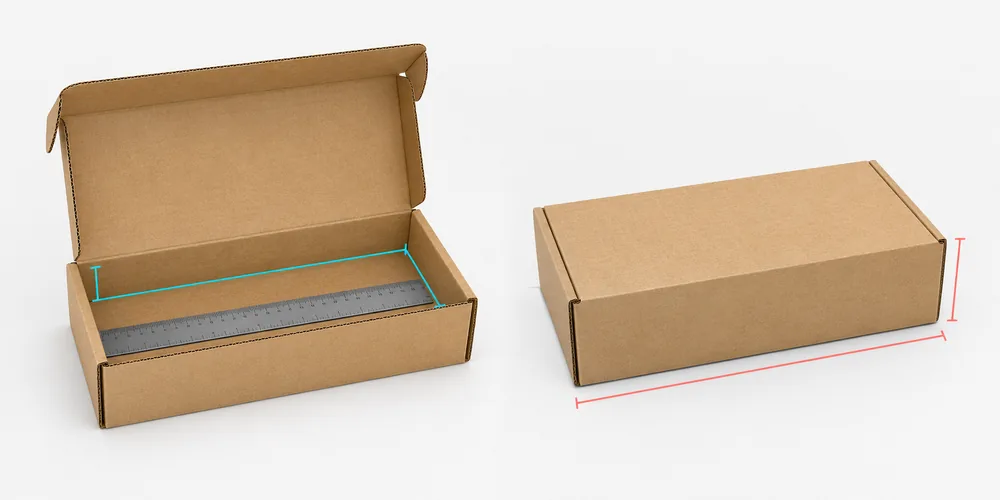
Internal and external dimensions answer different questions. Treating them as interchangeable can cause fit and freight problems.
| Measurement type | What it tells you | Common uses |
| Internal dimensions | Usable space inside the box | Product fit, inserts, custom packaging orders |
| External dimensions | Finished outside size | Shelves, master cartons, pallets and storage |
| Packed external dimensions | Maximum outside size after filling and sealing | Carrier rates, dimensional weight and parcel limits |
| Score-to-score dimensions | Distance between structural crease centers | Dielines, converting and structural production |
When should you measure inside the box?
Use internal dimensions when the goal is to place a product, insert or group of items inside the package. Measurements should be taken between the inner faces of opposite walls.
For a corrugated box, measure from the center of one inside score area to the corresponding point where required by the supplier. Thick flute can reduce usable space, especially around folds and overlapping flaps.
When should you measure outside the box?
Use external measurements for shelf space, case packing, pallet patterns and carrier billing. A parcel company handles the packed outer shape, not the empty space available inside it.
At Packaging NextGen, the safest specification states both the number and its type. “300 mm width” is incomplete; “300 mm internal width” is clear.
Why Board Thickness Changes Box Measurements
A folding carton made from thin paperboard has a smaller internal-to-external difference than a double-wall corrugated box. Material thickness accumulates around folds, corners and overlapping layers.
Important variables include:
- Paperboard caliper
- Corrugated flute profile
- Single-wall or double-wall construction
- Laminated or lined surfaces
- Fold and score allowances
- Overlapping panels
- Rigid-box board and wrap thickness
Do not calculate a new box size by adding a random thickness value to every side. Ask the packaging supplier to translate the required internal space into the correct structural size for the chosen board.
How to Measure a Product for the Right Box Size
The product should be measured before the box is selected. Place the item in its normal packed orientation and record the greatest length, width and height. Include caps, handles, pumps, cables and parts that project from the main body.
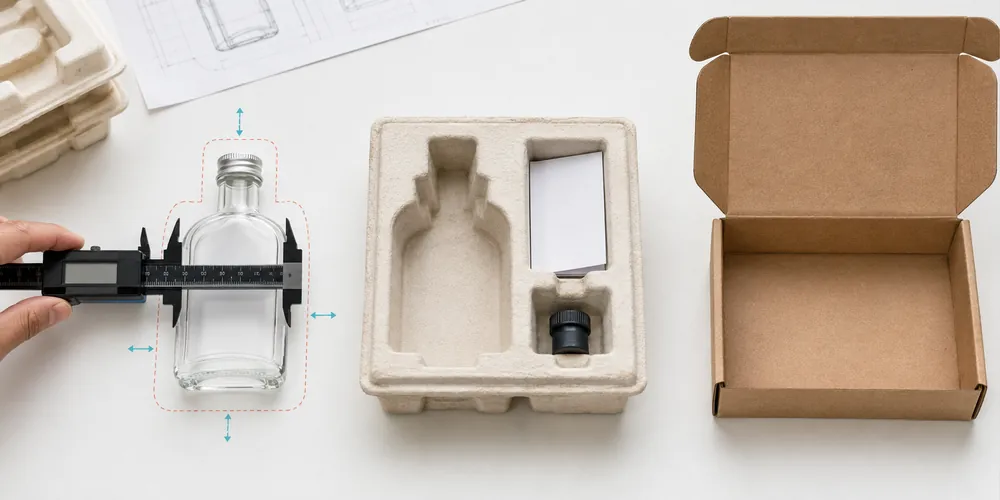
Next, add the space needed for:
- Paper or molded insert
- Foam or air cushioning
- Dividers
- Instruction booklet
- Accessories
- Sealing method
- Packing tolerance
- Product movement during transport
Packaging NextGen recommends testing the largest normal product sample, not only the nominal dimensions in a supplier sheet. Bottles, handmade items, soft goods and assembled products can vary across a production batch.
For cavity-based protection, the guide to processed molded pulp packaging explains why product samples, cavity count, box size and retention needs should be planned together.
Do not make the fit too tight
A package with no clearance may become difficult to fill or close. It can also place pressure on labels, caps or fragile edges. Space should be controlled, not removed without testing.
Do not leave unnecessary empty space
Excess space allows movement, increases material use and can raise shipping costs. The right target is enough clearance for safe packing and protection without paying to transport avoidable air.
How to Calculate the Volume of a Box
Once you understand how to measure a box, you can use the three recorded dimensions to calculate its total cubic capacity. To calculate the volume of a box, multiply its length by width by height using the same measurement unit. The resulting figure helps compare box sizes, plan storage space, review product fit, and estimate dimensional weight.
Multiply length, width and height:
Volume = Length × Width × Height
For a box measuring 16 × 12 × 8 inches:
16 × 12 × 8 = 1,536 cubic inches
If the measurements are in centimeters, the answer is cubic centimeters. If they are in millimeters, the result is cubic millimeters. The formula does not automatically convert the unit.
Volume helps with:
- Comparing box sizes
- Estimating storage needs
- Planning case packs
- Calculating dimensional weight
- Reviewing unused space
- Estimating pallet efficiency
Two boxes can have the same volume but different proportions. A long, shallow box and a compact cube may hold very different products, so volume alone cannot confirm fit.
How to Measure Box Girth
Girth is the distance around the thickest part of a parcel, measured perpendicular to its length. For a standard rectangular box:
Girth = 2 × Width + 2 × Height
For a box measuring 20 × 10 × 5 inches:
- Length = 20 inches
- Girth = (2 × 10) + (2 × 5)
- Girth = 30 inches
- Combined length and girth = 50 inches
Carriers may use combined length and girth to classify large parcels. Their limits and services can change, so confirm the current rule before booking shipment.
How to Measure a Box for Shipping
Measure a shipping box after it has been packed, closed and sealed. Use the widest points of the finished parcel, including any bulging side, raised tape, corner guard or closure that changes its profile.
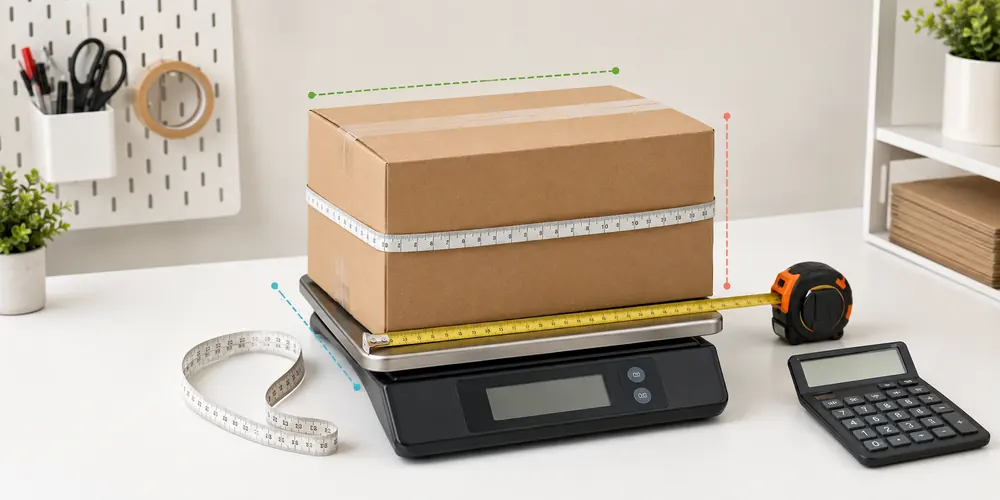
Follow this shipping sequence:
- Pack the actual product and protective material.
- Close every flap and apply the planned tape or seal.
- Place the parcel on a flat surface.
- Find the longest external side and record it as length.
- Measure the next external axis as width.
- Measure the remaining external axis as height.
- Follow the selected carrier’s current rounding rule.
- Weigh the packed parcel.
- Compare actual weight with dimensional weight.
Do not copy measurements printed on a stock-box listing without checking the physical parcel. Listed dimensions may be internal, and manufacturing tolerances or packed bulges may change the outer size.
How Dimensional Weight Works
Dimensional weight estimates how much transport space a parcel occupies relative to its physical weight. A large lightweight package may therefore be billed at a higher weight than the scale shows.
The basic formula is:
Dimensional weight = Length × Width × Height ÷ DIM divisor
For an 18 × 14 × 12-inch parcel with a divisor of 139:
- Cubic size: 18 × 14 × 12 = 3,024 cubic inches
- DIM weight: 3,024 ÷ 139 = 21.76 pounds
- Apply the carrier’s required rounding, producing a billable DIM weight of approximately 22 pounds in this example.
The divisor and rounding method depend on the carrier, service, country and contract. Confirm the current number rather than assuming one formula applies to every shipment.
How to Measure Different Packaging Types
Knowing how to measure a box also means adjusting the method for different packaging structures. Corrugated boxes, folding cartons, mailers, rigid boxes, tubes and flexible packages do not share the same measuring points. Always identify the package shape, intended use and internal or external requirement before recording its dimensions.
Corrugated shipping box
Measure usable inside dimensions for product fit and packed outside dimensions for shipping. Check whether the box has bowed walls, overlapping flaps or a thick joint that reduces space.
Folding carton
Measure the internal panel space after the carton is folded. Paperboard caliper and crease placement affect the finished size. If artwork or structure is being prepared, review the packaging dieline guide before changing any panel dimensions.
Mailer box
Measure the internal base length and width, then the usable height under the closed lid. Account for rolled edges, dust flaps and double-layer sidewalls that reduce the inside cavity.
Rigid box
Measure the base and lid separately when necessary. Wrapped edges, shoulder pieces and internal platforms can change both the usable space and outside profile.
Poly mailer or padded envelope
Pack and seal the mailer first. Lay it naturally without crushing the product, then measure its maximum length, width and filled thickness. An empty flat-mailer size does not represent the parcel travelling through the carrier network.
Mailing tube
Measure the end-to-end length and the outside diameter. Include end caps if they extend beyond the tube. For carrier calculations, the diameter may represent both width and height, subject to the carrier’s instructions.
Irregular package
Measure a rectangular boundary around the widest, longest and tallest points. Protrusions, handles and uneven surfaces should sit inside that imaginary outer box.
From Measurements to a Dieline and Prototype
Measurements are only the starting data for a custom box. A structural designer converts the product size, clearance, material and closure style into panels, flaps, scores and glue areas.
Browser-based tools can help teams review dimensions and visualize the assembled result. The Pacdora review explains where custom-size templates and 3D mockups save time and why a converter still needs to approve the production file.
A digital model can reveal orientation and artwork problems, but physical materials bend, compress and lock differently. The article on 3D printing innovations in packaging covers how physical prototypes and test pieces support fit checks before a larger order.
Common Box Measurement Mistakes
Mixing internal and external measurements
Using internal length with external width and height produces a set of numbers that cannot reliably describe either product fit or shipping size.
Writing dimensions in the wrong order
Changing L × W × H to W × L × H can rotate the intended structure or place openings on the wrong side. Label every axis rather than sending three unexplained numbers.
Measuring an empty box for shipping
The packed box may bulge or sit higher after protective material and product weight are added. Shipping dimensions should reflect the sealed parcel.
Rounding custom measurements to whole inches
One inch can be a major change in a small retail carton. Record exact product and internal measurements. Apply rounding only when the carrier or supplier instructs it.
Ignoring material thickness
Thick corrugated flute, rigid board and folded layers reduce usable space. The effect becomes more important in small boxes and tight-fitting inserts.
Measuring only one product sample
Product dimensions can vary. Check samples from the normal production range and design around the largest acceptable item.
Forgetting inserts and accessories
The primary product may fit, but its manual, cable, insert or protective pad may prevent the package from closing.
Measuring across a crushed panel
A damaged box does not represent the approved finished size. Use a clean sample assembled into its normal shape.
Assuming every company uses the same definitions
Packaging suppliers, dieline systems and carriers may apply different conventions. Confirm L, W, H or D, units, and internal or external status in writing.
Box Measurement Checklist
Before approving a custom box or shipping label, Packaging NextGen recommends checking each item below:
- What is the measurement being used for?
- Are the dimensions internal, external or packed external?
- Are they recorded as L × W × H?
- Is the unit clearly written?
- Was the longest side identified correctly?
- Was the product measured at its maximum points?
- Are inserts, manuals and accessories included?
- Has material thickness been accounted for?
- Was the box packed and sealed before measuring for shipping?
- Were bulges and protrusions included?
- Was volume calculated in the correct cubic unit?
- Was the carrier’s current DIM divisor confirmed?
- Were all three measurements repeated?
- Has a physical sample been tested before a large order?
Measure for the Decision You Need to Make
Knowing how to measure a box correctly depends on what the measurements will be used for. Internal dimensions help plan product fit, inserts and custom packaging, whereas external finished dimensions support shelf, storage and case planning. Maximum packed external dimensions should be used for carrier calculations and dimensional-weight estimates.
Record length, width and height in that order, state the unit and measurement type, account for material thickness and accessories, and test a physical sample. Packaging NextGen treats these details as part of the specification because three measurements are only useful when everyone understands exactly what they represent.
Frequently Asked Questions
What order are box dimensions listed in?
Box dimensions are normally listed as length × width × height or depth. Length is generally the longer base or opening dimension, width is the shorter one and height runs from the base to the top.
Are box dimensions inside or outside?
It depends on their purpose. Custom box specifications often use internal dimensions because they describe usable space. Shipping carriers use packed external dimensions because they need the space occupied by the parcel.
How do I know which side is length?
For a standard box opening, length is usually the longer side. For a packed shipping parcel, it is generally the longest exterior dimension. Confirm the supplier’s convention for unusual structures.
Is depth the same as height?
Many packaging suppliers use depth and height for the third dimension, but terminology varies. The safest specification labels all axes or includes a simple diagram.
Should I round box measurements?
Do not round exact product or manufacturing measurements unless the supplier requests it. For shipping, use the current rounding rule of the selected carrier.
How do I calculate cubic inches of a box?
Multiply length by width by height, with every measurement in inches. A 12 × 8 × 4-inch box has a volume of 384 cubic inches.
How much extra room should I leave around a product?
There is no universal allowance. Clearance depends on product fragility, insert type, packing method, material thickness and acceptable movement. Test the actual product in a physical sample.
Do corrugated box dimensions include the flaps?
Standard internal box dimensions describe the assembled cavity rather than open flap length. A dieline or flat blank includes flap geometry separately. Confirm this with the box supplier.
Can I use my phone to measure a box?
A phone measurement app may help with an early estimate, but a ruler, tape or caliper is safer for ordering packaging and creating shipping labels. Always verify the final numbers manually.
Why did the carrier charge more than my estimate?
The carrier may have recorded larger packed dimensions, applied its rounding method, used dimensional weight, or classified the parcel under a size-based fee. Compare the carrier scan with your sealed-package measurements.