
A standard poker-size playing card is commonly 2.5 × 3.5 inches (63.5 × 88.9 mm), while a bridge-size card is narrower at about 2.25 × 3.5 inches (57.15 × 88.9 mm). Tarot cards are usually larger, and mini, promotional and custom card decks can use many other formats.
Those measurements only describe the face of one finished card. If you are designing packaging, you also need to know the number of cards, finished stack thickness, card material, coating, inserts, sleeves and required clearance.
That distinction matters because a 2.5 × 3.5-inch card does not automatically require a 2.5 × 3.5-inch box.
This guide explains the major playing card dimensions and then shows how to turn those measurements into a practical packaging specification.
Table of Contents
- Standard Playing Card Dimensions
- What Is the Standard Playing Card Size?
- Poker Card Dimensions
- Bridge Card Dimensions
- Tarot Card Dimensions
- Mini, Large and Custom Cards
- How Many Cards Are in a Deck?
- Playing Card Stock and Thickness
- How Thick Is a Deck of Playing Cards?
- How to Measure a Card Deck
- Playing Card Box Dimensions
- Choosing the Right Playing Card Packaging
- Packaging Materials
- Printing and Finishing
- Dielines, Bleed and Artwork
- Protection and Shipping
- What to Give a Packaging Supplier
- Frequently Asked Questions
Standard Playing Card Dimensions at a Glance
Here are several commonly used finished card formats.
| Card Format | Inches | Millimeters | Trim Pixels at 300 DPI | Common Use |
| Poker | 2.5 × 3.5 in | 63.5 × 88.9 mm | 750 × 1050 px | Poker, general playing cards, custom games |
| Bridge | 2.25 × 3.5 in | 57.15 × 88.9 mm | 675 × 1050 px | Bridge, games requiring larger hands of cards |
| Mini | 1.75 × 2.5 in | 44.45 × 63.5 mm | 525 × 750 px | Travel decks, compact games, promotional cards |
| Tarot | 2.75 × 4.75 in | About 70 × 121 mm | 825 × 1425 px | Tarot, oracle and illustration-focused decks |
| Large formats | Varies | Varies | Varies | Education, promotions, accessibility, novelty decks |
The numbers above are useful reference sizes, not a substitute for a manufacturer’s current production template.
That point is important. Copag publishes poker cards at 2.5 × 3.5 inches and bridge cards at 2.25 × 3.5 inches, while Cartamundi provides common templates using 63 × 88 mm for poker and 56 × 87 mm for bridge. Both are legitimate production formats.So when someone asks, “What is the exact standard size of a playing card?” the most useful answer is:
Poker cards are commonly about 2.5 × 3.5 inches, but manufacturers can use slightly different metric cuts. Always use the finished specification supplied by the printer that will produce your deck.
What Is the Standard Playing Card Size?
For many U.S. decks, 2.5 inches wide by 3.5 inches high is the familiar poker-size format.That measurement is widely used for traditional playing cards, promotional decks, magic decks and many custom card games.
A packaging designer should not treat a standard deck of cards or poker cards as having one fixed international production specification. While the commonly used poker-card format is approximately 2.5 × 3.5 inches (63.5 × 88.9 mm), actual card and deck dimensions can vary depending on the manufacturer, cardstock, coating, card count, and production process.
For packaging purposes, two pieces of information are especially important: the finished dimensions of the poker cards and the complete thickness of the deck of cards. The card face determines the box’s width and height, while the finished deck thickness determines the required internal depth. Card count, stock thickness, coatings, additional cards, and inserts can all affect the final fit.
Therefore, when developing custom playing card boxes, designers should confirm the manufacturer’s final card specifications and measure the completed deck before approving the packaging dieline. This helps ensure that the cards fit securely while still allowing practical insertion and removal.
Nominal format: Poker, bridge, tarot, mini or another category.
Actual finished dimensions: The width and height stated on the approved card specification or physical production sample.
The second number should control the packaging.
What Are Poker Card Dimensions?
The commonly referenced poker card size is:
2.5 × 3.5 inches
63.5 × 88.9 mm
6.35 × 8.89 cm
At 300 DPI, the finished trim area works out to 750 × 1050 pixels.That pixel size represents the card after trimming. It does not automatically represent the artwork file you should send to a printer because production artwork normally extends beyond the trim into a bleed area.
BoardGamesMaker, for example, publishes a larger upload requirement for its 2.5 × 3.5-inch product because its production file includes bleed.Use the printer’s current template rather than creating a production file from pixel arithmetic alone.
Complementary Card Size and Production Templates
When choosing a complementary card size for a deck or card game, designers should consider more than the finished trim dimensions. Cards that need to work together should have compatible proportions, handling characteristics, and packaging requirements. The selected size should also account for the final card stock, coating, and deck configuration.
For example, a poker-size card is commonly produced at approximately 2.5 × 3.5 inches, while bridge-size cards are typically narrower at around 2.25 × 3.5 inches. However, these dimensions describe the finished card rather than the complete artwork file.
Production artwork may require additional bleed and safe areas beyond the final card size. BoardGamesMaker, for instance, lists an 822 × 1122 pixel minimum upload requirement for its 2.5 × 3.5-inch poker-size cards at 300 DPI and explains that the additional area accommodates production bleed.
For this reason, designers should use the printer’s current production template instead of calculating artwork dimensions from pixels alone. The correct template establishes the trim line, bleed, and safe area for that manufacturer’s equipment and production process. This is particularly important when preparing complementary cards, custom playing cards, or a complete deck that must maintain consistent dimensions and packaging fit.
What Are Bridge Card Dimensions?
A traditional bridge-size reference is:
2.25 × 3.5 inches
57.15 × 88.9 mm
Bridge cards therefore have approximately the same nominal height as poker cards but are about 0.25 inch narrower.The narrower format can make a larger hand of cards easier to hold and fan.
Copag explicitly distinguishes its bridge format from poker size by width. Its published reference sizes are 2¼ × 3½ inches for bridge and 2½ × 3½ inches for poker.
From a packaging perspective, that quarter-inch difference is significant. A carton made for a poker deck should not simply be reused for a bridge deck without checking the fit.
Excess horizontal space can allow the deck to shift, while a structure sized too tightly can rub or damage card edges.
Poker Cards vs Bridge Cards
| Feature | Poker Size | Bridge Size |
| Nominal Width | 2.5 in | 2.25 in |
| Nominal Height | 3.5 in | 3.5 in |
| Metric Reference | 63.5 × 88.9 mm | 57.15 × 88.9 mm |
| Relative Shape | Wider | Narrower |
| Typical Packaging Effect | Wider carton | Narrower carton |
| Best Practice | Confirm printer’s actual cut size | Confirm printer’s actual cut size |
Neither format is automatically “better.” The correct choice depends on game mechanics, artwork, handling, target users and production requirements.
What Are Tarot Card Dimensions?
A widely used tarot format measures approximately:
2.75 × 4.75 inches
69.85 × 120.65 mm
It is frequently expressed in production catalogs as roughly 70 × 120 mm.Tarot cards provide more visual area than poker or bridge cards, which is useful for illustration, symbolism and larger typography. They also create a larger package.
That package may need to accommodate 78 cards rather than the 52 cards associated with a standard French-suited playing deck, so both the card footprint and finished stack depth need to be considered.
A tarot box should therefore be designed from the actual deck specification instead of scaling a poker-card tuck box proportionally.
How Big Are Mini Playing Cards?
A common mini or patience format is approximately:
1.75 × 2.5 inches
44.45 × 63.5 mm
Mini cards can work well for travel games, compact product bundles, promotional pieces and games containing multiple types of components.The smaller card does not eliminate normal packaging requirements. Corner radius, deck thickness, finger access, flap dimensions and card removal still need to be tested.
Are Jumbo Playing Cards a Standard Size?
Not in the same sense as the familiar poker-size reference.Different suppliers use different large-card formats. Examples found in current manufacturer catalogs include 3.5 × 5 inches and 3.5 × 5.75 inches, among other dimensions.
There is another source of confusion: jumbo index usually refers to larger rank and suit markings, not necessarily a physically larger card.
A poker-size card can therefore have a jumbo index while remaining poker size.For packaging, ask for the actual width and height instead of relying on the word jumbo.
Can Playing Cards Be Made in Custom Sizes?
Yes. Custom games, educational decks, flash cards, affirmation cards, promotional decks and specialty products can use non-standard dimensions.Before selecting an unusual size, consider:
- How easily users can hold and shuffle the cards.
- Whether common card sleeves will fit.
- Whether the dimensions fit the printer’s existing tooling.
- How efficiently cards impose on a printing sheet.
- Whether the box requires new tooling.
- How the size affects case packing and shipping.
- Whether inserts, rulebooks or tokens also need to fit.
A visually interesting size can create unnecessary production problems if the full packaging system is not considered early.
How Many Cards Are in a Standard Deck?
A standard French-suited deck contains 52 cards divided among Hearts, Diamonds, Clubs and Spades.Retail packs frequently include additional cards such as Jokers, advertising cards or instructions.
For a deeper breakdown of suits, ranks, Kings, Queens and Jacks, see Packaging NextGen’s guide to how many face cards are in a deck.For packaging, the physical count is more important than the phrase “standard deck.”Consider these two products:
Deck A: 52 cards.
Deck B: 52 cards + 2 Jokers + 2 promotional cards + 1 instruction card.
Both might be described casually as playing-card decks, but Deck B contains five additional pieces. If the same stock is used, its stack will be thicker.A supplier therefore needs the total packed count, not only the number of playable cards.
Playing Card Stock: GSM, Caliper and Material
Card stock affects how a deck shuffles, bends, springs, feels and fits inside its packaging.Common paper playing-card stocks may be described by weight, such as 280, 300, 310 or 330 GSM. Manufacturers also offer plastic and specialty materials.
Do not assume that GSM directly tells you the thickness.GSM means grams per square meter. It describes material mass per area.Caliper describes physical thickness.
Two card materials with similar GSM figures can have different calipers because fiber composition, compression, coatings, core construction and surface texture differ.
Current card manufacturers show this clearly. Commercial card stocks in similar weight ranges can have thicknesses around 0.28–0.36 mm, while heavier specialty stocks may be thicker still.
This is why the packaging specification should include the actual card stock and finished caliper rather than only “300 GSM.”
Black-Core and Blue-Core Card Stock
Playing cards may use an opaque colored core between printable outer layers.A darker core can reduce show-through between the face and back of the card.
The relevant purchasing questions include:
- Finished thickness.
- Stiffness and flexibility.
- Opacity.
- Surface texture.
- Coating.
- Shuffle characteristics.
- Print reproduction.
- Resistance to repeated handling.
These properties affect both the playing experience and the thickness of the final pack.
Plastic Playing Cards
Plastic cards are also available for products that require moisture resistance or frequent handling.Manufacturers publish plastic card options at different thicknesses, commonly around fractions of a millimeter. Again, the chosen specification should be measured as a complete finished deck before box production.
How Thick Is a Deck of Playing Cards?
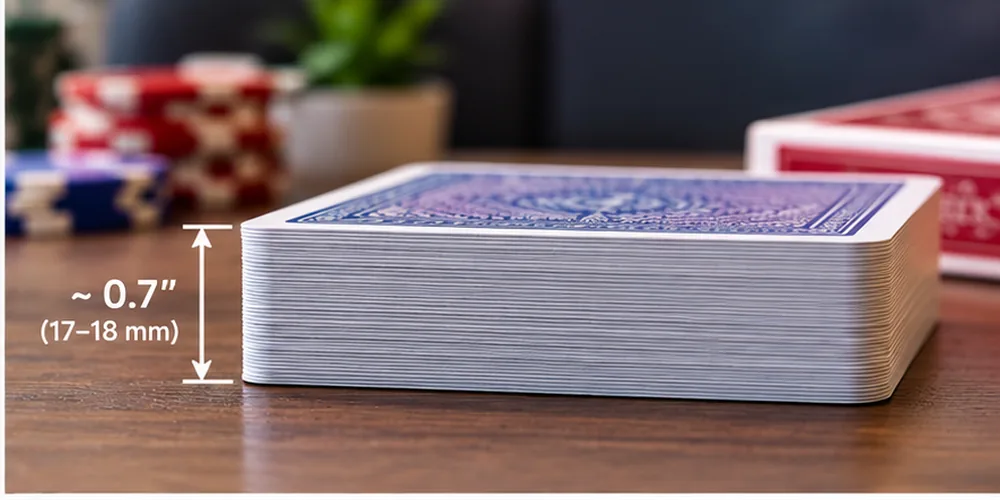
There is no single correct thickness for every 52-card or 54-card deck.Deck depth depends on:
Card count × finished card thickness, followed by the real effects of coatings, embossing, compression, curl and production tolerance.For example, a theoretical 54-card deck made from cards measuring 0.31 mm each would be:
54 × 0.31 mm = 16.74 mm
That calculation is useful as an early estimate.It should not be used as the final carton depth without checking a physical stack.A textured finish may change how cards sit against one another. Coatings can add thickness. A deck can also compress differently under light pressure.The production-safe approach is to assemble the complete finished deck and measure it.
How Do You Measure a Deck of Playing Cards for Packaging?
Use a finished sample whenever possible.
Step 1: Confirm the Final Card Count
Include:
- All game cards.
- Jokers.
- Rule cards.
- Advertising cards.
- Replacement cards.
- QR or promotional cards.
Step 2: Measure Card Width and Height
Use a rigid ruler or caliper and measure the actual finished cards rather than the artwork file.
Step 3: Measure the Complete Stack
Place the complete deck on a flat surface.Keep the cards naturally aligned and apply only the amount of compression expected during normal packing.
Measure the full stack thickness with a suitable caliper.
Step 4: Include Sleeves if They Ship With the Product
If consumers receive the deck already sleeved, measure the sleeved cards.Do not design the box around bare cards and expect sleeves to fit later.
Step 5: Add Other Components
A booklet, score sheet, divider, token or promotional insert changes the required cavity.
Step 6: Record Internal and External Requirements Separately
The space required by the product is an internal packaging dimension.The assembled carton’s outer measurements are external dimensions.
Packaging NextGen’s guide to measuring a box correctly explains why those measurements should not be mixed.
What Are Standard Playing Card Box Dimensions?
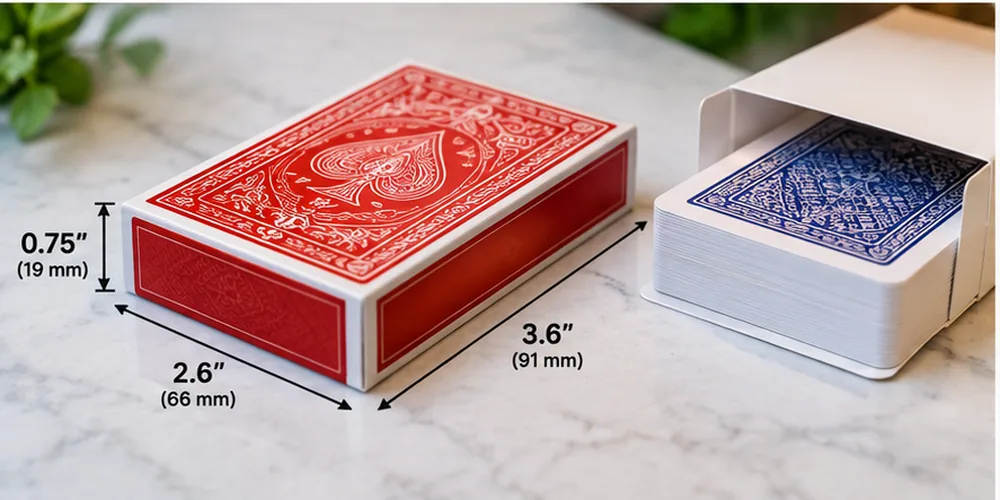
There is no single universal box size for all standard playing-card decks.That is the most important answer.A playing-card box must accommodate three dimensions:
Card width × card height × finished deck thickness
Then the structural designer accounts for the selected material, folds, scores, seams and usable clearance.
A box built to exactly the same width and height as the cards is usually too tight because there is no practical room for loading, removal or production variation.
A box that is unnecessarily large creates the opposite problem: cards can shift inside, presentation suffers and material is wasted.
The correct allowance depends on:
- Card dimensions.
- Deck thickness.
- Board caliper.
- Carton style.
- Fold geometry.
- Tuck-flap construction.
- Coatings or laminations.
- Sleeves.
- Inserts.
- Filling method.
- Supplier tolerances.
For that reason, treat generic online box measurements as references, not as production specifications.
Card Size Is Not Box Size
This distinction deserves emphasis.If a card measures 63.5 × 88.9 mm, those numbers tell you the width and height of the card.
They do not tell you:
- The deck thickness.
- Required side clearance.
- Board thickness.
- Tuck-flap geometry.
- Outside box size.
- Shipping carton size.
A production brief that simply states “box size: 63.5 × 88.9 mm” is incomplete.Instead, specify the finished deck and let the structural dieline establish the correct carton geometry.
Which Packaging Is Best for Playing Cards?
The right structure depends on price point, card count, customer experience, storage and distribution.
Tuck Boxes
A folding paperboard tuck box is the familiar structure used around many retail playing-card decks.It provides a compact format, large printable surface and efficient material use.Tuck boxes are especially suitable when:
- The product contains a single compact deck.
- Keeping package weight low matters.
- Large production quantities are expected.
- The deck needs a familiar opening experience.
- Full-surface graphics are important.
The structural design still needs to account for flap wear and repeated opening.
Sleeve-and-Tray Boxes
A tray sliding into an outer sleeve can create a more deliberate opening sequence while remaining relatively compact.This format can work for:
- Tarot decks.
- Gift decks.
- Educational cards.
- Card sets containing a booklet.
- Branded promotional editions.
Finger access and tray friction need to be tested with the production material.
Two-Piece Rigid Boxes
A rigid lid-and-base box provides stronger presentation and more structural mass.It can suit:
- Collector editions.
- Limited releases.
- Gift sets.
- High-value tarot decks.
- Multi-component products.
Rigid packaging also adds material, weight and shipping volume, so it should be selected for a clear protective or presentation reason.
Packaging NextGen’s guide to chipboard packaging and rigid-box materials explains how greyboard and wrapped structures differ from ordinary folding cartons.
Drawer Boxes
Drawer or slide boxes combine a tray with an outer sleeve.They can work well for premium card products, but the tray needs enough clearance to slide without binding while remaining tight enough to avoid a loose or cheap feel.
Multi-Deck Boxes
Products containing two decks, score pads, booklets, tokens or dice move beyond the simple single-deck tuck-box problem.At that point, it is often better to treat the package as a small card-game system.Partitions or fitted inserts may be required to keep components organized.
What Materials Work for Playing Card Boxes?
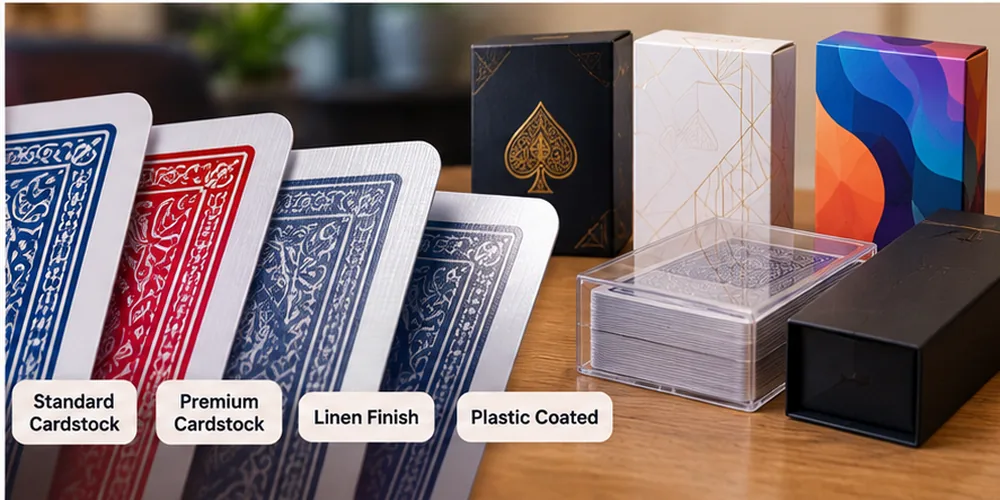
Do not confuse playing-card stock with box stock.They perform different jobs.
SBS Paperboard
Solid Bleached Sulfate provides a smooth white print surface and is widely used for high-quality folding cartons.It can be a strong option when detailed graphics, controlled colors, foil or embossing are required.
Folding Box Board
FBB is another folding-carton material that can provide good stiffness relative to weight.Availability and terminology vary by market, so the actual mill specification should be reviewed.
Recycled Board
Coated recycled board can suit many retail cartons where its appearance, stiffness, odor, cleanliness and print response meet the project requirements.
Kraft-Based Board
Kraft materials can provide a natural brown visual character, although colors reproduce differently on an unbleached surface than on white coated stock.
Greyboard for Rigid Boxes
Rigid presentation boxes often use thick greyboard or related board as a structural core, with printed paper wrapped around it.
For a more detailed comparison of SBS, FBB and recycled options, review Packaging NextGen’s guide to paperboard grades for packaging.
Printing Options for Playing Card Packaging
A box is often the largest continuous branding surface associated with a deck.
It may carry:
- Brand name.
- Game title.
- Suit or artwork motifs.
- Card count.
- Instructions.
- Product description.
- Barcode.
- Web or QR information.
- Edition details.
Common printing approaches include process-color printing and spot colors.When an exact corporate color matters, a spot-color system may be considered alongside process printing. Packaging NextGen’s guide to PMS colors in packaging printing explains why the substrate and coating can change the final appearance.
A color approved on a monitor should not automatically be treated as proof of how the finished box will look.
Finishing Options
Playing-card boxes can use finishes such as:
- Matte or gloss coatings.
- Film lamination where appropriate.
- Foil stamping.
- Embossing.
- Debossing.
- Spot coatings.
- Window cutouts.
- Specialty papers.
Use finishes selectively.A deep emboss close to a fold can affect the carton structure. Heavy finishing layers can change scoring behavior. Metallic or film components may also influence recyclability and material separation.
Finishing should therefore be evaluated as part of the converted package rather than added after the structure has already been approved.
Playing Card Dielines, Bleed and Safe Areas
A packaging dieline is the flat technical drawing that defines the carton before it is folded.For a playing-card tuck box, it can contain:
- Front panel.
- Back panel.
- Side panels.
- Top and bottom flaps.
- Dust flaps.
- Glue tab.
- Cut lines.
- Crease lines.
- Bleed boundaries.
- Safe areas.
The dieline should come from the converter or printer producing the final package.Do not take a random tuck-box template from the internet and scale it until the width looks correct. Changing the dimensions can alter flap geometry, score positions, board behavior and closing performance.
Packaging NextGen’s guide to packaging dielines, bleed and file setup covers these production elements in more detail.
How Much Bleed Do Playing Cards Need?
Bleed means extending background artwork beyond the final trim edge so normal cutting variation does not expose an unintended white strip.
A commonly encountered requirement is approximately 0.125 inch or 3 mm, but the printer’s own template controls.
For example, BoardGamesMaker lists its finished poker card at 2.5 × 3.5 inches while requiring a larger production image that includes bleed.
That illustrates an important distinction:
Trim size = final card.
Artwork size = trim plus the printer’s required bleed.Important symbols, corner indices, text and logos should also remain inside the supplier’s safe area.
Should You Design the Cards or the Box First?
- Ideally, develop them as one packaging system.
- The card format affects the carton footprint.
- The card stock affects the deck thickness.
- The number of cards affects the carton depth.
- The box material affects structural tolerances.
- The artwork affects finishing and dieline placement.
- The outer shipping configuration affects how much protection the retail box needs.
- Working through those decisions together reduces late structural changes.
How Do Sleeves Change Playing Card Packaging?
Sleeves can change both the width and height of each card assembly and, more importantly, the thickness of the complete stack.A box designed around an unsleeved deck may not fit the same deck once every card is sleeved.If sleeves ship separately, they can be treated as another component.If the cards arrive pre-sleeved, use the complete sleeved stack as the product being packaged.
For tabletop games, also consider whether buyers are expected to sleeve the cards after purchase. If long-term storage of sleeved cards is an intended feature, the package may need more room than the factory configuration alone requires.
Protecting Playing Cards in Storage and Transit
Playing cards are light, but their retail cartons can still suffer:
- Crushed corners.
- Scuffed print.
- Torn tuck flaps.
- Moisture exposure.
- Abrasion.
- Deck movement.
- Pressure from adjacent products.
- Carton deformation during case packing.
A paperboard tuck box should normally be considered the retail package, not necessarily the full shipping solution.Multiple retail units can require an outer corrugated shipping case or another suitable transit pack.Premium surface treatments also need rub testing because a visually impressive finish can still scuff against neighboring boxes in shipment.
How Shipping Affects Packaging Choice
Packaging decisions influence freight as well as presentation.A rigid box generally occupies more volume and weighs more than a lightweight folding carton.A larger package can also reduce the number of decks that fit into:
- A shipping case.
- A warehouse shelf location.
- A fulfillment bin.
- A retail display.
- A pallet layer.
If dozens or hundreds of thousands of decks will ship, a few extra millimeters per unit can become significant at case and pallet scale.This is another reason to avoid unnecessary empty space.
Do You Need a Prototype?
For a basic repeat tuck carton using an established specification, a digital proof plus an appropriate physical sample may be enough.A physical prototype becomes particularly useful when the product includes:
- An unusual deck size.
- Multiple components.
- Custom inserts.
- A drawer mechanism.
- A rigid presentation structure.
- Sleeved cards.
- High-value finishing.
- Tight registration between panels.
- An unconventional opening sequence.
Packaging NextGen’s discussion of 3D printing and packaging prototypes explains the difference between reviewing a digital concept and validating physical fit.
A 3D rendering can show how the graphics wrap around the box. It cannot prove that a finished stack slides out cleanly or that a flap closes correctly on the selected material.
What Information Should You Give a Playing Card Packaging Supplier?
A good production brief should answer the following questions before a quote or structural dieline is finalized.
Card Specifications
- Finished card width.
- Finished card height.
- Corner radius.
- Card material.
- Finished card caliper.
- Surface finish.
Deck Specifications
- Total card count.
- Number of Jokers.
- Extra advertising or rule cards.
- Finished stack thickness.
- Whether cards are sleeved.
Additional Components
- Rulebook dimensions.
- Inserts.
- Tokens.
- Dice.
- Score pads.
- Promotional pieces.
Packaging Requirements
- Preferred box style.
- Desired material.
- Printing requirements.
- Finishes.
- Quantity.
- Retail environment.
- Shipping destination.
- Outer shipping requirements.
This information is far more useful than asking a supplier for “a standard playing card box.”
Playing Card Packaging Specification Example
Consider a hypothetical poker-format deck.
Card size: 63.5 × 88.9 mm
Card count: 54
Nominal card caliper: 0.31 mm
Calculated stack: About 16.74 mm before real-world verification
Extra components: None
Preferred package: Printed folding-carton tuck box
At this stage, the calculated depth is useful for estimating.The next step is not to declare the box exactly 16.74 mm deep.
Instead:
- Produce or obtain the finished cards.
- Stack all 54 cards.
- Measure the real deck.
- Confirm the selected box board.
- Let the packaging engineer establish the necessary internal clearance and structural dimensions.
- Cut and fold a sample.
- Insert and remove the deck repeatedly.
- Test the packed unit before approving production.
Common Playing Card Packaging Mistakes
Using Card Size as Box Size
A 2.5 × 3.5-inch card should not be placed into a box with exactly that usable cavity.
Ignoring Card Thickness
Two decks with the same width and height can require different box depths.
Quoting GSM Instead of Finished Caliper
Material weight alone does not tell a structural designer how thick the deck will be.
Forgetting Extra Cards
Two Jokers, advertising cards and instructions all occupy space.
Designing for Bare Cards When the Product Uses Sleeves
This is a common cause of tight-fit problems.
Scaling an Existing Dieline
Changing one carton dimension can alter flaps, scores and closure geometry.
Approving Only a 3D Mockup
A rendering can show appearance but cannot prove physical fit.
Ignoring Shipping
A beautiful retail carton can still arrive crushed if the outer pack is weak.
Frequently Asked Questions
What are standard playing card dimensions?
A commonly used poker-size playing card measures 2.5 × 3.5 inches, or 63.5 × 88.9 mm. Some manufacturers use nearby metric dimensions such as 63 × 88 mm, so production artwork and packaging should follow the selected printer’s actual specification.
What size is a poker card?
The familiar traditional poker format is approximately 2.5 × 3.5 inches.
What size is a bridge card?
A common bridge-size reference is 2.25 × 3.5 inches. It is narrower than poker size while having approximately the same nominal height.
What is the difference between poker and bridge playing cards?
The primary dimensional difference is width. A traditional poker card is about 2.5 inches wide, while a bridge card is about 2.25 inches wide.
What size are tarot cards?
A common tarot format is approximately 2.75 × 4.75 inches, or roughly 70 × 120 mm depending on the manufacturer’s production specification.
What size are mini playing cards?
One common mini format is 1.75 × 2.5 inches, or approximately 44.45 × 63.5 mm.
How many cards are in a deck?
A standard French-suited deck contains 52 cards. Commercial packs may also contain Jokers, promotional cards or instructions.
Is a deck of cards 52 or 54 cards?
The standard playing deck itself contains 52 cards. A retail pack containing two Jokers has 54 physical cards.
How thick is a deck of playing cards?
There is no universal thickness. It depends on card count, card caliper, coating, texture and compression. Measure the complete finished stack before approving packaging.
Does 300 GSM tell me how thick a card is?
No. GSM measures mass per square meter, not physical thickness. Ask the card manufacturer for finished caliper or measure a production sample.
What are standard playing card box dimensions?
There is no universal finished box dimension. The structure must be based on the card width and height, actual deck thickness, board material and required clearance.
How much clearance should a playing card box have?
Enough clearance is needed for cards to enter and leave without binding, while excessive space should be avoided. The correct allowance depends on the structure, board, card finish and converter tolerances, so it should be validated with a folded sample.
Do card sleeves change the box size?
Yes. Sleeves add dimensions and substantially increase the thickness of a full deck. If cards will ship or be stored sleeved, design the box for the sleeved stack.
What is the best box for ordinary playing cards?
A folding-carton tuck box is a common choice for a compact single retail deck. Collector editions, gift decks and multi-component products may justify sleeve-and-tray, drawer or rigid structures.
Do playing cards need bleed?
Printed playing cards normally require artwork to extend beyond the finished trim edge. The exact bleed value should come from the printer’s template.
What artwork size should I use for a 2.5 × 3.5-inch card?
At 300 DPI, the finished trim area equals 750 × 1050 pixels, but the production file must normally be larger to include the printer’s required bleed. Always use the manufacturer’s template.
Should I order the box before printing the cards?
Ideally, finalize the card specification first and approve the carton around a finished or production-representative deck. Card thickness, coatings and count directly affect box depth.
Final Takeaway
Playing card dimensions look simple until packaging enters the project.A poker card may be described as 2.5 × 3.5 inches, but a successful card package depends on much more than those two numbers. The final specification must account for the manufacturer’s actual cut size, card count, stock caliper, coatings, sleeves, instructions, inserts, usable clearance and the physical behavior of the chosen box material.The most reliable workflow is therefore:
Confirm the card size → finalize the card stock → confirm the total packed count → measure the finished stack → choose the box structure → build the supplier’s dieline → test a physical sample → approve printing and production.
That sequence protects both the cards and the production budget while giving the finished deck a package that fits intentionally rather than approximately.
Planning a custom card deck? Start with the exact finished card size, full deck count, stock specification and complete stack thickness. From there, use Packaging NextGen sizing, material and dieline resources to prepare a production-ready packaging brief. If Packaging NextGen adds a dedicated custom playing-card packaging service page, this final CTA should link directly to that page with options to request a quote or discuss your packaging requirements.