
Spread a standard deck across a table and 12 illustrated cards immediately stand apart from the numbered ranks. If you are wondering how many face cards are in a deck of cards, the answer is 12: four Kings, four Queens, and four Jacks. Each of the four suits Hearts, Diamonds, Clubs, and Spades contains three face cards. Aces and Jokers are not included in this count.
The number matters in card games, probability questions, classroom exercises, deck design, printing, and box planning. A card producer must account for every playing card, optional Joker, instruction card, and promotional insert before setting the size of a deck box. This guide from Packaging NextGen explains the complete card breakdown and connects it with the practical packaging decisions behind a finished deck.
How Many Face Cards Are in a Standard Deck?
A standard 52-card deck contains 12 face cards. The calculation is simple:
3 face cards per suit × 4 suits = 12 face cards
| Deck detail | Number |
| Total cards in a standard deck | 52 |
| Total suits | 4 |
| Cards in each suit | 13 |
| Face cards in each suit | 3 |
| Kings | 4 |
| Queens | 4 |
| Jacks | 4 |
| Total face cards | 12 |
| Red face cards | 6 |
| Black face cards | 6 |
| Number cards from 2 through 10 | 36 |
| Aces | 4 |
| Total non-face cards | 40 |
The standard term is face cards. “Facing cards” sometimes appears in searches, but it is usually a wording mistake and does not describe a separate card category.
What Are Face Cards in Playing Cards?
Face cards are the cards that show illustrated human figures. In a standard English-pattern deck, they are:
- King, marked with a K
- Queen, marked with a Q
- Jack, marked with a J
They are also called court cards because their characters represent members of a royal court. The term picture cards is also used, although its meaning can vary between card traditions. Face cards differ from pip or number cards, which are identified mainly by numbers and suit symbols.
The artwork may change across brands, regions, limited editions, casino decks, promotional decks, or collector sets, but the standard King–Queen–Jack grouping remains familiar across widely used 52-card decks.
Which 12 Face Cards Are in a Deck?
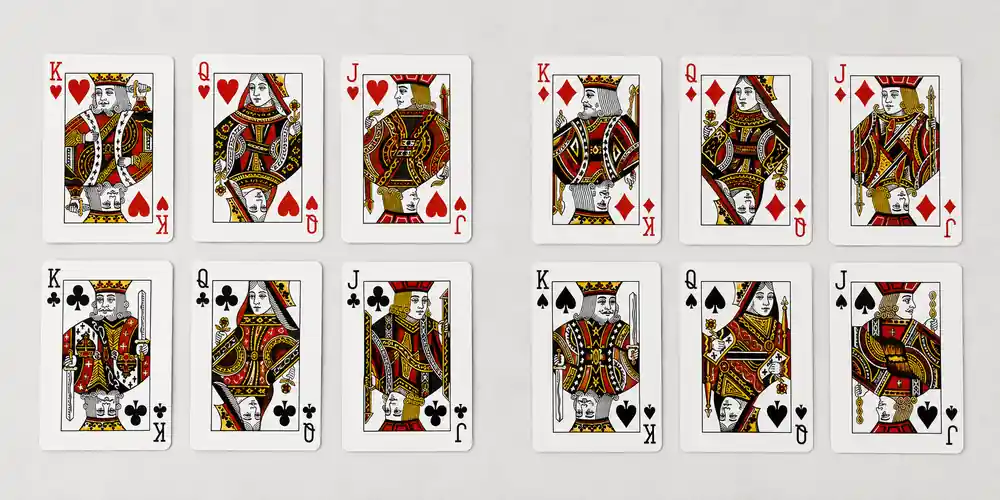
The full set contains one King, one Queen, and one Jack from every suit.
| Suit | Color | Face cards |
| Hearts | Red | King of Hearts, Queen of Hearts, Jack of Hearts |
| Diamonds | Red | King of Diamonds, Queen of Diamonds, Jack of Diamonds |
| Clubs | Black | King of Clubs, Queen of Clubs, Jack of Clubs |
| Spades | Black | King of Spades, Queen of Spades, Jack of Spades |
This arrangement produces four Kings, four Queens, and four Jacks. It also means that every rank is split evenly between the two red suits and two black suits.
How Many Face Cards Are in Each Suit?
Each suit has three face cards:
- One King
- One Queen
- One Jack
Hearts, Diamonds, Clubs, and Spades each follow the same structure. Every suit also contains one Ace and nine numbered cards from 2 through 10. That gives each suit 13 cards:
1 Ace + 9 number cards + 3 face cards = 13 cards
Across four suits, the total becomes:
4 Aces + 36 number cards + 12 face cards = 52 cards
This breakdown prevents a common mistake: a deck does not contain 40 number cards. It contains 36 number cards and four Aces, making 40 non-face cards in total.
How Many Red Face Cards Are in a Deck?
There are six red face cards in a standard deck. Hearts and Diamonds are the two red suits, and each has a King, Queen, and Jack:
- King, Queen, and Jack of Hearts
- King, Queen, and Jack of Diamonds
The calculation is:
2 red suits × 3 face cards = 6 red face cards
How Many Black Face Cards Are in a Deck?
There are six black face cards. Clubs and Spades are the two black suits, and each contains three face cards:
- King, Queen, and Jack of Clubs
- King, Queen, and Jack of Spades
The calculation is:
2 black suits × 3 face cards = 6 black face cards
The red and black counts are equal, so the 12 face cards are divided into two balanced groups of six.
Is an Ace a Face Card?
No. An Ace is not a face card in a standard deck. A face card shows a King, Queen, or Jack as a human court figure. An Ace normally shows one large suit symbol and does not belong to the court-card group.
The confusion comes from card values. An Ace can rank above a King in Poker and can carry a higher value in Blackjack, but a high rank does not turn it into a face card. Its classification and its value are separate issues.
Some game rules group Aces with face cards for a particular action or scoring rule. That game-specific grouping does not change the standard deck definition.
Is a Joker a Face Card?
A Joker is not normally counted as a face card. It may show a jester, clown, or another human character, but it does not belong to Hearts, Diamonds, Clubs, or Spades. It is an optional card added for games that use special wild-card or penalty rules.
A retail pack may contain 52 standard cards plus two Jokers, bringing the physical count to 54. The deck still has only 12 face cards because the two Jokers sit outside the four-suit structure.
Packaging teams should confirm whether a product includes zero, one, or two Jokers. Extra rule cards, advertising cards, or warranty inserts can also change the final thickness even when the core playing deck remains 52 cards.
Face Cards vs Number Cards
Face cards and number cards differ in artwork, quantity, identification, and game value.
| Feature | Face cards | Number cards |
| Included ranks | King, Queen, Jack | 2 through 10 |
| Total in a standard deck | 12 | 36 |
| Quantity per suit | 3 | 9 |
| Main visual | Illustrated court figure | Number and suit pips |
| Typical identification | K, Q, J | 2–10 |
| Game value | Changes by game | Often matches the printed number |
The four Aces form a separate rank. They are neither face cards nor number cards from 2 through 10. Jokers also form a separate optional category.
What Is the Order of Face Cards?
In many games, the face-card order from highest to lowest is:
King → Queen → Jack
The Ace often ranks above the King, but its position can change. It may also rank below the 2 or serve as both a high and low card, depending on the rules.
There is no single ranking rule for every game. Gin Rummy commonly places King above Queen and Jack, while other games assign special actions or point values to individual face cards. The International Playing-Card Society’s explanation of the Jack also notes that the Jack was historically called the Knave in England.
What Is the Probability of Drawing a Face Card?
Probability compares the number of desired outcomes with the total number of possible outcomes. A standard deck has 12 face cards among 52 total cards:
12 ÷ 52 = 3 ÷ 13 = 0.230769
That equals approximately 23.08%.
It is often rounded to “about one in four,” but the exact chance is closer to one face card in every 4.33 draws. One in four is 25%, so it should only be used as a rough estimate.
Probability of Drawing a Red Face Card
There are six red face cards:
6 ÷ 52 = 3 ÷ 26 = 11.54%
Probability of Drawing a Black Face Card
There are also six black face cards:
6 ÷ 52 = 3 ÷ 26 = 11.54%
Probability of Drawing a King, Queen, or Jack
There are four cards of each face-card rank:
4 ÷ 52 = 1 ÷ 13 = 7.69%
Therefore, the chance of drawing any King is 7.69%. The same percentage applies to drawing any Queen or any Jack.
Probability of Drawing a Non-Face Card
There are 40 non-face cards:
40 ÷ 52 = 10 ÷ 13 = 76.92%
These calculations assume a complete, properly shuffled 52-card deck and a single draw without prior cards being removed.
What Are Face Cards Worth in Popular Card Games?
Face-card values depend on the game. Artwork identifies the rank, but the rules determine its numerical value or strategic role.
| Game | Typical role or value |
| Blackjack | King, Queen, and Jack count as 10 |
| Poker | Used by rank to form pairs, straights, flushes, full houses, and other hands |
| Gin Rummy | King, Queen, and Jack generally count as 10 points |
| Rummy | Commonly 10 points, depending on the version |
| Bridge | King, Queen, and Jack are honor cards with strategic importance |
| Hearts | Queen of Spades normally carries a 13-point penalty |
| Euchre | Jack ranking changes according to the trump suit |
| Crazy Eights | King, Queen, and Jack commonly count as 10 penalty points |
Game rules should always take priority over general rankings. For example, the published Gin Rummy rules from Bicycle rank King, Queen, and Jack in descending order and assign each figure card 10 points.
A Short History of Face Cards
Playing cards have a long international history, and their ranks have not always looked the same. Cards were used in Europe by the late 1300s, and regional makers developed different suit systems and court figures. The International Playing-Card Society’s history of playing cards explains how card designs changed while retaining several medieval elements.
Early European court systems often used a King, mounted Cavalier, and foot servant. French makers later used a Queen in place of the Cavalier, while the English Knave became the Jack. Double-ended portraits eventually allowed players to read the cards without turning them upright. Some French patterns named their characters, but modern English court figures cannot always be linked reliably to specific historical people.
How Face-Card Design Affects Playing-Card Packaging
Face cards often contain the deck’s most detailed artwork. Fine lines, skin tones, crowns, suit marks, and mirrored portraits can expose printing issues that are less visible on number cards. Packaging NextGen recommends planning the cards and box together so the structure matches the dimensions, count, stock thickness, coating, booklet, and inserts.
Card Size
Poker-size cards are commonly about 2.5 × 3.5 inches, while bridge-size cards are about 2.25 × 3.5 inches. Rounded corners, lamination, card-stock thickness, deck compression, and production tolerances can change the fit, so measure a finished sample before approving the dieline.
Card Count and Deck Thickness
A standard deck has 52 cards, but a retail product may include:
- One or two Jokers
- Instruction cards
- Brand, QR-code, warranty, or advertising cards
- Rule booklets
These additions increase stack height. Packaging NextGen can use a physical sample or prototype to check whether cards slide out smoothly without moving loosely inside the box. Brands developing an unusual insert or holder can also review 3D printing innovations in packaging before committing to a larger production run.
Box Style
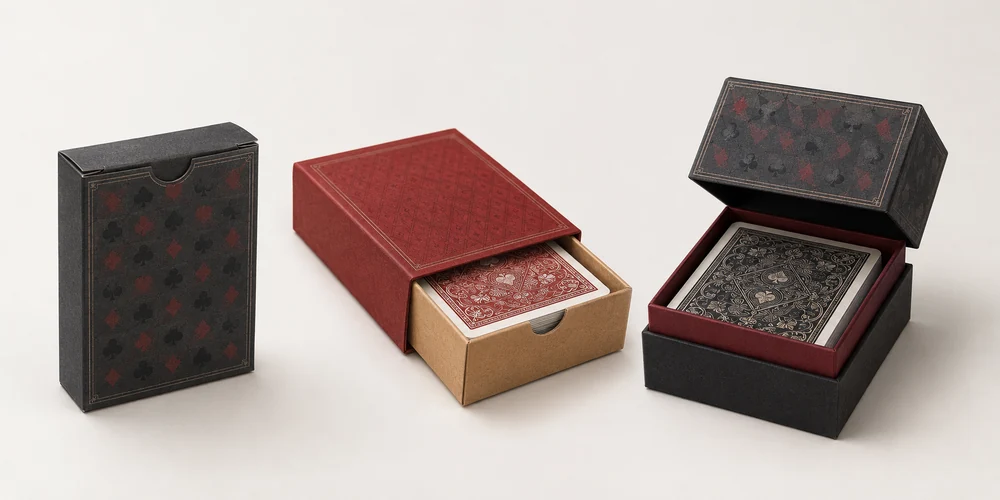
Common packaging choices include:
Reverse or Straight Tuck Boxes
Tuck boxes are compact and suitable for standard retail decks. Their panels can carry the brand name, card count, instructions, barcode, and legal information.
Sleeve and Tray Boxes
A sliding tray can hold a deck, booklet, or small accessory. It works well for gift, educational, and themed sets.
Two-Piece Rigid Boxes
Rigid boxes suit collector decks, limited editions, and higher-priced sets, though they use more material and shipping space.
Multi-Deck Boxes
Games containing two decks, score pads, tokens, or instruction books may need dividers or paperboard inserts.
Material and Finish
Folding cartons may use paperboard or kraft stock, while premium sets may use rigid board wrapped with printed paper. Matte or gloss coatings protect the print. Foil, embossing, debossing, and spot treatments can be used when small details remain readable.
Printing and Collation
Every deck must be assembled in the correct sequence before it enters the box. Missing, duplicated, or wrongly ordered cards can make a product unusable. Brand teams working with instruction booklets, multiple print sets, or promotional inserts can review what collate means when printing to plan the assembly process.
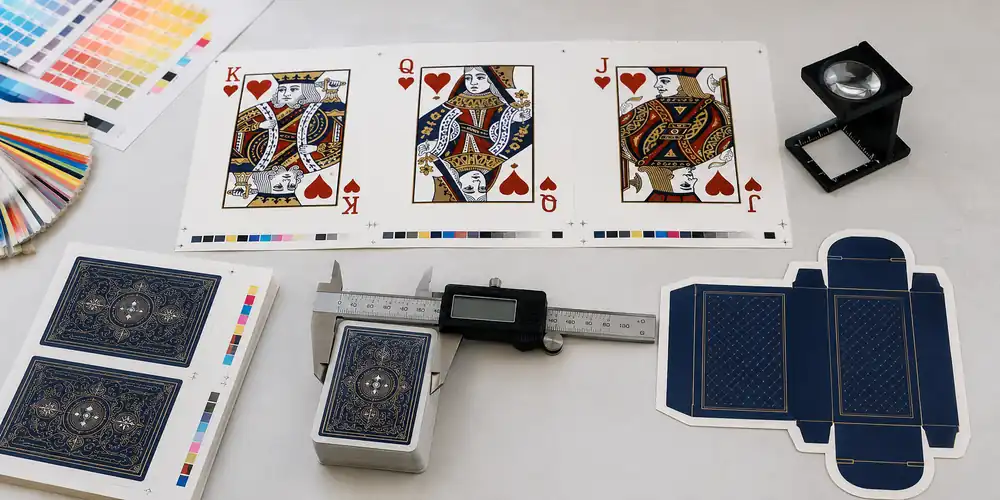
Face-card artwork should also be checked for:
- Consistent color between Kings, Queens, and Jacks
- Clear suit symbols and corner indices
- Sufficient contrast
- Safe margins around trimming areas
- Correct orientation for double-ended artwork
- No important details inside rounded-corner cut areas
Promotional Mail and Sample Decks
Brands may mail sample decks, proofs, instructions, or promotional cards before a launch. The outer mailer must protect the tuck box, while the standard envelope dimensions guide can help size envelopes for flat card samples and printed inserts.
How to Choose the Right Box for a Playing-Card Deck
Use the finished product specifications, not assumptions, to select a box.
- Confirm the complete card count. Include Jokers, rule cards, promotional cards, and replacements.
- Measure finished card dimensions. Record width, height, corner radius, and stack thickness.
- Choose the card stock and coating. Thicker stock or lamination increases deck depth.
- Select a box style. Match the structure with the retail price, audience, and distribution method.
- Plan printed information. Reserve room for the brand name, card count, barcode, age range, safety notes, and instructions.
- Test a sample. Check whether the deck enters and leaves the box without damage.
- Review shipping conditions. Test crushing, rubbing, moisture exposure, and movement inside outer cartons.
- Approve color and finishing. Review physical proofs under normal lighting before production.
Packaging NextGen advises card brands to test the complete packed set instead of only the empty box. A box can look correct on a screen and still fail if the stack is thicker than expected or the flap catches the cards.
Final Answer
So, how many face cards are in a deck of cards? A standard 52-card deck has 12: four Kings, four Queens, and four Jacks. Each suit contributes three face cards, creating six red and six black face cards. The deck also contains 36 number cards and four Aces, while Jokers remain optional.
For card brands, this count is also the starting point for box sizing. Card dimensions, stock thickness, Jokers, instructions, and promotional inserts all affect the final package. Packaging NextGen helps businesses plan printed packaging around the real product so the deck fits securely, opens smoothly, and reaches customers in good condition.
Frequently Asked Questions
How many face cards are in a deck of cards?
There are 12 face cards in a standard 52-card deck: four Kings, four Queens, and four Jacks.
What are the names of the face cards?
The face-card ranks are King, Queen, and Jack. Each rank appears once in Hearts, Diamonds, Clubs, and Spades.
How many face cards are in a deck of 52?
A 52-card deck contains 12 face cards. The remaining cards are 36 number cards and four Aces.
Is an Ace a face card?
No. An Ace is a separate rank. Its game value may be high or low, but it is not a King, Queen, or Jack.
Are Jokers face cards?
No. Jokers are optional cards outside the four standard suits and are not included in the 12-card face-card count.
How many black face cards are in a deck?
There are six black face cards: the King, Queen, and Jack of Clubs and the King, Queen, and Jack of Spades.
How many red face cards are in a deck?
There are six red face cards: three from Hearts and three from Diamonds.
What is the probability of drawing a face card?
The probability is 12/52, which simplifies to 3/13 or approximately 23.08%.
Does a Deck With Two Jokers Have 14 Face Cards?
No. A 54-card pack containing two Jokers still has 12 standard face cards. The Jokers are additional cards outside the four suits.