
A dimension such as 12 × 8 × 4 inches looks simple until a supplier builds the opening on the wrong side, a shipping platform reads a different axis, or a product will not lie flat inside the finished carton. In most rectangular packaging specifications, the length width height order is written as L × W × H. Length usually describes the longer side of the opening, width is the shorter side, and height runs from the base to the top. That rule is a useful starting point, but it is not universal. Product listings, GS1 records, furniture drawings, envelopes, and carriers may use depth, breadth, diameter, or a different orientation.
The safe practice is to label every axis, state whether the dimensions are internal or external, name the unit, and record any tolerance. This guide from Packaging NextGen explains how to read, measure, calculate, and write dimensions so a number set means the same thing to the buyer, designer, printer, converter, warehouse, and carrier.
Length Width Height Quick Answer
For a rectangular box, length × width × height normally means:
- Length: the longer horizontal side of the box opening
- Width: the shorter horizontal side of the opening
- Height: the vertical distance from the base to the top
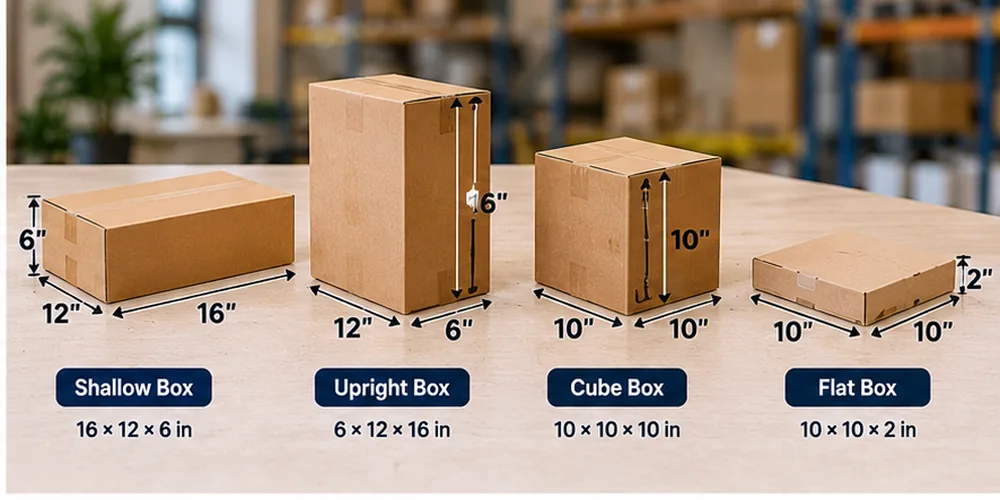
If a box is marked 16 L × 12 W × 6 H in, it has a 16-by-12-inch opening and is 6 inches tall. Its volume is:
16 × 12 × 6 = 1,152 cubic inches
The multiplication produces the same volume even if the three numbers are rearranged. The package, however, is not described correctly when its axes are switched. A 16 × 12 × 6 shallow carton and a 6 × 12 × 16 upright carton each hold 1,152 cubic inches in a mathematical sense, but their openings, panel proportions, packing motion, artwork orientation, and product fit are different.
Length Width Height in One Diagram
Imagine looking down into an open rectangular carton:
- Measure the longer edge of the opening for length.
- Measure the shorter adjacent edge for width.
- Measure from the bottom panel to the top opening for height.
Write the result as L × W × H, followed by the unit and the measurement type. A clear entry would be:
305 × 205 × 100 mm, internal, L × W × H, tolerance ±2 mm
That line is more reliable than writing only “305 × 205 × 100,” because the reader does not have to guess what the numbers, axes, or units represent.
What Length Width and Height Mean
Length, width, and height describe three perpendicular directions. Their exact assignment depends on the object, its normal orientation, and the convention used by the industry or data system.
What Is Length
Length is commonly the longest dimension across the base or opening of a rectangular package. On a regular slotted corrugated box, it is normally the longer of the two opening dimensions. On a folding carton, it may describe the first horizontal panel dimension in the structural specification.
“Longest side” is useful but not absolute. A package can be stood upright, rotated, or displayed on another face. A controlled drawing should therefore show an L label or define the dimension order in a note.
What Is Width
Width is normally the shorter horizontal dimension across the package opening, perpendicular to length. It may also be called breadth in some countries and technical references. If someone asks “what’s the width?” without showing an orientation, the correct response is to identify the front, base, or opening before measuring.
Length is not width merely because the item has been rotated on a table. The assigned axes should stay tied to the agreed drawing or packaging convention.
What Is Height
Height is the distance from the base to the top when the package is in its intended orientation. For a closed box, it describes the third dimension perpendicular to length and width. For a bottle, jar, tube, or stand-up pouch, height commonly runs from the lowest point to the highest point of the finished package.
Do not assume the visible vertical edge is always the official height. A carrier may define length as the longest side regardless of how the parcel is standing. A product-data standard may define height from a designated natural base.
Depth and Breadth
Breadth usually means the same thing as width. That is why international specifications may show length × breadth × height, or L × B × H, instead of L × W × H.
Depth has two common uses:
- In a box specification, depth may replace height and describe how far the box extends from its opening to its base.
- In a product listing, depth often means the front-to-back measurement, while width is side to side and height is bottom to top.
As a result, width × depth × height can be correct for furniture or a retail data record, while length × width × height can be correct for a shipping carton. Neither order should be copied into another system without confirming the labels.
Length Width Height Order
What Comes First Length or Width
In common U.S. box specifications, length comes first, width comes second, and height comes third. The usual sequence is:
Length × Width × Height
Length is typically the longer side of the opening, while width is the shorter adjacent side. This answers questions such as “is length or width first?” and “is it length by width?” for most rectangular cartons.
There is an important qualification: dimension order is a convention, not a law of geometry. The words or abbreviations control the meaning. If a supplier uses W × D × H, the first number is width because it is labeled W, even if it happens to be the longest measurement.
Does Width or Height Come First
In an L × W × H packaging record, width comes before height. In a W × H graphic size, width also comes before height. In other systems, the order can differ. The safest answer to “does height or width come first?” is to read the axis labels rather than relying on the number positions.
Why Dimensions Are Listed in Different Orders
Different trades describe an item from different reference faces. A box maker starts with the opening and panel layout. A furniture seller commonly starts with the front view. A carrier focuses on the parcel’s longest side and girth. A designer may start with the flat artwork view. A data standard may define a default front and natural base.
| Object or record | Common dimension order | How to interpret it |
| Rectangular corrugated box | L × W × H or L × W × D | Longer opening edge, shorter opening edge, box height or depth |
| Folding carton | L × W × H | Panel length, panel width, carton height, as defined on the structural drawing |
| Flat printed piece | W × H | Horizontal artwork size followed by vertical artwork size |
| Furniture or appliance | W × D × H | Side-to-side, front-to-back, bottom-to-top |
| Envelope | Often H × L | Shorter side followed by longer side in many envelope charts |
| Cylinder | Diameter × H | Circular width followed by total height |
| Carrier parcel | L plus width and height or girth | Length is normally the longest side of the packed parcel |
| GS1 product record | Width × Depth × Height | Axes depend on the standard’s default-front and natural-base rules |
For example, a 10 × 7 envelope may be described using a short-side-first convention, while a carton with the same face could use a long-side-first convention. The standard envelope dimensions guide gives packaging-specific examples without treating envelope notation as a box rule.
Length Width Height Is Common but Not Universal
The core mistake in many dimension guides is presenting one order as correct everywhere. Packaging NextGen recommends putting the notation beside the values whenever a specification will move between companies or software systems. “24 × 18 × 12 in” is incomplete. “24 L × 18 W × 12 H in, packed external” is clear.
The GS1 Package and Product Measurement Standard is a useful example of why context matters. Its measurement rules establish orientation for consumer and non-consumer trade items and can record width, depth, and height. A carton supplier’s L × W × H record should not be pasted into a GS1 field set until the package has been oriented under the GS1 rules.
How to Read Dimensions Correctly
To read dimensions, complete four checks:
- Identify the notation, such as L × W × H or W × D × H.
- Confirm the unit, such as inches, millimeters, or centimeters.
- Confirm whether the measurements are internal, external, or packed external.
- Check the drawing, product orientation, and tolerance.
Reading L × W × H
L × W × H is read as “length by width by height.” The multiplication sign is spoken as “by,” not as the letter x.
Example:
14 × 10 × 4 in, L × W × H
Read this as “fourteen inches long by ten inches wide by four inches high.” The base opening is 14 by 10 inches, and the package is 4 inches tall.
Reading W × D × H
W × D × H is read as “width by depth by height.” This sequence is common for products where the front face is the reference.
Example:
20 W × 12 D × 30 H in
The object is 20 inches from side to side, 12 inches from front to back, and 30 inches from bottom to top. Do not relabel it L × W × H unless the receiving system requires that conversion and the axes have been mapped correctly.
Reading L × W
L × W or L × B describes a two-dimensional area, not a finished three-dimensional volume. It may refer to:
- A sheet or blank
- The opening of a box
- A label face
- A panel
- A tray footprint
- A pallet footprint
A specification of “12 × 8 in, L × W” says nothing about height. If height affects the order, fit, price, or shipping calculation, the third measurement must be added.
Reading Diameter and Height
A round package is usually clearer as Ø × H than as L × W × H. A record of Ø 3 × 8 H in describes a 3-inch outside diameter and an 8-inch finished height. If a database requires three rectangular dimensions, it may store the diameter as both length and width, but the source specification should still identify the package as cylindrical.
L × W × H, LXWXH, L × W, and Other Abbreviations
The same dimension order can appear in several written forms:
- L × W × H
- L x W x H
- LXWXH
- L/W/H
- Length × Width × Height
- Length by Width by Height
The multiplication symbol × is typographically clearer than a lowercase x, but both appear in product catalogs and data sheets. Spacing also varies. LXWXH and lxwxh usually mean the same three axes, but uppercase letters are easier to scan.
For two dimensions, common forms include L × W, L x W, LXW, and length × width. A width × length listing is not necessarily wrong if its labels are explicit, though it departs from the usual box order.
Use one format throughout a specification. Mixing L × W × H in one table with H × W × L in another creates an avoidable translation risk.
Length vs Width vs Height
The fastest way to distinguish the axes on a rectangular box is to start at its intended opening:
| Axis | Typical box meaning | Common question it answers |
| Length | Longer side of the opening | How long is the base? |
| Width | Shorter adjacent side | How wide is the base? |
| Height | Base-to-top distance | How tall or deep is the box? |
Width Versus Length
Length and width lie on the same plane and meet at a right angle. On a typical box opening, length is assigned to the longer edge and width to the shorter edge. A square box is a special case because the two measurements are equal. The specification still needs both labels so panel and artwork references remain clear.
Width vs Height
Width runs across the base or face; height runs upward from the base in the intended orientation. If a package is laid on its side, its physical edges do not change, but the viewer’s idea of “up” does. Controlled documentation prevents that visual rotation from changing the recorded axes.
Length vs Height
Length normally follows a horizontal base edge, whereas height is perpendicular to the base. An upright carton can have a height greater than its length. “Length is the longest number” is therefore not a safe rule for every package. The opening convention and labeled drawing decide the axes.
Internal, External, Packed, and Manufacturing Dimensions
A correct length width height sequence can still lead to the wrong package if the measurement type is missing.
Internal Dimensions
Internal dimensions describe usable space inside a package. They are the starting point for product fit, dividers, trays, inserts, and cushioning. Corrugated case sizes are often ordered using inside dimensions, but the purchase specification should say so.
Usable space is not always equal to the nominal internal size. Folded flaps, rolled edges, corner posts, pads, liners, and insert geometry can reduce the space available to the product.
External Dimensions
External dimensions describe the outside of the finished, unfilled package. They help with shelf planning, case packing, pallet patterns, warehouse slots, and master-carton selection.
Material thickness creates the difference between inside and outside. A double-wall corrugated case has a larger dimensional offset than a thin folding carton. Adhesive seams and overlapping panels may also create small local increases.
Packed External Dimensions
Packed external dimensions describe the parcel after the product, protective materials, closure, tape, labels, handles, and any bulge are present. These measurements matter for carrier acceptance and dimensional-weight calculations.
A flat empty carton and a filled taped carton do not always have the same size dimensions. Soft contents can bow panels, overfilled flaps can crown the top, and labels or pouches can project beyond a face. Measure the finished shipment at its maximum points.
Score-to-Score Dimensions
A corrugated or paperboard drawing may use score-to-score measurements to control where folds occur. These are manufacturing dimensions, not necessarily the same as the clear inside size or the finished outside size. Board caliper, score allowances, fold direction, and panel sequence affect the conversion.
The article on what a dieline is in packaging explains how cut lines, crease lines, bleed, panels, and glue areas appear in a flat structural file.
Blank Dimensions
Blank dimensions describe the flat sheet before it is folded and glued. A blank may be much larger than the finished package because its panels, flaps, seam, and waste allowances are spread out. Do not enter blank length × width as the finished length width height.
Part Number Width Specifications and Revision Control
A part number should point to one controlled dimensional definition. If two suppliers interpret the same number differently, the number is not doing enough work.
For packaging, a useful item master or specification table includes:
| Field | Example | Why it matters |
| Part number | BX-RSC-121008-R3 | Connects orders and inventory to one approved record |
| Description | RSC shipping carton | Identifies the package style |
| Dimension order | L × W × H | Assigns each number to an axis |
| Nominal size | 12 × 10 × 8 in | States the intended dimensions |
| Measurement type | Internal | Separates product-fit data from shipping data |
| Tolerance | ±1/8 in | Defines the acceptable production range |
| Material | C-flute corrugated board | Helps explain caliper and performance |
| Closure state | Erected, flaps closed | Sets the condition for inspection |
| Artwork orientation | Front panel at 12-inch length | Aligns printing with structure |
| Revision | R3, approved 2026-09-28 | Prevents an old drawing from controlling a new order |
The phrase part number width specifications often appears in component searches, but the principle also applies to packaging records. The part number alone does not tell a supplier which axis the width represents. The linked drawing or item master should state the dimension order, reference face, unit, tolerance, and revision.
Packaging NextGen also recommends recording both nominal internal dimensions and maximum packed external dimensions when a single packaging item affects product fit and freight rating. Keep the two value sets in separate fields. Do not overwrite one with the other.
A Clear Specification Example
Part: BX-RSC-121008-R3
Style: Regular slotted container
Size: 12 L × 10 W × 8 H in
Type: Nominal internal dimensions
Tolerance: ±1/8 in unless noted
Board: C-flute corrugated
Inspection: Erected and squared, manufacturer’s joint closed
Packed maximum: Record separately after pack-out validation
This record answers what the length and width are, which number is height, how the package should be checked, and which revision controls production.
How to Write Dimensions Without Ambiguity
Use this format:
Value + unit + dimension order + measurement type + tolerance
Example:
18 × 12 × 6 in, L × W × H, internal, ±1/8 in
Rules for Writing Length Width Height
- Put a space between each value and its unit when writing prose. For a compact table, state the unit in the column header.
- Use one unit system in each value set. Do not write 12 in × 200 mm × 4 in.
- Label the order. Add L × W × H, W × D × H, or the convention required by the record.
- Name the measurement type. State internal, external, packed external, score-to-score, or blank.
- State the condition. Note whether the package is flat, erected, closed, filled, or sealed.
- Add tolerances. A nominal size without an acceptable range is incomplete for manufacturing control.
- Show unusual shapes. Add a drawing for tapers, curves, handles, windows, or projections.
- Control the revision. Match the purchase order, drawing, artwork, and inspection sheet to the same issue.
Inches, Millimeters, and Conversion Rounding
One inch equals exactly 25.4 millimeters. Still, converting a specification is not as simple as switching unit labels. Rounding can move a value outside tolerance.
For example:
12 in × 25.4 = 304.8 mm
Writing 305 mm may be acceptable as a rounded description, but it is not identical to a 304.8 mm controlled dimension. State which unit governs if both appear on the drawing.
Avoid the Apostrophe Error
Use in or the double-prime symbol for inches. A single prime indicates feet. Therefore:
- 12 in = twelve inches
- 12″ = twelve inches
- 12′ = twelve feet
In packaging, confusing inches and feet can create an obvious error, but a database or automated order may still accept the wrong character. Written unit abbreviations are often safer in item records.
How to Measure Length Width Height
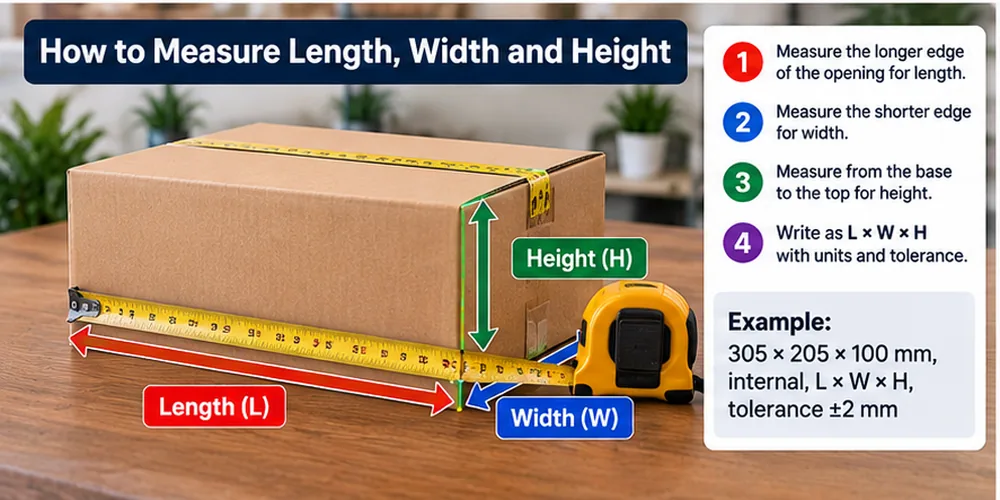
For a rectangular package, place it on a stable surface and identify its normal opening or base. Measure the longer opening edge for length, the shorter adjacent edge for width, and the perpendicular base-to-top distance for height. Hold the rule straight, avoid compressing the walls, and read to the precision required by the tolerance.
This section is intentionally brief because the detailed how to measure a box guide covers tools, internal and external methods, irregular packages, carrier measurements, volume, and product-fit clearance step by step.
Internal Measurement Method
Open and square the carton. Measure between the inside faces rather than from the outer edges. Keep the measuring tool parallel to the panel being checked. Do not follow a bowed wall or place the tool diagonally. Record L, then W, then H under the inspection method defined in the specification.
External Measurement Method
Close the package as it will be used. Measure the maximum outside-to-outside distance on each labeled axis. Include projections when the record calls for maximum dimensions. A metal rule or caliper can give more repeatable results than a soft tape on small rigid packages.
Packed Parcel Method
Pack and seal the product using the production materials and method. Measure the longest points after tape, labels, pouches, handles, and panel bulge are present. If a carrier asks for whole-inch rounding, follow that carrier’s current published method rather than changing the engineering drawing.
Length Times Width Times Height
Multiplying length times width times height gives the volume of a rectangular prism:
Volume = L × W × H
If all three measurements are in inches, the result is cubic inches. If they are in centimeters, the result is cubic centimeters.
Example: 20 in × 14 in × 8 in = 2,240 in³
Width Multiplied by Length
Width multiplied by length gives the area of a rectangular face or footprint:
Area = L × W
For a 20 × 14-inch base: 20 in × 14 in = 280 in²
That number can help compare shelf footprints, pallet coverage, label faces, or sheet areas. It does not give carton capacity until height is included.
Why Reordering Does Not Change Volume but Does Change the Box
Multiplication is commutative, so 20 × 14 × 8 and 8 × 14 × 20 both equal 2,240. This mathematical fact does not make the two packaging specifications interchangeable.Reassigning the axes can change:
- The size and direction of the opening
- Which panels carry the load
- Flap depth and manufacturer’s-joint position
- Product loading direction
- Display-panel orientation
- Grain or flute direction
- Window and handle placement
- Artwork reading direction
- Case-packing and pallet patterns
Treat the formula and the structural description as two separate uses of the same numbers.
Dimensional Weight and Carrier Measurements
Carriers use package dimensions to estimate the space a parcel occupies in a vehicle, aircraft, or sorting system. The billed result may depend on actual weight, dimensional weight, service, destination, package type, and current carrier rules.
A common dimensional-weight structure is:
Dimensional weight = L × W × H ÷ divisor
The divisor and rounding procedure can vary. Use the current instructions for the selected carrier and service. UPS shipping dimensions and weight guidance tells U.S. shippers to determine cubic size from package length, width, and height and explains its dimensional-weight method.
The U.S. Postal Service also treats parcel length as the longest dimension. Girth is the distance around the thickest part perpendicular to that length. The USPS parcel measurement guidance should control when preparing a USPS shipment.
Carrier Length Can Differ From Carton Length
Suppose a carton drawing defines a 14-inch panel as length, a 10-inch panel as width, and an 18-inch panel as height. For a carrier calculation, the 18-inch side may become the parcel’s “length” because it is the longest external side. That does not mean the converter’s structural drawing was wrong. It means the carrier is using a different measurement convention for a different purpose.Keep separate fields for manufacturing dimensions and shipping dimensions when software or staff might confuse them.
Material Thickness, Caliper, and Tolerance
Material thickness affects the relationship between internal and external dimensions. It also affects scoring, bending, closure, nesting, and the available product space.
Corrugated Board
Corrugated board consists of liners and fluted medium. Flute profile, paper combination, moisture, compression, and converting can influence finished caliper. A box made from thicker board will normally have a larger outside size when the inside dimensions remain fixed.
The FEFCO code system provides an internationally used method of identifying corrugated packaging designs. A style code helps identify structure, but it does not replace the dimensions, material specification, closure details, or tolerance.
Paperboard Cartons
Folding carton dimensions are affected by paperboard caliper, coatings, score geometry, panel layout, and the way layers overlap. The paperboard grades for packaging guide helps connect board choice with printing, stiffness, food contact, and common carton uses.
Tolerance Is Not Optional Data
No production process makes every pack at one infinitely exact size. A tolerance tells the manufacturer and inspector how much variation is acceptable.
A good tolerance should reflect:
- Product clearance needs
- Material behavior
- Converting process capability
- Test method and tool precision
- Fit with inserts, closures, and machinery
- Customer or regulatory requirements
Do not choose a tighter tolerance simply because it appears more precise. An unrealistic tolerance can increase rejects and cost without improving product protection.
Dielines, Artwork, and Length Width Height
A flat dieline converts a three-dimensional package into panels, flaps, folds, cuts, and glue areas. Its page width and height are not the same as the finished box length width height.
For artwork placement, the structural file should identify:
- Front, back, side, top, and bottom panels
- Cut and crease lines
- Bleed and safe areas
- Glue zones
- Window or handle positions
- Reading direction
- Barcode orientation and quiet zones
- The intended display face
If the 12-inch panel becomes the front, record that fact. A designer should not infer the front solely from the largest rectangle on the flat file.
Before production, a package team can inspect the structure in a digital mockup. The Pacdora review for packaging mockups explains the role of 3D previews, dielines, materials, lighting, and export checks. A digital preview helps catch orientation errors, but final dimensions still need validation against an approved structure and physical sample.
Dimensions for Common Packaging Types
Corrugated Shipping Boxes
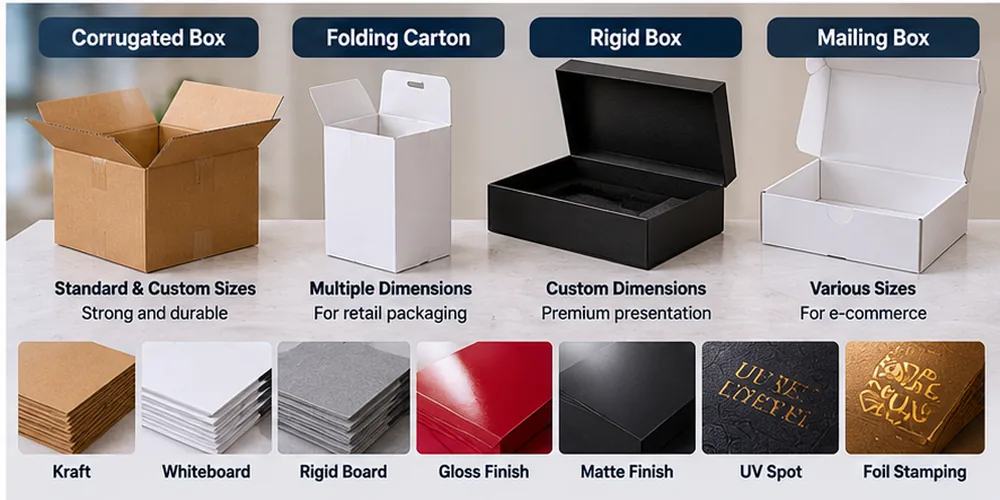
Use L × W × H or L × W × D as defined by the box supplier. Internal dimensions are common for ordering because they relate to usable space. Keep maximum packed external dimensions for carrier and pallet calculations.
For corrugated box design references, FEFCO uses length, breadth, and height terminology. Breadth corresponds to the second base dimension. If a U.S. supplier uses width instead, write the labels so neither party has to translate by assumption.
Folding Cartons
Folding cartons commonly use L × W × H, but panel naming can vary with the carton style. Carton dimensions should be tied to a structural drawing, board caliper, grain direction, closure style, and score allowance. Small dimensional changes can alter tuck-flap engagement, dust-flap overlap, and machine performance.
Rigid Boxes
For setup boxes, specify whether the dimensions describe the base interior, base exterior, lid interior, or closed assembled pack. Lid clearance and paper wrap add thickness. A single unlabeled dimension set cannot fully describe a two-piece rigid box.
Mailer Boxes
Mailer dimensions normally describe the usable interior after the sidewalls, front roll, dust flaps, and locking tabs are folded. The nominal height may not equal the clear height at every point because rolled edges and double layers occupy space.
Tissue Boxes
Tissue cartons show why package orientation matters. A horizontal facial-tissue box and an upright cube carton may hold related products, yet their opening, dispensing panel, and display face differ. The tissue box dimensions guide compares common size ranges and explains how product count, stack height, opening geometry, and board affect the carton.
Pouches and Flexible Packaging
Flexible packages are often listed as width × height plus bottom gusset, side gusset, seal area, or lip. A pouch marked 6 × 9 + 3 in may mean a 6-inch width, 9-inch height, and 3-inch bottom gusset, but suppliers do not all write gussets the same way. Ask for a labeled drawing.
Useful flexible-packaging dimensions can include:
- Finished width and height
- Bottom or side gusset
- Seal width
- Zipper location
- Tear-notch position
- Hang-hole center
- Valve or spout position
- Cutoff length
- Repeat length
Bottles, Jars, and Tubes
Round containers are usually described by diameter and height. Bottles also require neck finish, brimful capacity, overflow capacity, label panel, shoulder profile, and base dimensions. A rectangular bottle may use width × depth × height. State whether caps, pumps, or sprayers are included in the maximum height.
Irregular Packages
For tapered, curved, or asymmetric packaging, a three-number record is often insufficient. Add a drawing, maximum envelope dimensions, critical fit points, radii, angles, and a 3D file when needed. Physical prototypes can confirm grip, closure, display, and equipment clearance. The guide to 3D printing in packaging covers prototype uses and the limits of treating a printed model as production material.
Common Length Width Height Mistakes
1. Writing Three Numbers Without Labels
“10 × 8 × 4” forces the reader to guess the order, unit, and measurement type. Add all three.
2. Assuming the Largest Number Is Always Length
That shortcut works for many carrier parcels and box openings, but not for every product-data record or upright package. Read the convention first.
3. Swapping Axes Because Volume Stays the Same
The cubic result remains equal, but the opening, panels, artwork, and packing process can change. Do not use equal volume as proof that two specifications describe the same box.
4. Mixing Internal and External Dimensions
Internal dimensions guide fit. External and packed external dimensions guide shelf, case, pallet, warehouse, and shipping decisions. Label each set.
5. Measuring an Un-Squared Box
A leaning or partially erected carton can produce diagonal or compressed readings. Square it under the specified condition before inspection.
6. Ignoring Material Thickness
Changing flute, board caliper, wrap, foam, or insert material can change finished fit even when the nominal values appear unchanged.
7. Omitting Units
A 12-inch package and a 12-centimeter package are not close substitutes. Put units in the value or column heading.
8. Rounding Too Early
Keep the controlling value at its required precision through calculations. Round only at the stage defined by the specification or carrier.
9. Using an Old Revision
A revised dieline paired with an old purchase specification can place graphics, windows, or closures incorrectly. Match revision identifiers across all files.
10. Treating Nominal Size as Guaranteed Size
Nominal dimensions need tolerances and an inspection method. Packaging materials respond to humidity, compression, folding, and process variation.
Packaging Dimension Specification Checklist
Before approving a drawing, purchase order, product record, or carrier entry, verify the following:
- The dimension order is written beside the values.
- Length, width, height, depth, breadth, or diameter labels are defined.
- The unit is stated.
- Internal, external, packed external, score-to-score, or blank is identified.
- The package condition is stated.
- The reference face and natural base are clear.
- Material grade and caliper are controlled.
- Tolerances and test method are stated.
- Closures, caps, handles, and projections are addressed.
- Artwork orientation matches the dieline.
- The part number and revision match the purchase order.
- Shipping measurements follow the selected carrier’s current rules.
- A production sample or approved prototype has been checked.
Packaging NextGen treats this checklist as a communication control, not just a measuring exercise. Most dimensional errors begin when a correct number set loses its labels while moving between a drawing, spreadsheet, quote, item master, and shipping system.
Frequently Asked Questions
What Is the Standard Length Width Height Order
For most rectangular box specifications, the standard order is length × width × height, written L × W × H. Length is usually the longer opening dimension, width is the shorter adjacent dimension, and height is perpendicular to the opening. Always confirm the labels because other industries and data standards may use a different order.
Is It Length by Width or Width by Length
For rectangular packaging, it is commonly length by width. For artwork, screens, labels, furniture, and some product listings, width may come first. The abbreviations decide the meaning, so write L × W or W × L rather than leaving two bare numbers.
How Are Dimensions Listed
Dimensions are listed as numeric values separated by a multiplication sign or the word “by,” followed by a unit. A reliable packaging entry also states the order and type, such as 12 × 8 × 4 in, L × W × H, internal.
Which Is Length and Which Is Width
On a typical rectangular box opening, length is the longer edge and width is the shorter adjacent edge. If the object has a designated front or is governed by another data standard, use its labeled drawing instead of assuming the longest horizontal edge is length.
How Do I Read Dimensions Such as 10 × 8 × 4
First find the notation. If the record says L × W × H, read it as 10 units long, 8 units wide, and 4 units high. Then check the unit and whether the dimensions are internal or external. Without those details, the number set is incomplete.
What Does LXWXH Mean
LXWXH means length by width by height. It is a compact form of L × W × H. Uppercase letters and the multiplication sign are easier to read, but catalogs may use lowercase letters or the letter x.
Does Width or Height Come First
In L × W × H, width comes before height. In other formats, the labels may put height elsewhere. Never decide only from the number positions.
Are Depth and Height the Same
They can refer to the same third box dimension when depth means the distance from the opening to the base. In furniture and product listings, depth usually means front to back while height means bottom to top. Define the reference orientation before treating them as equivalent.
Are Breadth and Width the Same
In many packaging specifications, breadth is the same axis that U.S. sources call width. L × B × H is therefore often equivalent to L × W × H, provided the same reference opening and measurement type are used.
Does Length Times Width Times Height Give Volume
Yes, for a rectangular prism. Use the same unit for all three dimensions. The result is a cubic unit, such as cubic inches or cubic centimeters.
Does Length Times Width Give Area
Yes. Length multiplied by width gives the area of a rectangular face or footprint. It does not give three-dimensional capacity until height is included.
Why Does Dimension Order Matter If Multiplication Gives the Same Answer
It matters because a package is a structure, not only a volume. Changing the assigned axes changes the opening, panel layout, loading direction, artwork orientation, and sometimes strength. The numeric volume can stay equal while the box becomes unsuitable.
Should Box Dimensions Be Internal or External
Use internal dimensions for product fit and inserts. Use finished external dimensions for shelves, cases, pallets, and warehouse planning. Use maximum packed external dimensions for carrier calculations. Label the measurement type every time.
How Should Part Number Dimensions Be Written
Connect the part number to a controlled drawing or item record that includes the values, L × W × H order, unit, measurement type, tolerance, material, package condition, and revision. A part number without those definitions can be interpreted differently by suppliers.
Is Height Width Length a Valid Order
It can be valid when a particular form, database, or drawing defines H × W × L. It is not the usual rectangular-box order. Preserve the source labels or map the axes carefully before converting the record.
Final Answer
The usual packaging order is length width height, written L × W × H. Length and width describe the two opening or base directions, and height describes the perpendicular third direction. That short answer works for many rectangular cartons, but it should never replace labeled specifications.
For reliable packaging communication, state the dimension order, units, measurement type, condition, tolerance, part number, and revision. Separate internal product-fit measurements from maximum packed shipping measurements, and do not assume that a GS1 record, furniture listing, envelope chart, dieline, and carrier use the same axes. Packaging NextGen uses that context-first method because clear dimensions prevent errors in structural design, printing, ordering, packing, storage, and freight calculations.