
Shrink wrap turns a loose sheet or tube of film into a close-fitting package by releasing molecular orientation with controlled heat. The visible result is simple, but a reliable pack depends on decisions made before the tunnel starts: resin, thickness, shrink direction, seal range, product geometry, ventilation, artwork and distribution load. Treating the film as a generic clear cover is how teams end up with torn seals, scorched corners, distorted graphics or a package that looks different on every production shift.
This guide explains how shrink film works, where it fits in a packaging system and how to select it for U.S. retail, food, beverage, publishing, personal-care and industrial applications. It also covers printed film, machinery, sizing, testing, common defects and environmental claims.
Shrink wrap is a heat-responsive polymer film placed around a product, sealed where required and exposed to controlled heat. The film contracts in one or both directions and follows the product’s shape. It can provide containment, surface protection, bundling, visibility or an opening indicator, depending on the film, seals and package design.
Key Takeaways
- Polyolefin, polyethylene and PVC films do not behave the same way.
- Shrink wrap and stretch wrap use different materials, forces and equipment.
- Film thickness should be selected from product weight, edges, package role and distribution tests, not appearance alone.
- Printed film needs controlled orientation, repeat length, registration, ink adhesion and proofing after shrinkage.
- Direct-food-contact suitability must be verified for the complete material and intended conditions of use.
- A material’s resin code does not prove that consumers can recycle the finished package in their local system.
- The best settings come from a documented film, machine and product trial.
What Is Shrink Wrap?
Shrink wrap is polymer film manufactured with stored orientation. During film production, the material is stretched in the machine direction, cross direction or both, then cooled so that orientation remains in place. When the film reaches its activation range, its molecular chains move toward a less stretched state. That change causes the material to contract around the package.
The packaging process usually has four stages:
- Place film around or over the product.
- Seal the open film edges when the format requires a closed pack.
- Apply controlled heat with a chamber, tunnel or suitable industrial tool.
- Cool the pack and inspect the film, seals and product.
Heat alone does not create a good result. Film must have space to move, air needs a way to escape and the package must tolerate the selected temperature and airflow. A film that performs well on a square carton may behave differently around a bottle cluster, tray, sharp metal part or soft food.
Shrink Wrap, Shrink Film, Shrink Sleeves and Stretch Wrap
Packaging language often uses these terms loosely, so the first buying step is naming the required system correctly.
| Term | How it becomes tight | Common role | Heat required? |
| Shrink wrap or shrink film | Film contracts after heat exposure | Product overwrap, multipack, bundle or protective cover | Yes |
| Shrink sleeve | Preformed tube contracts around a container or part of it | Printed label or tamper band | Yes |
| Stretch wrap | Film is stretched around a load and held by cling and recovery | Pallet stabilization and load containment | No |
| Cling film | Thin film clings to itself or a surface | Household or food covering | No |
Shrink film is the material; shrink wrapping is the packaging process. A shrink sleeve belongs to the same heat-shrink family but is normally specified as a label or band. Stretch wrap is not a substitute for heat shrink film, even though people sometimes call pallet film “pallet shrink wrap.”
Main Types of Shrink Wrap Film
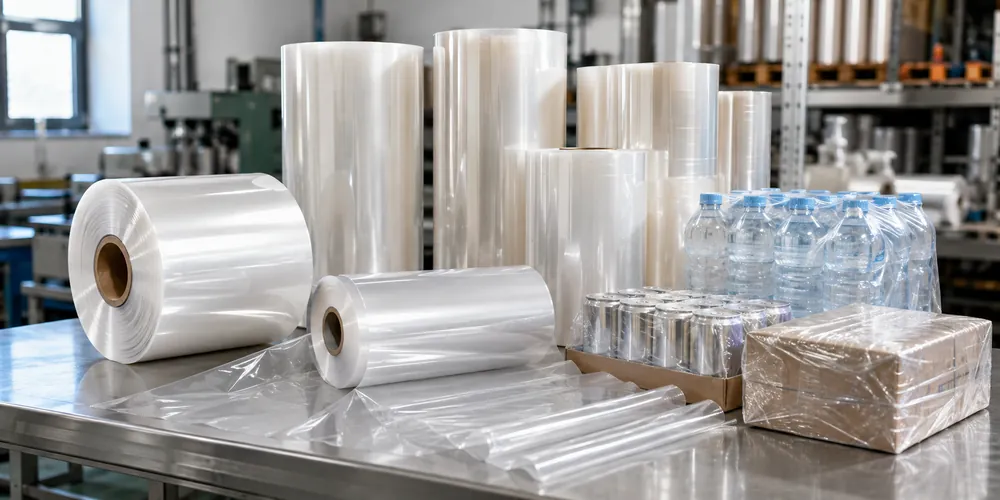
The three names buyers see most often are polyolefin, polyethylene and PVC. Suppliers may offer crosslinked grades, multilayer structures, antifog versions, perforated film, high-slip or low-slip surfaces, UV additives and other options. Compare grade-level data rather than assuming every film within one resin family performs identically.
| Film family | Typical strengths | Common applications | Points to verify |
| Polyolefin, often called POF | Clarity, balanced shrink, seal strength and puncture resistance | Retail cartons, food packs, stationery, toys and mixed product shapes | Shrink force, crosslinking, food-contact status, tunnel range and seal settings |
| Polyethylene, commonly LDPE for shrink use | Toughness, heavier gauges and strong bundling capability | Beverage multipacks, trays, cans and industrial bundles | Lower clarity on some grades, required heat, print treatment, film weight and holding force |
| PVC | High clarity, low activation range and easy processing on some equipment | Lightweight nonfood retail goods, books and selected sleeves | Ventilation, product-contact limits, storage, sealing behavior and local material restrictions |
Polyolefin Shrink Film
POF is widely used where clear presentation, flexible handling and good seal performance matter. Crosslinked grades can provide strong seals at thinner gauges and may tolerate irregular products better than an economy film. Polyolefin is a family name, so the exact layer structure, additives and regulatory status still need to be checked on the supplier’s data and compliance documents.
POF is often selected for printed cartons, games, baked goods, frozen products and multipacks. Film choice should reflect whether it touches food directly, whether the package enters a freezer and whether the product has sharp corners that can concentrate shrink force.
Polyethylene Shrink Film
PE shrink film is common in heavier bundling applications. LDPE-based structures can hold bottles, cans, jars or industrial goods together with or without a corrugated tray. Printed polyethylene also provides a large branding area for beverage and household-product multipacks.
Its production window can differ from thin retail overwrap film. Film thickness, tunnel temperature, airflow, unsupported openings and pack weight all influence the final bundle. A strong film does not fix a weak bottle arrangement or an undersized tray.
The article on Coca-Cola bottle packaging shows how shrink film can sit beside trays, paperboard carriers and corrugated cases in a wider beverage-packaging system.
Pvc Shrink Film
PVC can shrink at a relatively low temperature and deliver a crisp, glossy retail appearance. It has historically been used around books, software boxes, candles, baskets and other light consumer products. It is less suitable for many modern food and material-recovery briefs, and overheated PVC can create process and ventilation concerns.
Do not choose PVC only because a machine already runs it. Review the product-contact requirement, worker controls, customer material policy, destination market and end-of-life route. A change from PVC to POF can also require new temperature, sealing and dwell settings.
Shrink-Sleeve Materials
PETG, OPS, PVC and selected polyolefin structures can be used for shrink-sleeve labels. Sleeve resin selection depends on container material, contour, required shrink percentage, steam or hot-air application, graphics and recovery-system compatibility.
Do not place a shrink-sleeve specification inside an overwrap purchase order without clear drawings. Sleeves carry graphics and follow container curves; product overwraps primarily enclose or group the item. Their prepress, seams and tolerances can be different.
Shrink Film Formats
Centerfold Film
Centerfold film is folded lengthwise on the roll. The product enters between the two layers, and an L-bar or side sealer closes the remaining open edges. It is common for retail products and variable pack sizes.
Single-Wound Film
Single-wound film is one flat web rather than a folded sheet. It is common on automated bundling lines and can be supplied plain or printed. The web width, repeat, unwind direction and tracking marks must match the machine.
Shrink Bags
Preformed bags are sealed on three sides and open on one. They reduce cutting and side-sealing work for products that fit a standard bag size. Bags that are too large can leave dog ears; undersized bags can split or pull hard against corners.
Shrink Tubing
Tubing is a continuous sleeve open at both ends. It suits long products, variable cut lengths, bands and applications where a continuous tube is easier to manage than centerfold film.
Shrink Bands And Full-Body Sleeves
A narrow neck band can show that a closure area has been opened, while a full-body sleeve can carry graphics across most of a bottle or container. The package still needs a defined opening experience, tear feature where required and wording that accurately describes the evidence provided.
The discussion of tamper bands in toothpaste packaging shows why the band, cap, inner seal and carton should be reviewed as one package rather than as unrelated parts.
Common Shrink-Wrap Packaging Uses
Retail Products
Clear film can hold a carton closed, group a set, reduce scuffing and leave the printed package visible. Books, games, stationery, candles, household goods and gift sets are common examples. Heat-sensitive coatings, windows, electronics and waxes need trials before commercial production.
Food Products
Approved grades can be used for direct contact or as an outer layer around a food tray or carton. The real requirement depends on food type, storage temperature, contact time and whether the film is exposed to cooking, reheating or freezing conditions.
Shrink film alone does not guarantee freshness or shelf life. Oxygen transmission, moisture transmission, seal integrity, product respiration, sanitation and cold-chain conditions must be set from product testing. Current material and regulatory developments can be tracked through food packaging news coverage.
Beverage Multipacks
PE film can unitize cans or bottles, sometimes with a tray or pad. Printed graphics can identify flavor, count and promotional information. Engineers should test carrying behavior, unsupported openings, bottle movement, condensation, film creep and pallet compression.
Printed Cartons And Publishing
A clear overwrap can protect print surfaces from abrasion, moisture exposure and casual opening. It should not trap uncured ink, coating odor or residual solvent. Packs need enough venting for clean shrinkage without leaving openings that defeat the intended barrier.
Personal-Care And Health Products
Shrink bands and overwraps may provide visible opening evidence, bundle related items or protect cartons from handling. Product-specific U.S. rules can require particular tamper-resistant features and statements. A generic shrink band should never be assumed to meet every category’s legal requirement.
Industrial Products
Thicker PE film can contain doors, equipment, building materials, boats or pallet-size loads. These applications may need flame-safe work practices, reinforced edges, vents, access points, UV exposure control and trained installers. They should not be treated as scaled-up retail wrapping.
How to Choose the Right Shrink Wrap
Start with a written application brief. Film selection becomes much easier when the supplier knows what the package must do.
1. Define The Package’s Job
Is the film meant to group products, show opening evidence, protect a decorated carton, carry print, block dust or hold a heavy bundle? One film may give high clarity but lack the puncture resistance required for a sharp product.
2. Record The Product Conditions
Document dimensions, weight, shape, edge radius, surface finish and heat sensitivity. Add fill temperature, storage range, freezing, condensation and expected shelf life where relevant.
3. Select The Film Family And Grade
Compare shrink percentage in both directions, shrink force, seal initiation range, hot-slip behavior, haze, gloss, tear, puncture and machinability. Ask for the test method behind each figure.
4. Match The Film To The Equipment
State whether the line uses a chamber machine, L-bar sealer, side sealer, lap sealer, hot-air tunnel or steam tunnel. Include conveyor speed, maximum temperature, sealing jaw type and current film width.
5. Verify Product-Contact Status
For food, cosmetics or other controlled uses, obtain supplier documentation covering the exact grade, additives, inks and intended conditions. “Food safe” written on a marketplace listing is not enough evidence for a commercial specification.
6. Test The Distribution Pack
Inspect the wrapped unit inside its case and on its pallet. Film that survives the tunnel can still fail at a corrugated edge, during case packing or after vibration and compression.
When case dimensions change, use the correct internal and external measurements. The guide on how to measure a box explains the difference between product-fit dimensions and packed shipping dimensions.
Shrink-Wrap Thickness and Gauge
U.S. suppliers often describe thin film in gauge and thicker film in mils. In the common film convention, 100 gauge equals 1 mil, which equals 0.001 inch or 25.4 microns. Confirm the supplier’s stated unit because “gauge” can be used inconsistently across products and markets.
| Nominal gauge | Mil | Approximate microns | Typical starting discussion |
| 45 | 0.45 | 11.4 | Very light retail products using a suitable high-performance grade |
| 60 | 0.60 | 15.2 | Light products and display overwrap |
| 75 | 0.75 | 19.1 | Common retail and general-purpose range |
| 100 | 1.00 | 25.4 | Heavier or sharper retail products and stronger bundles |
| 150 | 1.50 | 38.1 | Heavy product or higher puncture demand |
| 200 | 2.00 | 50.8 | Bundling applications, often in PE |
These are not load ratings. Resin, orientation, crosslinking, seals and package shape can make a thinner grade outperform a thicker film in one test and underperform it in another. Sample at least two candidate gauges and compare material use per accepted pack, not just roll price.
How to Measure for Shrink Film
There is no single sizing formula for every machine and format. Use the equipment and film supplier’s method for the production specification.
For centerfold film around a rectangular product, a common starting estimate is:
Centerfold width ≈ product width + product height + sealing and shrink allowance
For a round product, begin from half the circumference plus the required allowance. Bag length or cut length must also cover the product length, end depth and seal area.
Three rules prevent many sizing errors:
- Measure the largest finished product, including caps, protrusions and normal manufacturing tolerance.
- Leave enough material for seals and movement, but not so much that large corners remain after shrinking.
- Confirm the estimate with the actual film on the actual machine.
How to Shrink Wrap a Product Step by Step
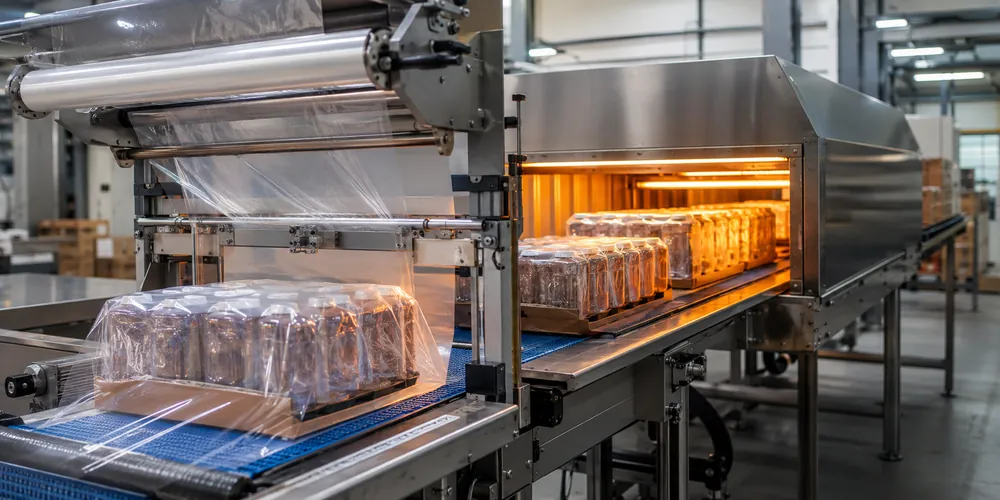
1. Approve The Film And Settings
Verify the film code, width, thickness, orientation and machine recipe. Check that the product can tolerate the planned heat exposure.
2. Place The Product In The Film
Keep the package square to the web and leave even film around the edges. Misalignment can pull a seal into a corner or move printed graphics away from their target position.
3. Make The Seal
Use the approved sealing time, temperature and pressure. The seal should be continuous and strong without brittle edges, melted film or excessive strands.
4. Allow Air To Escape
Use supplier-approved perforation or venting when needed. Trapped air can balloon the pack, while too much venting can stop the film from lifting and shrinking evenly.
5. Apply Controlled Heat
Run the package through the approved chamber or tunnel recipe. With a suitable industrial heat gun, keep the tool moving and follow the equipment and film safety instructions. Concentrated heat can burn film or damage the product.
6. Cool Before Handling
Film and seals continue to settle as the pack exits the heat zone. Allow enough cooling before stacking, case packing or evaluating the final appearance.
7. Inspect And Record
Check film tightness, corner shape, seal integrity, holes, clarity, graphics, barcode scans and product deformation. Record the film batch, machine, speed and settings so the result can be repeated.
Shrink-Wrap Equipment by Production Level
| Equipment | Best fit | Main limitation |
| Impulse or I-bar sealer with industrial heat gun | Samples and low-volume work | Operator variation and slower output |
| Chamber shrink machine | Small products and moderate batches | Chamber size and cycle-time limits |
| L-bar sealer with shrink tunnel | Retail packs and medium production | Needs film, seal and tunnel setup control |
| Automatic side sealer with tunnel | High-volume, variable-length products | Higher investment and tighter web-control needs |
| Bundling sealer and heavy-duty tunnel | Bottles, cans, trays and industrial multipacks | Larger footprint, energy use and film-load engineering |
| Steam tunnel | High-shrink sleeve labels and complex containers | Moisture, utilities and sleeve-specific process control |
Do not compare machines on packages per minute alone. Changeover time, reject rate, film threading, tunnel recovery, maintenance access, compressed air, electrical load and operator training affect the cost of accepted packages.
Printing on Shrink Film
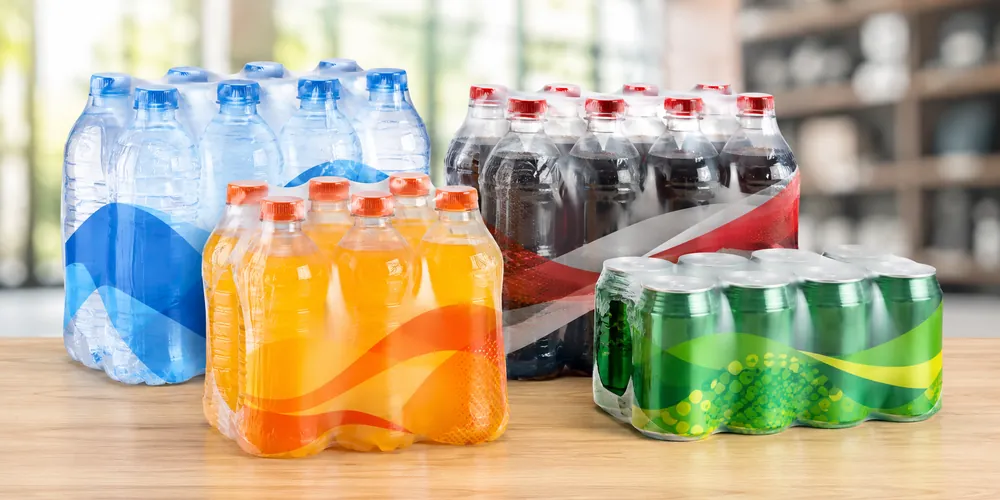
Printed shrink film can turn a clear bundle into a branded sales unit, but artwork cannot be prepared like a flat paper label. The web changes dimensions under heat, and the amount of change may differ by direction and location around the package.
Common Print Routes
Flexographic printing is widely used for PE bundling film and other roll-fed packaging. It supports high-speed repeat production and spot or process colors. Plate, anilox, ink and film treatment need to be set for the job.
Rotogravure printing can provide fine image reproduction for long runs. Cylinder cost and lead time make it more suitable where volume and repeat stability justify the setup.
Digital printing can suit prototypes, versioned graphics and shorter runs where a qualified film and ink system is available. Maximum web width, color gamut, white ink, finishing and heat response need confirmation.
Surface printing places ink on the outside of the film and may require a protective coating. Reverse printing places ink behind a clear film layer, which can protect graphics from scuffing when the structure and viewing direction allow it.
Prepress Requirements
The artwork file should identify:
- Web width and film thickness
- Machine and cross directions
- Print repeat and cut length
- Unwind direction
- Eye-mark size and position
- Seal, overlap and no-print zones
- Perforation or vent locations
- White ink, spot colors and coatings
- Barcode orientation and quiet zones
- Approved distortion map for sleeves or highly shaped packs
A package layout should be based on the converter’s current drawing. The explanation of what a dieline is in packaging covers bleed, safe areas, technical layers and proofing principles that also apply to shrink-film artwork.
Distortion And Graphic Placement
Artwork can narrow, stretch visually or curve after the film conforms to the package. Full-body sleeves often need a distortion grid created from container geometry and physical trials. Printed multipack film may require compensation around bottle shoulders, unsupported openings and end seals.
Keep small text and machine-readable codes away from high-distortion areas, folds, seams and deep contours. Scan codes on a filled, shrunk and cooled package rather than only on the flat proof.
Color And Ink Adhesion
Color on clear film is affected by the product behind it. White ink may be needed beneath brand colors, but its opacity and trapping can change the final tone. Test ink adhesion after corona treatment, printing, shrinking, cooling, rubbing, condensation and distribution.
For food packaging, inks, coatings and residual solvents must be reviewed as part of the intended structure and print position. Low odor is not proof of regulatory suitability or low migration.
Food-Contact and Labeling Checks in the United States
The U.S. Food and Drug Administration explains that the regulatory standing of a food-contact material depends on the substances that make up the article and their intended use. Food type, contact time and temperature can change the applicable condition.
Instead of asking whether a resin name is “FDA approved,” request:
- Exact film grade and manufacturer
- Compliance statement for the intended food and use conditions
- Resin, additive and processing-aid coverage
- Ink, coating and adhesive status where relevant
- Temperature and time limitations
- Statements for direct or indirect contact
- Change-notification process
The FDA’s page on determining the regulatory status of food-contact material components explains why each substance reasonably expected to migrate must have an applicable regulatory basis.
Quality Tests for Shrink Film and Finished Packs
Supplier data starts the selection process; finished-pack testing confirms whether the complete system works.
Film-Level Checks
- Thickness and profile across the web
- Free shrink in machine and cross directions
- Shrink tension or force
- Tensile and elongation
- Tear and puncture behavior
- Coefficient of friction
- Haze, gloss and clarity
- Surface treatment and ink adhesion
- Seal strength and seal window
ASTM D2732 covers unrestrained linear thermal shrinkage of plastic film at specified temperatures. Related methods may be used for tensile, tear, friction, impact and shrink-tension measurements. State the edition, conditioning, specimen direction and test temperature when comparing results.
Finished-Pack Checks
- Seal continuity and opening force
- Holes, splits and exposed corners
- Pack dimensions after cooling
- Product distortion or heat damage
- Graphic registration and color
- Barcode and date-code scanning
- Condensation and freezer performance where relevant
- Drop, vibration and compression suited to the route
- Case packing, pallet stacking and retail handling
Do not approve a film from a single attractive sample. Run enough packages to capture normal variation in product size, film roll, operator, line speed and tunnel recovery.
Common Shrink-Wrap Problems and Fixes
| Defect | Likely causes | First checks |
| Dog ears at corners | Bag too large, insufficient heat or dwell, poor airflow | Confirm film size, tunnel recipe and corner exposure |
| Crow’s feet or wrinkles | Low heat, short dwell, uneven airflow or excess film | Check settings, vents, film fit and product alignment |
| Ballooning | Trapped air or insufficient perforation | Review vent pattern and seal timing |
| Film stays loose | Wrong film, low heat, fast conveyor or poor circulation | Confirm film code, activation range, speed and airflow |
| Burn holes | Excess heat, long dwell or concentrated hot air | Reduce exposure and inspect heaters and airflow |
| Angel hair at seal | Seal wire, temperature, dwell or residue problem | Clean and inspect sealing parts; reset approved recipe |
| Weak or open seal | Contamination, low energy, wrinkles or incompatible film | Inspect seal area, jaw condition, pressure and film grade |
| Split at corners | Film too tight, sharp edges, high shrink force or low thickness | Add edge protection, review size, force and gauge |
| Cloudy or scorched film | Excess heat, unsuitable grade or poor tunnel balance | Verify temperature with the film data and inspect circulation |
| Distorted graphics | Wrong orientation, repeat, distortion file or line setup | Check web direction, approved artwork and final pack position |
Change one controlled variable at a time. If temperature, conveyor speed and airflow are changed together, the team cannot tell which adjustment solved the problem or created the next one.
Shrink-Wrap Cost Should Be Measured Per Accepted Pack
Roll price is only one part of cost. A fair comparison includes:
- Film weight per package
- Scrap during setup and changeover
- Rejected packs
- Labor and line speed
- Energy used by sealers and tunnels
- Printed-film plates or cylinders
- Downtime and maintenance
- Secondary packaging removed or added
- Damage and returns in distribution
- Storage space for film and finished packs
A thinner film can lower material weight but raise punctures or rejects. A more expensive grade can reduce gauge, improve speed or remove a tray. The winning option is the lowest verified system cost that meets product, production and distribution requirements.
Environmental and Recycling Claims
Material reduction can lower film use, but “less plastic” does not establish the full environmental result. Product damage, energy, recycled content, transport, collection access and actual reprocessing all matter.
In the United States, many flexible films are not accepted in curbside programs. Some clean, dry PE films may qualify for a store drop-off route, but acceptance depends on the package and program.
The FTC Green Guides are designed to help marketers avoid misleading environmental statements. Packaging teams should qualify claims, keep evidence for recycled content and verify collection access before using broad “recyclable” language.
Possible reduction routes include downgauging after testing, right-sizing film, reducing setup scrap, using verified recycled content where permitted, removing unnecessary components and comparing film against other packaging systems. Fiber protection such as processed molded pulp packaging may suit some products, but it is not a direct replacement for every clear overwrap or heavy bundle.
Shrink Wrap Selection Matrix
| Packaging need | Starting film discussion | Production priority |
| Clear light retail overwrap | POF or a qualified PVC grade | Clarity, seal range and product heat tolerance |
| Direct-food-contact retail pack | Documented food-contact grade, often POF or a specified PE structure | Intended-use compliance, seal integrity and shelf-life test |
| Bottle or can multipack | PE shrink film | Holding force, puncture, carrying and print registration |
| Irregular product | Crosslinked POF or another grade tested for the shape | Shrink force, corners and complete coverage |
| Printed promotional bundle | Treated and print-qualified PE or POF structure | Repeat, ink adhesion, white ink and scuffing |
| Bottle label | Qualified shrink-sleeve structure | Distortion, seam, application method and container recovery route |
| Industrial cover | Heavy PE shrink film | Installation safety, weather exposure, vents and edge protection |
This matrix starts a supplier discussion; it does not replace a material data review and line trial.
Procurement Checklist
Before approving a shrink-wrap order, confirm:
- Product drawing, weight and tolerance
- Package role and required service life
- Film resin, grade, layer structure and thickness
- Width, format, roll length, core and unwind
- Machine and cross-direction shrink data
- Shrink force and temperature window
- Seal range and required seal strength
- Equipment, speed, dwell and airflow range
- Food-contact or other compliance documents
- Print process, colors, repeat and eye marks
- Vent or perforation pattern
- Finished-pack acceptance limits
- Distribution and storage test plan
- Environmental-claim evidence
- Retained approved sample and change-control process
Final Guidance
Shrink wrap performs well when film, equipment, product and distribution pack are specified together. Begin with the job the film must do, compare grade-level data, verify product-contact conditions, test the real package and record the approved settings. For printed film, protect technical zones, compensate for shrinkage and approve graphics only after the package has been filled, shrunk and cooled.
Packaging NextGen recommends keeping the film code, artwork version, machine recipe, test results and signed sample in one controlled specification. That record turns a successful trial into a repeatable production standard.
Frequently Asked Questions
What Is Shrink Wrap Made Of?
Most commercial shrink wrap is made from polyolefin, polyethylene or PVC-based film. Shrink sleeves may also use PETG, OPS and other structures. The right material depends on the product, heat process, required strength, printing, contact conditions and recovery route.
How Does Shrink Wrap Work?
The film is oriented during manufacturing and set by cooling. Controlled heat later releases part of that orientation, causing the film to contract around the product. Sealing, ventilation, airflow and cooling determine whether the final pack is tight and even.
What Is The Difference Between Shrink Wrap And Stretch Wrap?
Shrink wrap contracts after heat is applied. Stretch wrap is pulled around a load and holds through cling and elastic recovery. Shrink film commonly encloses products or bundles; stretch film commonly stabilizes pallet loads.
What Temperature Does Shrink Wrap Need?
There is no universal temperature. The correct setting depends on film grade, thickness, tunnel design, airflow, conveyor speed and product. Use the supplier’s data as a starting range and approve a documented production recipe from trials.
Can I Use A Heat Gun For Shrink Wrap?
An industrial heat gun can suit samples and low-volume work when the film, product and work area are appropriate. Keep the tool moving, follow safety instructions and avoid concentrated heat. A tunnel usually gives more repeatable results at production volume.
Does Shrink Wrap Need A Heat Sealer?
Many overwrap formats need a sealer before shrinking. Preformed sleeves and some bands can shrink without a separate closing seal, while bags generally need their open end sealed. The required equipment depends on film format and package design.
Is Shrink Wrap Food Safe?
Some grades are suitable for specified food-contact uses, but the resin name alone is not proof. Verify the exact film, additives, inks and intended contact time and temperature through supplier documentation and applicable FDA authorization.
Is Shrink Wrap Waterproof?
Not automatically. Film can resist liquid water, but seals, vents, holes, seams and open ends may allow entry. Validate the finished package against its expected storage and distribution exposure before making a moisture-protection claim.
Is Shrink Wrap Recyclable?
It depends on resin, inks, labels, adhesives, local collection and end-market acceptance. Most flexible film is not accepted curbside in the United States. Some qualified clean, dry PE film may carry store drop-off instructions. Follow current package-specific guidance.
Can Shrink Wrap Be Printed?
Yes. Flexographic, rotogravure and qualified digital systems can print shrink film. Artwork must account for web direction, repeat, seals, vents, shrink distortion, white ink, registration, scuffing and barcode performance on the final pack.
How Thick Should Shrink Film Be?
Choose thickness from product weight, edges, package role, shrink force, seals and distribution tests. Common retail films may begin around 45 to 100 gauge, while bundling film can be much thicker. A supplier trial is more reliable than a generic weight chart.