
Food packaging news becomes important at the exact moment a familiar pack stops meeting the job: a grease barrier loses regulatory acceptance, a recycled resin needs new evidence, or a code that looked clear on screen fails at checkout. The useful question is rarely “what launched?” It is “can this material protect my food, run on my line, carry compliant print and enter the recovery system claimed on the label?” Packaging NextGen follows those connections so food brands can judge news by its effect on the finished pack rather than by the excitement of an announcement.
Food Packaging News In 2026
Three subjects define the 2026 conversation. First, food-contact chemical controls are getting stricter, led by the EU Packaging and Packaging Waste Regulation’s PFAS limits that apply from August 12, 2026. Second, brands are trying to simplify structures through mono-material films, fiber formats and food-grade recycled content without losing oxygen, moisture, grease or seal performance. Third, printing is becoming more data-rich as 2D barcodes, variable codes and connected packaging move closer to retail adoption.
The right response is not a rapid material swap. A change should move through food-contact review, migration evidence, line trials, shelf-life work, distribution tests, artwork control and recovery-claim checks. Packaging NextGen recommends keeping those approvals linked to one packaging specification for each stock-keeping unit.
Why Food Packaging News Matters To Brand Owners
Food packaging performs several jobs at once. It contains the product, limits contamination, controls moisture and gases, survives filling and distribution, communicates required information and helps shoppers use the food correctly. A change that improves one job can weaken another.
A lighter film may use less material but puncture more easily. A paper-based format may reduce plastic weight but require a barrier layer. A larger window may improve product visibility but expose light-sensitive food. A compostable item may need an industrial system that is not available where the consumer lives. A new ink may meet a supplier’s compositional criteria while the finished pack still requires migration testing for its intended food, temperature and storage time.
This is why food packaging industry news should be read as input to a controlled development process, not as proof that a new pack is ready for market.
The 2026 EU Phase Limits Change Food-Contact Packaging Decisions
The EU Packaging and Packaging Waste Regulation, Regulation (EU) 2025/40, entered into force in 2025 and became generally applicable on August 12, 2026. From that date, food-contact packaging cannot be placed on the EU market when PFAS concentrations meet or exceed the stated limits:
| PPWR threshold | Limit stated in Article 5(5) |
| Any PFAS measured through targeted analysis | 25 ppb |
| Sum of PFAS measured through targeted analysis | 250 ppb |
| PFAS including polymeric PFAS | 50 ppm |
The rule includes details on measurement, precursor treatment, total fluorine and technical documentation. A simplified marketing statement is not enough for a release decision. Teams selling into the EU should read the official PPWR text and obtain qualified regulatory guidance for their exact package.
Food Packs That Need Close Review
PFAS have been associated with grease, oil and water resistance, which makes the change relevant to items such as:
- fast-food wrappers;
- bakery bags and papers;
- pizza boxes and liners;
- microwave popcorn bags;
- molded-fiber bowls and trays;
- takeaway cartons;
- pet-food bags;
- coated paperboard for oily foods.
The base material does not answer the compliance question. Paper, board and molded fiber may contain coatings, processing aids, recycled inputs, inks, adhesives or contamination that require review. The same caution applies to a plastic or multilayer format.
A Practical Pfas Documentation File
For each affected package, retain:
- the exact material and supplier code;
- a bill of materials for every layer and component;
- food-contact declarations and intended-use conditions;
- restricted-substance and non-use statements where relevant;
- analytical reports required for the decision;
- ink, coating and adhesive declarations;
- artwork and specification revision numbers;
- approval date, approver and market scope.
Do not reuse one declaration across different grammages, coating systems or suppliers unless the issuer explicitly covers them.
The U.S. Pfas Position Is Different From The Eu Rule
In February 2024, the U.S. Food and Drug Administration announced that manufacturers were no longer selling PFAS-containing grease-proofing substances for food-contact use in the U.S. In January 2025, the FDA determined that 35 related Food Contact Notifications were no longer effective because those uses had been abandoned. The agency gave a June 30, 2025 compliance date for specified existing paper-packaging stock.

This U.S. route is not the same legal mechanism as the EU’s numerical PPWR limits. A multinational brand should not use one region’s statement as automatic proof for another market. The FDA’s notice on the 35 Food Contact Notifications gives the regulatory history and scope.
For buyers, the operating lesson is simple: request current documentation for the exact supplied article. “PFAS-free” should have an agreed meaning, a defined test or supplier basis and an approved claim review. It should not be inferred from a brown color, natural texture or paper label.
Mono-Material Flexible Packaging Is Moving From Concept Toward Production
Flexible food packs often combine layers because one polymer rarely delivers every property required for sealing, stiffness, toughness, print, oxygen barrier and moisture barrier. That performance comes with a recovery problem: structures made from unlike materials can be difficult to sort and recycle in existing systems.
This is driving interest in polyethylene-rich and polypropylene-rich designs that keep most of the pack within one polymer family. 2026 supplier announcements include high-barrier mono-PP pouches and food-contact post-consumer recycled PP films. These developments are relevant, but the words “mono-material” and “recyclable” do not remove the need for evidence.
Questions To Ask About A Mono-Material Pouch
- What percentage of the total pack is the main polymer?
- Which inks, primers, adhesives and barrier coatings remain?
- Does the structure meet the target recycling guideline in the sale market?
- Has it been tested on the intended filling and sealing equipment?
- What are the measured oxygen and water-vapor transmission rates?
- Does the seal survive grease, powder, product particles or retort conditions?
- What shelf-life study supports the change?
- Can the supplier maintain the same structure at commercial volume?
A technically simpler structure may still fail if its barrier is too low, its seal window is narrow or local facilities do not accept it. Claims should describe the conditions rather than implying universal acceptance.
Recycled Plastic In Food Contact Needs More Than A Recycled-Content Percentage
Food-grade recycled plastic attracts attention because it may reduce demand for virgin resin and help brands meet recycled-content goals. Yet direct food contact raises questions about feedstock history, contamination, cleaning efficiency and intended use.
The FDA asks manufacturers seeking its review of recycled plastic for food-contact applications to describe the recycling process, source controls and methods used to remove possible incidental contaminants. Where source material cannot be tightly controlled, surrogate-contaminant testing may be used to show cleaning efficiency. The FDA’s guidance on recycled plastics in food packaging explains the information it expects.
Packaging buyers should therefore request more than a certificate stating “30% PCR.” Useful records include:
- polymer type and recycled-content calculation;
- post-consumer or post-industrial source;
- collection and sorting route;
- decontamination process;
- food-contact opinion, authorization or applicable basis;
- intended food types and use conditions;
- lot traceability and change control;
- color, odor and mechanical-property limits.
Recycled resin can vary more visibly than virgin material. Agree on color and black-speck tolerances before production, notably for clear or natural-colored packs.
Fiber-Based Food Packaging Is Growing, But Barrier Design Decides Performance
Paperboard, corrugated board and molded fiber remain central to takeaway food, frozen foods, dry foods, produce, bakery products and secondary packaging. The current shift is not simply from plastic to paper. It is toward fiber structures that use less hard-to-separate material while still resisting grease, moisture and heat.
Paper and fiber packaging may use dispersion coatings, extrusion coatings, wax alternatives, laminations or internal sizing. Each route affects forming, sealing, printing, repulpability and food-contact review. A barrier that performs well against grease may respond differently to hot liquid, steam, freezer condensation or microwave heating.
Readers comparing fiber insert formats can review this guide to processed molded pulp packaging. For carton-stock comparisons, this explanation of paperboard grades for packaging covers SBS, FBB, recycled board and kraft-based choices. Material names are only the starting point; food-contact status and barrier construction must be confirmed for the final use.
What To Test On A Fiber Food Pack
- Grease resistance over the intended contact time
- Liquid holdout and edge wicking
- Stiffness after hot filling, refrigeration or freezing
- Heat-seal or closure strength
- Odor and taste transfer
- Scuffing and ink rub
- Nesting and denesting on the packing line
- Lid fit and leak resistance
- Compression during stacking
- Repulpability or recycling evidence for the complete structure
Packaging NextGen would not approve a fiber conversion from a flat material sample alone. A formed, filled and conditioned package gives much stronger information.
Food Packaging Printing Is Becoming A Safety And Data-Control Issue
Graphics sell food, but print chemistry and production conditions also affect compliance. Ink printed on the outside can reach the food-contact side through set-off in a roll or stack, migration through a substrate, vapor transfer or poor curing. Risk depends on the ink system, coverage, substrate, barrier, pack geometry, food type, storage time and temperature.
Low-Migration Ink Does Not Make The Finished Pack Automatically Compliant
“Low migration” describes an ink system and intended production controls; it is not a universal certificate for every package. The printer still needs to follow the ink maker’s conditions, use suitable substrates and coatings, control curing or drying, prevent unintended set-off and maintain good manufacturing practice.
Food brands should ask printers for:
- ink-series and coating declarations;
- intended food-contact position;
- exclusion or restricted-substance statements;
- press and curing controls;
- cleaning and changeover procedures;
- set-off prevention during reels and stacks;
- migration testing responsibility;
- records for each production batch.
A late artwork change can alter ink coverage or place heavy print near an unsealed edge. The compliance review should therefore match the released artwork, not an earlier concept.
High-Temperature Packaging Needs Use-Condition Evidence
Ink and coating suppliers are promoting systems for food packs exposed to baking, reheating and other high-temperature conditions. Supplier temperature claims should be read with their test method, duration, substrate and food-contact position. A system tested at a stated peak temperature does not automatically cover every oven profile, microwave condition or direct-contact application.
Run a pack-specific review for:
- maximum and average temperature;
- heating duration;
- conventional oven or microwave use;
- direct, indirect or no food contact;
- fat and moisture content of the food;
- deformation, odor and color change;
- migration and organoleptic results.
Digital Printing Helps Versioning, But Process Selection Still Matters
Digital printing can reduce plates, shorten setup and make several language, flavor or promotional versions easier to manage. Flexography, gravure and offset remain strong choices for many repeated, high-volume food-packaging jobs. The right route depends on run length, material, colors, coverage, change frequency and compliance controls.
| Print process | Common food-packaging fit | Main checks |
| Flexography | Flexible film, labels, paper bags, cartons and corrugated cases | Plate gain, anilox choice, drying, registration and ink/substrate fit |
| Gravure | Long flexible-packaging runs and detailed graphics | Cylinder cost, forecast stability, solvent controls and version risk |
| Offset lithography | Folding cartons, sleeves and labels | Coating, drying, set-off, board surface and indirect-contact review |
| Digital inkjet or toner | Shorter campaigns, prototypes, multiple SKUs and variable print | Ink approval, curing, color consistency, rub, heat and run economics |
Digital does not mean the file can bypass prepress. Bleed, trapping, small text, barcodes, white layers, varnish masks and cutting tolerances still need checks. Start with a controlled food-packaging dieline that clearly marks cuts, folds, seals, glue zones, safe areas and code positions.
Gs1 2d Barcodes are Changing The Food-Label Layout
The retail industry has set an ambition for point-of-sale systems to read a defined group of GS1-standard 2D barcodes alongside traditional linear codes by the end of 2027. This is a readiness target, not a claim that the UPC disappears on one universal date. Adoption varies by retailer, country and equipment.
A QR Code using GS1 Digital Link can connect a product identifier with online information such as ingredients, allergens, nutrition, origin, recipes, storage directions or recall status. GS1 DataMatrix can carry identifiers and attributes such as batch or expiry information in a compact area. GS1 explains the supported data carriers in its guide to 2D barcodes.
Packaging Implications Of The 2d Transition
- Artwork systems need controlled GTIN, lot and date data.
- Code placement must avoid folds, seams, curves and metallic glare.
- Digital links need an owner, stable domain and update policy.
- Existing consumer QR codes may need a migration plan.
- POS and smartphone use cases should be defined separately.
- Every production route needs barcode verification, not only visual approval.
- Dynamic data requires line-level printing and inspection controls.
GS1 states that retail aims for POS systems to process specified 2D barcodes in addition to existing linear barcodes by the end of 2027. Its Ambition 2027 explanation also notes that transition timelines will differ.
For designers, the key challenge is quiet space. A small code may occupy less panel area, but surrounding graphics, varnish, curvature, print growth and resolution can reduce readability. Verify the code on the final substrate after forming and filling.
Connected Packaging Can Improve Traceability Without Overcrowding The Label
Food labels carry dense information: product name, net contents, nutrition, ingredients, allergens, preparation, storage, responsible business details, date codes, certifications, recycling directions and promotional copy. Digital links can give consumers more detail without forcing every item onto a small panel.
They should not be used to hide information that law requires on the physical label. Nor should a brand assume every consumer has a compatible phone, internet connection or willingness to scan. The physical and digital information architecture should be planned together.
A stable connected-packaging program needs:
- One approved source for product data.
- Defined ownership for every landing page.
- Market and language routing.
- Privacy review for analytics.
- Link monitoring and redirect control.
- A recall and correction process.
- A plan for the code after a campaign ends.
Variable data also creates production risk. A missing digit or repeated serial code can affect traceability even when the graphics look correct. Camera inspection and reconciliation should be part of the line plan.
Packaging Design Must Protect Shelf Life Before Making A Sustainability Claim
The environmental value of a food package cannot be judged by material weight alone. When a package extends usable shelf life, prevents leakage or reduces breakage, it may avoid the impacts tied to wasted food. On the other hand, excess material, poor empty-space design or a pack that cannot enter a real recovery system should still be challenged.
The design brief should rank requirements in this order:
- Food safety and legal compliance.
- Product protection and shelf life.
- Filling, sealing and distribution performance.
- Consumer opening, dosing and storage.
- Material efficiency and end-of-life route.
- Printing, branding and cost.
These areas interact, so the sequence is not permission to ignore later items. It prevents a visual or environmental claim from overriding a safety-critical requirement.
Barrier Measures That Matter
Oxygen transmission can affect oxidation, flavor, color and nutrient stability. Water-vapor transmission can affect crispness, caking, dehydration or moisture gain. Light can affect oils, dairy products, beverages and sensitive ingredients. Seal integrity can decide whether any stated barrier survives distribution.
Do not compare supplier data unless test temperature, relative humidity, material thickness and method are aligned. A very low transmission rate in one laboratory condition may not predict performance in a warm, humid supply chain.
Packaging Format Should Match The Food And Distribution Route
| Format | Often used for | Buyer checks |
| Flexible pouch or flow wrap | Snacks, frozen food, coffee, dry mixes and prepared foods | Barrier, seal contamination, puncture, opening and recycling route |
| Folding carton | Cereal, frozen food, bakery, tea, dry goods and multipacks | Board grade, coating, glue, rub, window and inner-pack relationship |
| Corrugated case | Produce, beverages, bulk food and secondary transport | Compression, moisture, ventilation, pallet pattern and direct-print quality |
| Molded fiber | Trays, bowls, cup carriers, produce and protective inserts | Grease/liquid barrier, nesting, forming variation and recovery route |
| Rigid plastic | Dairy, sauces, ready meals and deli foods | Resin, closure, heat, impact, recycled content and label compatibility |
| Metal can or tray | Shelf-stable food, beverages and heat processing | Lining, seam, corrosion, retort conditions and decoration |
| Glass bottle or jar | Sauces, preserves, beverages and premium foods | Breakage, closure torque, light, label adhesive and transport weight |
Food type alone does not decide the format. Hot fill, retort, modified atmosphere, high-pressure processing, freezing, refrigeration and ambient distribution create very different demands.
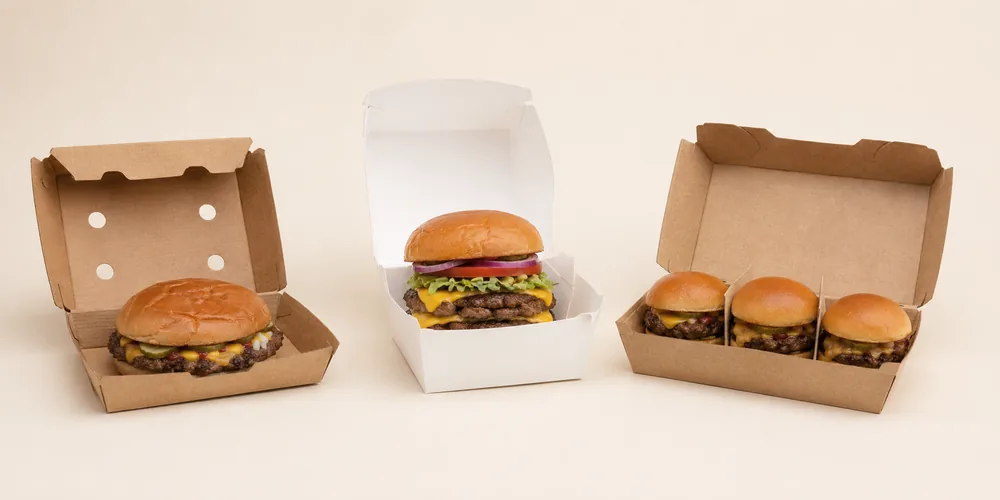
Food-service readers can also review 20 burger types and their packaging needs to see how grease, steam, stacking and portion format change the box or wrap brief.
How To Test A Food Package Before Launch
A sensible validation plan starts with the failure that must be prevented. Laboratory work, production trials and distribution tests then provide different kinds of evidence.
Material And Chemical Review
Confirm food-contact status, intended conditions, composition disclosures, migration basis, restricted substances and market-specific declarations. Review inks, coatings, adhesives, labels and closures—not only the main web or board.
Filling-Line Trial
Run the package at realistic speed. Record web tracking, sealing temperature, dwell time, pressure, rejects, code quality, dust, static, forming and changeover behavior. A sample made by hand may not predict production.
Seal And Leak Testing
Choose methods that match the format, such as burst, creep, vacuum decay, dye penetration, peel strength or torque. Define acceptance limits before testing.
Shelf-Life Study
Evaluate the real food in the real pack. Monitor relevant measures such as sensory quality, microbial safety, moisture, oxidation, weight loss, color, texture, seal performance and pack appearance.
Distribution Work
Review vibration, drops, compression, pallet stability, temperature cycling and handling. For e-commerce, include the final parcel and any refrigerant or insulation system.
Consumer-Use Checks
Test opening force, tear control, reclosure, pouring, portioning, instructions and disposal communication. Include users with different hand strength and vision when the product audience requires it.
Physical dimensions should be recorded consistently throughout development. This guide explains how to measure a box and when internal versus packed external measurements should be used.
How To Judge Packaging Supplier Announcements
Supplier news can reveal useful technology, but claims need context. Use this quick filter before putting a launch into a food-packaging specification:
| Announcement wording | What it may mean | What to request |
| “Recyclable” | Designed for or tested against a named stream | Protocol, market, score and full structure |
| “Food grade” | Intended for stated food-contact conditions | Declaration, authorization basis and limits |
| “Bio-based” | Some feedstock comes from renewable sources | Percentage, calculation method and certification |
| “Compostable” | Meets a named standard in stated conditions | Certification, thickness, facility route and labeling rules |
| “Mono-material” | Most layers use one polymer family | Total composition and recycling-guideline result |
| “High barrier” | Low transmission under a particular test | OTR/WVTR values, thickness and test conditions |
| “Commercial scale” | Production is available beyond a laboratory trial | Capacity, lead time, locations and approved customers |
| “Low migration” | Ink is designed for controlled food-packaging use | Ink declaration, GMP requirements and pack testing |
A supplier claim may be accurate within its stated test. The error occurs when a buyer extends it to another thickness, food, temperature, print coverage or country without confirmation.
A 12-Point Food Packaging Buyer Checklist
Packaging NextGen recommends using the following checklist before approving a material, print or artwork change reported in food packaging news:
- Define the food, contact type, storage time and temperature.
- List every country where the finished product will be sold.
- Record the full packaging bill of materials.
- Obtain food-contact and restricted-substance documentation.
- Confirm barrier targets and test conditions.
- Run material on the intended forming, filling and sealing equipment.
- Test migration or obtain the required basis for the final structure.
- Complete shelf-life and distribution work.
- Verify artwork, required label copy, barcodes and date codes.
- Substantiate environmental and recycled-content claims.
- Approve a physical production sample.
- Set change-control rules for suppliers, specifications and artwork.
Digital mockups can help teams review panel hierarchy and code placement before a sample is made. This Pacdora packaging mockup review explains why a 3D preview is useful for communication but cannot replace production approval.
What Food Packaging Updates Should Be Watched Next?
Pfas Implementation And Testing Guidance
Brands selling in Europe should watch official clarification of sampling, analytical methods, documentation and enforcement. Supplier non-use statements and analytical results may serve different purposes.
Recyclability Assessment Methods
Design-for-recycling criteria will increasingly affect material selection, declarations and artwork. Teams need the rule and assessment method for the market, not a global recycling icon added by habit.
Food-Grade Pcr Availability
New commercial grades may expand options for rigid and flexible packs. Supply consistency, color, odor, decontamination and direct-contact evidence will remain central.
Barrier Coatings For Paper And Fiber
Converters will continue testing water-based and other barrier routes intended to reduce difficult laminations. Heat seal, grease holdout, moisture response and repulpability need to be studied together.
2d Barcode Trials
Brands should use 2026 and 2027 to test code choice, data ownership, printing, verification and retailer readiness. Artwork space should not be removed until both current and future scan needs are understood.
State And National Packaging Rules
Extended producer responsibility, plastic reduction, labeling and single-use restrictions differ across jurisdictions. California retailers can use this 2026 plastic bag ban packaging guide for a focused example of how law changes paper-bag specifications and printing.
How This Page Should Be Updated
A food packaging news page loses value when it keeps an old date without new reporting. Use this schedule:
- Monthly: review major food-contact, material, printing and brand-packaging announcements.
- Quarterly: replace or expand the lead summary and add dated regulatory updates.
- Twice yearly: review material comparisons, barcode progress and supplier-check questions.
- Annually: update the title year, FAQs and editorial notes while retaining the URL.
When adding an item, include its event date, source type and buyer implication. Remove outdated promotional details and preserve important regulatory history in a dated change log.
Frequently Asked Questions
What are The Biggest Food Packaging Trends In 2026?
The leading themes are PFAS limits and food-contact documentation, mono-material flexible packs, food-grade recycled resin, fiber barriers, low-migration print systems, 2D barcodes and stronger proof behind recycling claims. Their importance differs by food, market and processing method.
What Changed For Food-Contact Packaging In The Eu In August 2026?
The PPWR became generally applicable on August 12, 2026, and its Article 5 PFAS limits apply to food-contact packaging placed on the EU market. The regulation states targeted and total concentration limits and requires supporting technical documentation. Businesses should verify the official text for their products.
Is Pfas Banned In All U.S. Food Packaging?
That wording is too broad. The FDA reported the end of U.S. sales of PFAS-containing grease-proofing substances for paper food packaging and later determined that 35 related notifications were no longer effective. Other federal and state rules may address different PFAS uses, so the exact material and jurisdiction matter.
Is Paper Food Packaging Always Safer Or Easier To Recycle Than Plastic?
No. Paper can be a good choice, but coatings, adhesives, inks, grease, moisture and mixed parts affect food-contact use and recovery. Compare the finished structure, product protection and local collection system rather than the base material alone.
What Does Low-Migration Ink Mean?
It generally describes an ink designed for packaging applications where transfer into food must be tightly controlled when the correct materials and production conditions are used. The finished package still needs a compliance review for its food, structure, storage and temperature.
are Mono-Material Pouches Recyclable?
Some are designed to meet named recycling guidelines, but acceptance depends on composition, barrier layers, inks, adhesives and local infrastructure. Ask for the assessment method, market and result for the exact pouch.
Can Recycled Plastic Be Used In Direct Food Contact?
It may be possible when the material and recycling process meet applicable requirements. Source control, decontamination, intended use and regulatory evidence are central. A recycled-content percentage by itself does not prove suitability.
Will Qr Codes Replace Upc Barcodes In 2027?
Not everywhere on one date. The retail ambition is for point-of-sale systems to process selected GS1-standard 2D codes alongside current linear codes by the end of 2027. Transition speed varies, and both symbols may appear during migration.
Which Tests are Important For Food Packaging?
The plan may include migration, overall and specific chemical testing, oxygen and water-vapor transmission, seal strength, leak testing, compression, drop, vibration, temperature conditioning, shelf-life work, organoleptic review and barcode verification. Tests should match the food and supply chain.
How Often Should A Food Packaging News Article Be Updated?
Review the market every month and make a deeper revision each quarter. Update immediately when a new rule, compliance date or official safety notice materially changes the guidance.
Final Takeaway
The strongest food packaging news page does not chase every new pouch, coating or machine. It tells readers which developments are binding, which are industry goals and which remain supplier claims. In 2026, the priority is food-contact evidence: PFAS documentation, safe printing, verified recycled inputs, shelf-life protection and traceable data all need to reach the same approved specification. Packaging NextGen can build lasting search value by keeping this hub current and adding real samples, test observations, dated revisions and named technical review.