
Ask how much is a quarter of weed, and the short answer is 7 grams. The packaging answer is less simple. Seven grams identifies net weight, not the space the flower occupies, the pouch dimensions it needs or the closure a state will accept. Dense buds, loose flower, trim level, headspace and filling method can make the same weight behave differently inside a pouch or jar.
For a cannabis brand, the package must do several jobs at once. It must hold the declared quantity, resist oxygen and moisture movement at the required level, control aroma, provide enough room for required text and variable data, and use the child-resistant or tamper-evident features required in the sales market. Packaging NextGen explains each decision from a packaging and printing perspective so that a familiar consumer question leads to a usable package specification.
This article is educational packaging information, not legal advice or purchasing guidance. Cannabis laws differ by state and can change. A licensed business should have its current package and label reviewed for every state in which the product will be sold.
How Much Is a Quarter of Weed in Grams and Ounces?
A quarter of cannabis means one-quarter of an avoirdupois ounce. The exact mathematical conversion is approximately 7.087 grams, while U.S. cannabis retail language commonly rounds the quantity to 7 grams.
The NIST unit-conversion table lists one avoirdupois ounce as approximately 28.34952 grams. Dividing that value by four produces approximately 7.08738 grams.
Quick Answer for Search and Voice Queries
How much is a quarter of weed? A quarter ounce is approximately 7.09 grams mathematically and is commonly sold and labeled as 7 grams in cannabis retail markets.
That distinction matters in packaging. Marketing language may say “quarter,” but the legally required net-quantity statement must follow the rules of the state where the cannabis product is packaged and sold.
Cannabis Weight Conversion Table
| Common name | Fraction of an ounce | Mathematical conversion | Common retail shorthand |
| Gram | About 0.035 oz | 1 g | 1 g |
| Eighth | 1/8 oz | About 3.54 g | 3.5 g |
| Quarter | 1/4 oz | About 7.09 g | 7 g |
| Half | 1/2 oz | About 14.17 g | 14 g |
| Ounce | 1 oz | About 28.35 g | 28 g |
| Quarter pound | 4 oz | About 113.40 g | 113.4 g |
The table separates mathematical conversion from market shorthand. A packaging team should never replace the declared quantity from the approved product record or compliance review with a rounded number copied from a blog.
Is a Quarter Ounce the Same as a Quarter Pound?
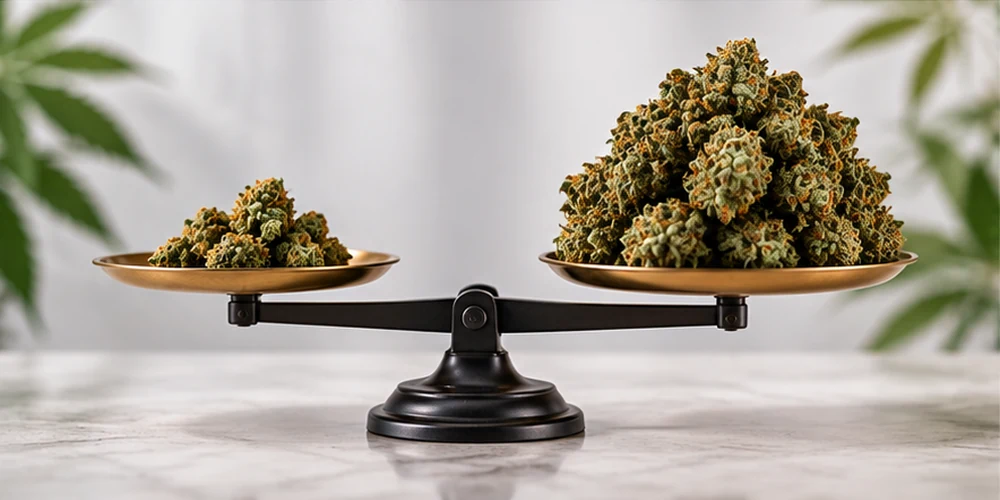
No. Confusing these two terms creates a large weight and packaging error.
- A quarter ounce is approximately 7.09 grams and is commonly treated as 7 grams.
- A quarter pound is four ounces, or approximately 113.4 grams.
- A quarter pound contains sixteen quarter-ounce quantities.
The word “quarter” only describes one-fourth of a referenced unit. When someone asks how much is a quarter of weed, normal retail context usually means a quarter ounce. Wholesale documents should always state the full unit because “quarter” alone is not precise enough for inventory, labeling, package ordering or transport records.
Why the Unit Must Appear on Packaging Documents
A purchase order that says “quarter bag” may be understood by a familiar supplier, but it is not a controlled packaging specification. A better request states:
- Nominal product weight
- Required net-weight declaration
- Product form, such as whole flower or ground flower
- Usable pouch or jar capacity
- Finished package dimensions
- Closure and seal system
- Required compliance standard
- Print and label version
- Sales jurisdiction
This detail prevents a quarter-ounce retail pouch from being confused with a bulk package or with a stock pouch carrying a supplier’s informal size name.
How Much Does a Quarter of Weed Cost?
There is no reliable national price that applies to every quarter ounce. Retail price changes with state taxes, local supply, licensed-store competition, flower grade, brand, harvest, testing results and promotions. Medical and adult-use markets may also use different tax structures.
At the time this guide was reviewed, Weedmaps listed a broad average range of $50 to $100 for a quarter ounce. That figure should be treated as dated marketplace context, not a guaranteed price. Readers seeking a current amount should check a licensed local retailer and the total after applicable taxes.
Packaging businesses should keep product price separate from package cost. A printed pouch quotation may include material, plates or cylinders, printing, child-resistant closure, finishing, freight, testing and order quantity. None of those figures indicates the legal retail price of the cannabis inside.
What Does a Quarter of Weed Look Like?
Seven grams cannot be confirmed by sight. One batch may contain several compact buds, while another may contain a larger volume of loose, airy flower. Trimming, breakage and settling during transport also change appearance without changing net weight.
This is why visual comparisons with coins, fruit or sandwich bags are weak package-development tools. A scale verifies mass. A representative fill trial shows volume. Packaging decisions need both.
Why Visual Volume Changes
The apparent size of a quarter ounce can change with:
- Flower density
- Bud dimensions
- Stem content
- Trim condition
- Moisture condition
- Compression during filling
- Settling during shipment
- Headspace inside the package
- Static and product adhesion
A packaging team should evaluate several production lots, including the bulkiest acceptable flower, before approving pouch dimensions. A package that works for one dense sample may crush or overfill another compliant 7-gram batch.
Why Seven Grams Does Not Determine Package Size
Mass and volume answer different questions. Seven grams tells a filler how much product should be placed in the package. It does not state the volume needed to contain the flower without damaging it or blocking the seal.
A pouch vendor may market a stock format as a 7 gram weed bag, yet the name is a capacity recommendation based on expected product behavior. It is not a universal standard. Supplier listings currently show quarter-ounce pouches near 4 × 6 inches and 4 × 6.5 inches, but even those similar formats can differ in gusset depth, seal area, closure, film thickness and child-resistant status.
One 4 × 6.63-inch quarter-ounce barrier pouch is explicitly listed as non-child-resistant. That is useful evidence that capacity, appearance and barrier film do not prove regulatory performance.
Flat Dimensions Are Not Usable Fill Dimensions
A flexible-pouch specification may list width and total height while leaving several areas unavailable for product:
- Top heat-seal band
- Child-resistant zipper
- Tear notch
- Bottom seal
- Side seals
- Gusset folds
- Hang hole
- Rounded corners
- Registration marks
The space below the zipper and above the bottom seal is closer to the usable fill zone. Even then, a flat pouch does not behave like a rigid rectangular container. Gusset opening, product shape and trapped air affect the filled profile.
Headspace Is a Controlled Variable
Too little headspace can place flower in the zipper or heat-seal area, leading to incomplete seals and contaminated closure tracks. Excess space can increase package material, shipment cube and product movement while making a seven-gram fill look small.
The right headspace is established through filling and sealing trials. It should let operators or equipment load the flower without crushing it, clear the sealing surfaces and close the package consistently.
Common 7g Cannabis Packaging Formats
A quarter ounce of flower can be packed in several formats. The correct choice depends on product stability, state rules, filling process, retail display, material use and consumer opening needs.
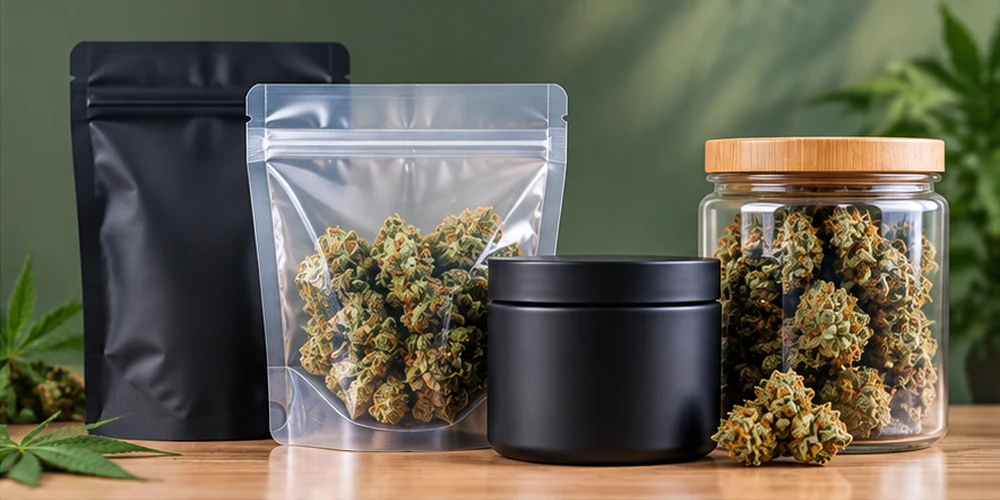
| Packaging format | Main advantages | Main checks before approval |
| Child-resistant flexible pouch | Low empty weight, large print area and efficient storage before filling | Certified closure, seal contamination, gusset volume, film barrier and opening instructions |
| Glass jar with child-resistant cap | Rigid walls, product visibility where permitted and good dimensional consistency | Cap system, light exposure, breakage, liner, label fit and shipping protection |
| Rigid plastic jar | Lower breakage risk than glass and several closure options | Resin compatibility, closure certification, panel area, odor barrier and environmental claims |
| Paperboard carton with an inner pack | More space for printed information and shelf communication | Whether inner or outer pack provides required protection, tamper evidence and child resistance |
| Rigid tube or pop-top container | Compact format and fast filling for selected product forms | Capacity, opening force, closure evidence, label seam and local acceptance |
Flexible Quarter-Ounce Pouches
Flexible barrier pouches are common because they arrive flat, store efficiently and provide broad front and back panels for printing. A bottom gusset can help the package stand on shelf and increase fill volume without making the face much wider.
Marketplace language often calls these “Mylar bags,” but that name does not describe one fixed material structure. A commercial pouch may combine polyester, metallized film, polyethylene or other layers. The converter should state the actual film construction, total thickness, sealant layer and barrier data.
A zipper can make a pouch resealable without making it child-resistant. Likewise, a heat seal can provide visible evidence of opening without proving that the reclosed package remains child-resistant. Each claimed feature needs its own evidence.
Glass Jars
Glass provides a rigid container that does not collapse around the flower. It can also create a stable surface for pressure-sensitive labels. One current supplier example for a 7-gram fill is a 4-fluid-ounce jar near 3.25 inches high and 2.25 inches in outside diameter, including its cap, but those measurements are not a cross-industry standard.
The development team must test actual flower volume, cap engagement, liner performance and headspace. If light protection is required, clear glass may need an opaque label, secondary carton or another solution permitted by the market.
Plastic Jars
Plastic jars can reduce shipping weight and breakage, but resin selection affects clarity, stiffness, aroma transmission and decoration. Cap and container threads must be validated as one system. A child-resistant cap placed on a jar with an unapproved neck finish is not automatically a compliant pack.
Paperboard Secondary Cartons
A folding carton can carry required information that does not fit comfortably on a small pouch or jar. It also provides a controlled rectangular face for shelf display, barcodes and brand identification.
The carton does not automatically replace the protective requirements of the inner package. When an outer carton is part of the child-resistant configuration, the exact tested assembly must be reviewed. For an example of a tested paperboard locking approach in another product category, read about child-resistant paperboard structures.
How to Choose a Quarter-Ounce Mylar Bag Size
When buyers ask how much is a quarter of weed, package suppliers often respond with a stock size. Treat that response as the beginning of evaluation, not final approval.
Some supplier catalogs associate a quarter ounce with a 4 × 6-inch flat pouch, while others offer approximately 4 × 6.5-inch formats. Those dimensions may work for certain flower, but width and height alone do not reveal gusset volume or usable space below the closure.
Step 1 Define the Product
Record whether the package will contain whole flower, small buds, ground flower or another permitted format. Use expected bud dimensions, density range and normal moisture condition from actual production.
Step 2 Weigh Representative Fills
Prepare multiple 7-gram samples using a calibrated scale and the business’s approved filling procedure. Include dense and bulky batches that fall inside the product specification.
Step 3 Fill Candidate Packages
Load each candidate without forcing flower into corners or crushing buds. Keep the zipper and heat-seal area free of product. Note whether manual or automated equipment can reach the same result repeatedly.
Step 4 Check the Usable Internal Space
Measure from the internal bottom seal to the closure obstruction, not merely from one outside edge to another. Open the gusset fully and examine how it changes the fill profile.
Step 5 Set Headspace
Approve enough clearance for loading, zipper engagement and heat sealing. Record a maximum filled thickness so the package will fit retail displays and shipping cartons.
Step 6 Confirm the Printed Area
Place all mandatory text, warnings, symbols and variable information on the production dieline. Small packages can run out of legal-copy space before they run out of product capacity.
Step 7 Test Production Samples
Run the selected film, closure, print and seal through the actual process. Evaluate leaks, closure use, aroma transmission, rub resistance, drop handling and distribution after conditioning.
Barrier Requirements for Cannabis Flower Packaging
Package barrier should match a defined shelf-life target. “Keeps it fresh” is not an engineering specification. The project should identify which transfer mechanisms matter and what level of performance is required.
Moisture Protection
Cannabis flower can gain or lose moisture through packaging depending on the material, environment and storage time. The team may use water-vapor transmission rate data to compare film structures, but supplier values should be checked against test conditions and the final converted pouch.
A strong film data sheet cannot compensate for a leaking top seal or a zipper contaminated with flower particles.
Oxygen Protection
Oxygen can enter through the film, seals and closure. Oxygen-transmission values help compare materials, but the finished package has seams, folds and opening features that a flat-film test does not fully represent.
Light Control
Opaque or metallized structures can reduce light exposure. Clear windows may help shoppers view the product, but they reduce light protection and may conflict with a state opacity rule. Confirm the target market before adding a window to the artwork or die.
Aroma Control
Aroma retention depends on film structure, seal integrity and closure design. Marketing phrases such as “odor proof” need evidence and a stated test method. Evaluate sealed packages over the intended storage period rather than relying on a brief hand check.
Product Contact and Odor
Packaging materials, inks, coatings and adhesives should not transfer unwanted odor or substances to the flower. The converter should identify whether printing is surface printed or trapped between layers and provide suitability documentation for the intended product-contact use.
Child-Resistant Packaging Is a Tested Claim
Child-resistant does not mean impossible for every child to open. It describes performance against a defined procedure. The U.S. Consumer Product Safety Commission explains that special packaging is designed to be difficult for children younger than five while remaining usable by adults. Its summary states the child and adult performance thresholds used under 16 CFR 1700.20.
Federal Poison Prevention Packaging Act rules do not by themselves create one nationwide cannabis-packaging system. State cannabis programs may incorporate or refer to federal test concepts, and their requirements differ. The business must identify which rule applies to its specific product and jurisdiction.
Single-Use and Reclosable Designs
A single-use child-resistant pouch may depend on a sealed opening that requires a defined action or tool. After opening, it may not provide repeated child resistance. A reclosable package must use the approved closure correctly after each use if the applicable rule requires protection throughout product life.
New York guidance, for example, says cannabis retail packaging must remain child-resistant for the product’s lifespan and be resealable when it contains multiple servings.
A Zipper Appearance Is Not Certification
Two pouches may look nearly identical while using different zipper profiles or opening sequences. Request documentation that identifies:
- Package manufacturer
- Exact structure and dimensions
- Closure type
- Test standard and report
- Whether the design is single-use or reclosable
- Material and gauge covered by the test
- Permitted printing or label changes
- Any required heat-sealing step
- Instructions that must appear on the package
- Expiration or change-control limits for supporting documents
Packaging NextGen recommends matching the certificate or laboratory report to the exact item ordered. A generic letter for a different size, zipper, resin or film is not enough.
Tamper Evidence and Child Resistance Are Different
Tamper evidence helps a buyer identify whether a package may have been opened. Child resistance makes access difficult for young children under the applicable test. One feature does not automatically supply the other.
Possible tamper-evident features include:
- Heat seal above a zipper
- Tear-away strip
- Breakable band
- Induction seal below a cap
- Shrink band over a jar closure
- Destructible label across an opening
- Sealed paperboard closure
A tamper-evident shrink band must be specified for material, shrink response, perforation and application conditions. It should not cover required information or imply child resistance unless the total package has evidence for that claim.
Cannabis Labeling for a Seven-Gram Flower Pack
Label requirements change by product type and state. A national brand may need separate artwork versions rather than one label for the whole country.
California’s guidance for non-manufactured cannabis products says the principal display panel includes product identity and net weight in metric and U.S. customary units. Other required information may sit on the informational panel.
Depending on the jurisdiction and product, a label review may need to account for:
- Product identity
- Net quantity
- Cannabis symbol
- Government warning
- THC or cannabinoid information
- Batch or lot identifier
- Package or UID information
- License details
- Harvest, packaging or testing dates
- Ingredients for applicable products
- Allergen information where applicable
- Usage or storage statements required by rule
- Barcode or QR code
- Contact information
This list is a design-planning aid, not a universal legal checklist.
Net Weight Statement
For a quarter-ounce flower product, the approved principal display may need a statement such as NET WT. 0.25 OZ (7 g), subject to the regulator’s formatting and rounding rules. The business should use the value approved for its actual fill and jurisdiction rather than copying the example unchanged.
Do not write one-quarter pound, 25 grams or seven ounces. Those errors are not minor wording issues. They misstate the quantity.
Cannabis Symbols and Warnings
Symbols have controlled artwork, size and placement requirements in some states. Do not redraw a required mark from a screenshot. Download the regulator’s approved file and keep it as a separate locked artwork element.
The California cannabis universal-symbol guidance provides the state’s current resource for the required mark. Another state may use a different symbol or warning.
Font Size and Legibility
Small packs create pressure to shrink legal text. That can make a technically complete label unreadable. New York’s current guidance states that required text must be clearly visible and no smaller than 6-point type, with named font rules for public-health warnings.
Packaging NextGen recommends checking text on a printed, filled and sealed package. Curved jars, pouch wrinkles, gloss reflections and gusset folds can reduce legibility even when the flat proof appears clear.
Variable Data
Batch, potency, testing and tracking information may not be available when base packaging is printed. Reserve a clean, high-contrast variable-data panel for thermal transfer, inkjet or pressure-sensitive labels.
Test variable data for:
- Adhesion to the pouch or jar
- Smear resistance
- Print contrast
- Barcode or QR scanning
- Space for the longest expected value
- Readability after sealing and handling
- Version control between artwork and production records
Printing 7g Cannabis Pouches and Labels
The printing method should match run length, graphics, material and version count. High-volume flexible packaging may use flexographic or gravure printing. Digital printing can suit shorter runs, regional artwork or frequent strain changes, subject to press and material limits.
Surface Printing and Reverse Printing
Surface printing places ink on the outside of the web and usually requires suitable resistance to abrasion, handling and cleaning. Reverse printing places the graphic on the inner side of a transparent outer web before lamination, trapping the ink inside the structure.
The converter should identify the print side, ink system, laminate sequence and any clear-coat requirement. The artwork team should not assume that a mockup’s metallic appearance will match a real metallized film.
Build Artwork on the Approved Dieline
Use the converter’s final file, not a generic online template. The packaging dieline guide explains cut, fold, bleed, safe-area and glue-zone layers. A 7g pouch dieline should also identify:
- Top seal
- Zipper or closure
- Tear notches
- Side and bottom seals
- Gusset folds
- Rounded corners
- Hang hole
- Eye marks
- Date-code area
- Variable-label panel
- Required-copy area
Keep legal text, symbols, barcodes and small type away from seals, notches and folds unless the regulator and converter approve the placement.
Design for the Filled Shape
A flat pouch can look balanced on screen while the filled product pushes text toward a side seam. Build a physical sample and inspect front, back, sides and bottom after filling.
The Pacdora review explains where a 3D packaging mockup helps and why it cannot replace a physical sample. Use digital visualization for artwork alignment, then use production material to verify closure, volume, print and handling.
Avoid Youth-Oriented Graphics
Cannabis rules may restrict packaging that appeals to children or resembles familiar candy and snack brands. Review characters, bright confectionery cues, imitation branding and product naming before printing. This is both a legal and artwork-control issue.
Control Color Across Versions
Strain families often use color to separate variants. Define spot colors or process targets on the actual film, label or board. Maintain enough contrast for mandatory text and scanning. A color-coding system should not make products easier to confuse when seen under dispensary lighting.
How to Test Quarter-Ounce Cannabis Packaging
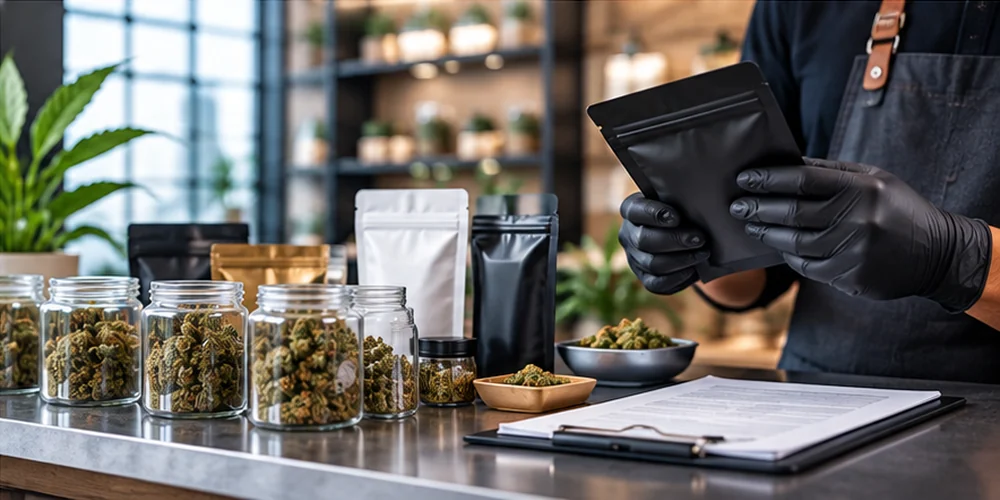
A supplier sample and a printed approval sheet do not prove finished-package performance. Testing should use the product, materials, closure, equipment and distribution conditions planned for sale.
Fill and Seal Checks
Evaluate:
- Filled net quantity
- Package capacity across flower-density limits
- Product contamination in the seal zone
- Heat-seal temperature, pressure and dwell time
- Seal continuity
- Zipper engagement
- Leak or channel formation
- Filled package thickness
- Manual or automated fill speed
Closure and Opening Checks
Record first opening, reclosure and repeated use. Verify that instructions match the actual opening action. If child resistance is claimed, testing and documentation must cover the package configuration being sold.
Barrier and Stability Checks
Set a shelf-life period and storage conditions. Review changes in moisture, aroma, appearance and package integrity. Barrier values supplied for flat film are useful inputs, but stability work should evaluate the finished sealed pack.
Print and Label Checks
Test:
- Ink rub and scuff resistance
- Lamination bond
- Label adhesion
- Variable-code durability
- Required-text legibility
- Barcode and QR scanning
- Color against the approved target
- Resistance to wrinkling at the fill level
Distribution Checks
Ship or simulate the actual secondary-pack configuration. Jars may need dividers or controlled case fit. Pouches can crease, puncture or slide inside an oversized case. Measure the filled retail pack before specifying the shipping carton.
For the basic length, width and height method, use this guide on how to measure a box. The final shipping case should also be checked for stacking, vibration, handling and pallet stability.
State Rules Must Be Checked Before Printing
There is no single federal retail-cannabis label that automatically works in every U.S. state. State agencies control licensed-market packaging, labeling and advertising, and rules can differ by product type.
California says cannabis goods sold at licensed retailers must use child-resistant packaging. New York requires child resistance, tamper evidence, full enclosure and other defined features. Those two examples alone show why a supplier’s “USA compliant” statement is too broad without a market list and current evidence.
Before approving artwork, create a jurisdiction matrix with:
- State and regulator
- Product type
- Rule version and review date
- Child-resistant requirement
- Tamper-evident requirement
- Reseal requirement
- Opacity rule
- Required symbol
- Warning text
- Font and size
- Net-quantity format
- Cannabinoid declaration
- Batch or tracking fields
- Prohibited imagery and claims
- Reviewer and approval date
Packaging NextGen recommends locking the legal copy only after the target market is confirmed. If the state changes a warning or symbol, create a new controlled artwork version instead of editing production files without a record.
Sustainability Decisions Need Specific Evidence
Cannabis packages are often small, but safety mechanisms, barriers and required label space can create multilayer structures. A material claim should explain what component it describes and what evidence supports it.
Ask suppliers for:
- Material structure by layer
- Total package weight
- Recycled-content percentage and source
- Barrier values and test conditions
- Closure material
- Adhesive and ink information
- Local recovery guidance
- Instructions for separating components
- Evidence behind recyclable or compostable claims
A glass jar may be widely recyclable as a material, but the cap, liner, label and product residue can affect local instructions. A flexible barrier pouch may use less material by weight but combine layers that are not accepted in ordinary curbside programs. Compare product protection, safety, transport and recovery instead of selecting one claim in isolation.
The food packaging news and regulation hub provides related coverage of flexible materials, printing and changing package rules. Cannabis teams should still use the regulator responsible for their specific market as the final source.
Common 7g Cannabis Packaging Mistakes
- Treating seven grams as a volume. Weight does not identify the pouch or jar capacity.
- Calling one pouch size standard. Four-by-six-inch formats are common supplier references, not universal dimensions.
- Assuming every Mylar-style pouch is child-resistant. Film appearance and zipper shape do not prove test performance.
- Confusing tamper evidence with child resistance. They serve different purposes.
- Using a certificate for another package. Evidence must match size, material, closure and configuration.
- Letting flower enter the heat-seal area. Product can create channels or weak seals.
- Printing legal copy before choosing the sales state. Required warnings, symbols and formats differ.
- Shrinking text to fit. A label can contain every required sentence and still fail legibility rules.
- Placing data on a gusset or wrinkle zone. Variable information and codes may become unreadable.
- Adding a clear window without checking opacity requirements. The design decision may conflict with state rules.
- Relying only on flat-film barrier data. Seals and closures affect the finished package.
- Approving only a digital mockup. A render cannot verify fill volume, seal integrity or opening force.
- Using an unsupported national price. Cannabis prices change by market, quality, tax and date.
- Confusing a quarter ounce with a quarter pound. The difference is 7 grams versus about 113.4 grams.
Buyer Specification Checklist for 7g Cannabis Packaging
Before requesting a quotation or approving production, confirm:
- Product form and sales jurisdiction
- Nominal and minimum net quantity
- Representative product-density range
- Maximum bud dimensions
- Required headspace
- Pouch, jar or carton style
- Finished external dimensions
- Usable internal fill dimensions or overflow capacity
- Film or container material
- OTR and WVTR requirements with test conditions
- Light-protection requirement
- Closure type
- Single-use or reclosable child-resistant status
- Test standard and report identifier
- Tamper-evident feature
- Filling and sealing equipment
- Heat-seal window
- Print process and number of colors
- Surface or reverse printing
- Approved dieline revision
- Required warnings and symbols
- Net-weight statement
- Variable-data fields
- Barcode or QR specifications
- Label material and adhesive
- Finished-pack stability plan
- Shipping-case count and orientation
- Quality limits and sampling plan
- Change-control procedure
- Legal-review owner and approval date
Frequently Asked Questions
How Much Is a Quarter of Weed?
A quarter of weed means one-quarter of an ounce. It is approximately 7.09 grams by mathematical conversion and is commonly sold as 7 grams in U.S. cannabis retail language.
Is Seven Grams a Quarter of Weed?
Yes. Seven grams is the common retail quantity associated with a quarter ounce of cannabis. The exact conversion of one-quarter avoirdupois ounce is approximately 7.087 grams.
Is a Quarter of Weed 7 or 7.09 Grams?
Both numbers describe different conventions. The mathematical conversion is about 7.09 grams. Retail cannabis quantities commonly use 7 grams. The printed net quantity must follow the applicable rule and approved product record.
Is a Quarter of Weed the Same as a Quarter Pound?
No. A quarter ounce is commonly 7 grams. A quarter pound equals four ounces or approximately 113.4 grams. Always include the full unit in purchasing and packaging documents.
What Size Bag Holds a Quarter of Weed?
Supplier catalogs commonly associate 7 grams of flower with pouches near 4 × 6 or 4 × 6.5 inches. Those sizes are starting references only. Flower density, gusset depth, headspace, closure and seal zones determine actual fit.
Will a 4 × 6-Inch Pouch Always Hold Seven Grams?
No. Pouches with the same outside dimensions can have different gussets, seals and closures. Seven grams of bulky flower may also occupy more space than a dense batch. Test the actual product in production samples.
Is Every Mylar Bag Child-Resistant?
No. A barrier pouch can be resealable or heat-sealable without meeting a child-resistant test. Obtain package-specific evidence for the exact pouch, dimensions, material and closure.
Is a Glass Jar Better Than a Pouch for Seven Grams?
Neither format is automatically better. Jars are rigid and label well but add weight and breakage risk. Pouches use less storage space before filling but need careful seal, closure and barrier control. Choose through product and distribution testing.
Does a 7g Cannabis Package Need Tamper Evidence?
Requirements vary by state and product. New York, for example, requires tamper-evident cannabis retail packaging. Verify the current rule in every planned sales jurisdiction.
Does a Cannabis Box Have to Be Child-Resistant?
It depends on the approved package configuration and state rule. A decorative outer carton does not automatically provide child resistance. The component or total assembly relied upon for the claim must meet the applicable requirement.
What Should Be Printed on Quarter-Ounce Cannabis Packaging?
The required information varies, but it may include product identity, net quantity, warnings, cannabis symbol, cannabinoid information, batch or tracking data and license information. Use the current state checklist for the specific product.
Can One Cannabis Label Be Used in Every State?
Usually not without detailed review. Symbols, warnings, type size, opacity, cannabinoid statements and other rules differ. National brands often need controlled state-specific artwork versions.
Why Does a Quarter Ounce Look Different Between Strains?
Flower density, bud size, trimming, moisture and settling affect visible volume. Weight should be verified with a calibrated scale rather than estimated from appearance.
How Should a Business Test a 7g Cannabis Pouch?
Test representative fills, usable capacity, headspace, seal integrity, zipper operation, applicable child-resistant performance, tamper evidence, barrier stability, printed-copy legibility, code scanning and distribution handling.
Final Packaging Answer
The simplest reply to how much is a quarter of weed is 7 grams, or approximately 7.09 grams by exact conversion. The correct packaging answer requires more evidence. Seven grams does not establish pouch width, jar volume, headspace, closure type or legal-copy area.
A reliable quarter-ounce package begins with representative fill trials and a state-specific compliance matrix. It then connects product density with usable capacity, barrier needs, child-resistant evidence, tamper evidence, printing, variable data and distribution testing. Packaging NextGen treats every one of those details as part of the finished 7g specification, because a package must do more than carry the right number on its label.